Pets are an important part of community life.
Many homeowners choose neighborhoods because they offer walkable green spaces, pet-friendly environments, and outdoor amenities. As pet ownership continues to increase, Homeowners Associations (HOAs) face a growing responsibility: managing pet waste in shared community spaces.
For many HOA boards, pet waste is one of the most common sources of resident complaints.
A few unattended incidents can quickly affect walking trails, landscaped areas, playground surroundings, and community gathering spaces. Over time, these issues can create frustration among residents, increase maintenance demands, and affect the overall appearance of the neighborhood.
The challenge is not simply about enforcing rules.
Successful HOA pet waste management programs focus on creating systems that make responsible behavior easier, while helping communities maintain clean and enjoyable shared spaces. Many communities achieve this through structured residential pet waste management solutions that combine infrastructure, maintenance, and resident participation.
In this guide, we will look at practical HOA pet waste management best practices that help reduce complaints, improve compliance, and support long-term community maintenance goals.
Why Pet Waste Is a Growing HOA Challenge
Today’s communities are more pet-friendly than ever.
According to the American Pet Products Association (APPA), a significant percentage of U.S. households own pets, and dogs remain one of the most common companion animals.
As the number of dogs increases, so does the amount of pet waste generated in common areas.
Unlike private yards, HOA-managed spaces are shared by everyone. Walking paths, community parks, landscaped entrances, and open green spaces must remain clean and accessible for all residents.
When pet waste is not consistently collected, it can quickly become a community-wide issue.
Many HOA boards discover that pet waste problems are rarely caused by a lack of rules. More often, they result from inconsistent participation, unclear expectations, or inconvenient disposal options.
For this reason, HOA pet waste management should be viewed as an ongoing operational program rather than a one-time maintenance project.
The Cost of Poor Pet Waste Management
The effects of unmanaged pet waste often extend beyond simple cleanliness concerns.
Over time, the impact can affect both community operations and resident satisfaction.
Resident Complaints
One of the first signs of a weak pet waste management program is an increase in complaints.
Residents expect common areas to remain clean and usable.
When dog waste repeatedly appears along sidewalks, walking trails, or green spaces, residents often turn to HOA boards and property managers for solutions.
In many communities, pet waste becomes one of the most frequently reported maintenance concerns.
Property Appearance
Community appearance influences how residents feel about where they live.
Clean landscapes, maintained parks, and attractive outdoor areas help create a positive living environment.
Pet waste can quickly undermine these efforts.
Even small amounts of uncollected waste can create negative impressions and reduce enjoyment of community spaces.
For neighborhoods focused on maintaining property values and resident satisfaction, appearance matters.
Increased Maintenance Costs
When pet waste issues become widespread, maintenance costs often increase.
Teams may spend additional time:
- Cleaning common areas
- Addressing complaints
- Maintaining landscaped spaces
- Servicing waste collection points
These recurring expenses can place unnecessary pressure on HOA maintenance budgets.
A proactive approach is usually more cost-effective than constantly responding to complaints.
Community Tension
Pet waste can also create tension between residents.
Responsible pet owners may become frustrated when others fail to follow community expectations.
At the same time, HOA boards may face criticism from both sides.
Without a structured system, discussions about pet waste often become emotional rather than productive.
A well-organized HOA pet waste management program helps reduce conflict by providing clear expectations and practical disposal solutions.
Best Practice : Establish Clear Community Expectations
Every successful HOA pet waste management program starts with clear expectations.
Residents should understand:
- Where pets are allowed
- How pet waste should be disposed of
- What community standards apply
- Who is responsible for cleanup
Many HOA communities already include pet-related policies in their governing documents.
However, policies are only effective if residents know they exist and understand them.
Community expectations should be simple, practical, and easy to communicate.
For example:
- Always pick up pet waste immediately.
- Dispose of waste in designated bins.
- Use community-provided disposal stations when available.
- Keep pets on designated walking routes where required.
The goal is not to create more rules.
The goal is to create consistency.
When expectations are clear, compliance becomes easier and enforcement becomes less necessary.
Best Practice #2: Make Disposal Convenient
Convenience plays a major role in human behavior.
Even residents who generally follow community rules may be less likely to dispose of pet waste properly if disposal options are difficult to access.
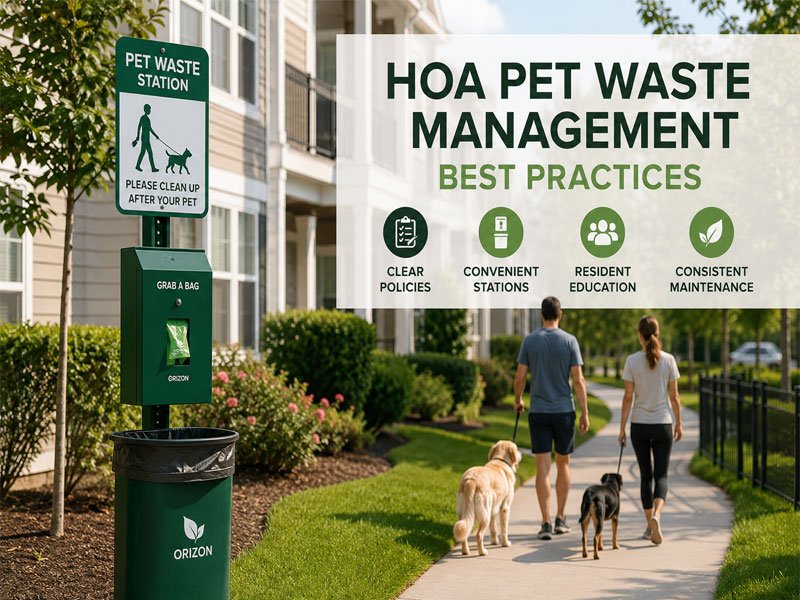
Many HOA communities invest in strategically placed dog waste stations throughout shared spaces. Properly designed dog waste station systems help improve participation while making routine maintenance more efficient.
Stations are commonly installed near:
- Walking paths
- Community parks
- Green belts
- Open recreational areas
- Apartment common spaces
- Community entrances and exits
The most effective HOA dog waste stations are located where residents naturally walk their pets.
Placement is often more important than quantity.
A small number of well-positioned stations typically performs better than a large number of poorly located stations.
Many communities incorporate dispenser-compatible dog waste stations into their broader community maintenance strategy to improve participation and simplify servicing requirements.
Best Practice #3: Educate Residents Instead of Only Enforcing Rules
Many HOA boards initially focus on enforcement.
While enforcement has a role, education is often more effective in the long term.
Most residents want clean and enjoyable community spaces.
The challenge is helping people understand how their individual actions affect everyone else.
Educational efforts may include:
- Welcome packets for new residents
- Community newsletters
- Email reminders
- Seasonal campaigns
- Signage near pet walking areas
Positive messaging often encourages better participation than punitive messaging.
For example:
“Help keep our walking trails clean for everyone.”
is usually received more positively than:
“Failure to clean up after your dog may result in penalties.”
The objective is to promote responsible pet ownership while building community support for the program.
Communities that combine education with convenient disposal infrastructure often see stronger resident participation over time.
Best Practice #4: Include Pet Waste Management in HOA Maintenance Programs
One of the most common mistakes is treating pet waste management as a separate initiative.
In reality, it works best when integrated into existing maintenance operations.
Many successful HOA communities incorporate pet waste management into:
- Landscape maintenance schedules
- Property inspections
- Cleaning routes
- Community service programs
- Vendor maintenance contracts
This approach helps ensure consistency. Similar maintenance frameworks are often used in larger public dog waste management programs operated by municipalities and local authorities.
For example, when maintenance staff already inspect common areas each week, checking disposal stations can become part of the same workflow.
The result is often lower operational costs and better program performance.
Communities that integrate pet waste management into routine maintenance generally experience fewer service interruptions and more reliable outcomes.
Best Practice #5: Track Complaints and Adjust the Program
A pet waste management program should not remain static.
Communities change.
Resident populations change.
Pet ownership patterns change.
Programs should evolve accordingly.
One of the simplest ways to evaluate performance is by tracking resident feedback and complaints.
Questions HOA boards may consider include:
- Which areas receive the most complaints?
- Are disposal stations located in the right places?
- Are maintenance schedules sufficient?
- Are residents using provided infrastructure?
- Do additional educational efforts appear necessary?
Small adjustments can often produce significant improvements.
For example, relocating a station closer to a popular walking route may reduce recurring issues in that area.
The most effective HOA pet waste management programs are reviewed regularly and adjusted based on actual community usage patterns.
Can Compostable Dog Waste Bags Support HOA Sustainability Goals?
Many HOA communities are also exploring ways to reduce environmental impact.
As part of broader sustainability initiatives, some communities evaluate compostable dog waste bags for use in shared spaces.
Certified compostable materials are designed to break down under specific composting conditions and may help support waste reduction goals where appropriate infrastructure exists.
Many HOA boards review compostable certification requirements before selecting materials for community-wide sustainability initiatives.
- Local waste regulations
- Available composting facilities
- Collection requirements
- Contamination prevention measures
- Certification standards
Not every region supports the same disposal pathways.
For this reason, material selection should always be evaluated within the context of local waste management systems.
Communities considering environmentally focused waste programs often review compostable certification requirements before selecting materials.
Benefits of a Structured HOA Pet Waste Management Program
A structured HOA pet waste management program provides benefits that extend beyond simple cleanliness.
For residents, it helps create more enjoyable shared spaces.
For HOA boards, it can reduce recurring complaints and improve operational efficiency.
Common benefits include:
✓ Cleaner walking paths and green spaces
✓ Reduced resident complaints
✓ Improved community appearance
✓ Better resident satisfaction
✓ Lower maintenance burden
✓ More consistent disposal behavior
✓ Support for sustainability initiatives Many communities view pet waste management as part of broader community environmental management strategies.
✓ Enhanced property value perception
Over time, these benefits contribute to a stronger overall community experience.
Many communities find that pet waste management becomes a visible example of how well the neighborhood is maintained and managed.
HOA Pet Waste Management Is Part of a Larger Community Strategy
Pet waste management should not be viewed as an isolated issue.
It is closely connected to broader community goals, including:
- Property maintenance
- Resident satisfaction
- Environmental stewardship
- Community appearance
- Shared-space management
Many of the same principles used in HOA programs also apply to broader community pet waste management solutions and public dog waste management programs implemented by municipalities and residential developments.
When pet waste management is approached as part of an overall community strategy, the results are often more sustainable and more effective.
FAQ
What is HOA pet waste management?
HOA pet waste management refers to the systems, policies, and maintenance procedures used to help residents properly dispose of pet waste in shared community spaces.
These programs typically combine community rules, disposal infrastructure, resident education, and routine maintenance activities.
Should HOAs install dog waste stations?
In many communities, dog waste stations help improve participation by making disposal more convenient.
Strategically placed stations can reduce pet waste accumulation, support responsible pet ownership, and simplify maintenance operations.
The effectiveness of a station program often depends more on placement and maintenance than on the number of stations installed.
How many dog waste stations does an HOA need?
There is no universal number.
The appropriate quantity depends on:
- Community size
- Number of pet-owning households
- Walking routes
- Green-space layout
- Resident traffic patterns
Many HOA communities begin by identifying high-traffic pet areas and then adjust station locations based on actual usage.
How can HOAs reduce pet waste complaints?
The most successful HOA communities usually combine several approaches:
- Clear community expectations
- Convenient disposal infrastructure
- Resident education
- Routine maintenance
- Program monitoring and adjustment
Relying on enforcement alone rarely solves long-term pet waste issues.
Are compostable dog waste bags suitable for HOA communities?
Some HOA communities choose certified compostable dog waste bags as part of broader sustainability initiatives.
However, implementation should always consider local waste regulations, available composting infrastructure, and contamination prevention requirements.
Communities should verify local acceptance policies before introducing compostable materials into their waste management program.
Who is responsible for maintaining dog waste stations?
Responsibilities vary by community.
Maintenance may be performed by:
- HOA maintenance teams
- Landscape contractors
- Property management companies
- Facility service providers
Most successful programs assign clear responsibilities and include station servicing within existing maintenance schedules.
Conclusion
Many of the operational principles used by HOA communities are also applied in animal shelter waste management solutions, where sanitation, maintenance, and responsible waste handling remain essential.
There is no single solution that completely eliminates pet waste issues.
Communities are made up of people, and people do not always behave the same way.
However, communities that implement structured HOA pet waste management programs often achieve meaningful improvements over time.
The most effective programs typically share several characteristics:
- Clear expectations
- Convenient disposal options
- Consistent maintenance
- Resident education
- Ongoing evaluation
Together, these elements create an environment where responsible behavior becomes easier and more common.
For HOA boards, property managers, and community operators, pet waste management is not simply a maintenance task.
It is part of creating cleaner neighborhoods, improving resident experience, and protecting the long-term value of shared community spaces.
Small improvements made consistently often deliver the greatest results.
A well-managed pet waste program is one example of how thoughtful community management can improve daily life for everyone.