Updated: 12 August 2026
2026 PPWR Update — PPWR Applies from 12 August 2026
Regulation (EU) 2025/40 on Packaging and Packaging Waste, commonly known as the Packaging and Packaging Waste Regulation (PPWR), entered into force on 11 February 2025 and generally applies across the European Union from 12 August 2026.
This does not mean that every PPWR requirement takes effect on the same date. Different requirements have different application timelines.
For compostable packaging, Article 9 introduces specific requirements that apply from 12 February 2028. Other requirements, including detailed design-for-recycling criteria, packaging minimisation and harmonised labelling rules, follow separate implementation timelines.
Compostable plastic packaging is also specifically exempt from the minimum recycled-content percentages set out in Article 7(1) and 7(2).
This guide has been updated to reflect the PPWR rules and timelines most relevant to buyers sourcing compostable packaging for the EU market.
PPWR compostable packaging is no longer only a future compliance topic for EU importers, brands and packaging distributors.
For buyers sourcing compostable bags and packaging, however, the key question is not simply whether a product is “compostable.”
The more useful questions are:
- Which PPWR requirements apply to this packaging?
- When do those requirements become mandatory?
- Is compostability required, permitted or appropriate for this application?
- Does the available certification or testing cover the finished packaging—not only the raw material?
- Which technical documents support the product and its environmental claims?
- What waste-management route is actually available in the target EU market?
Understanding these questions before production can help buyers avoid incorrect claims, unsuitable packaging specifications and unnecessary redesign later.
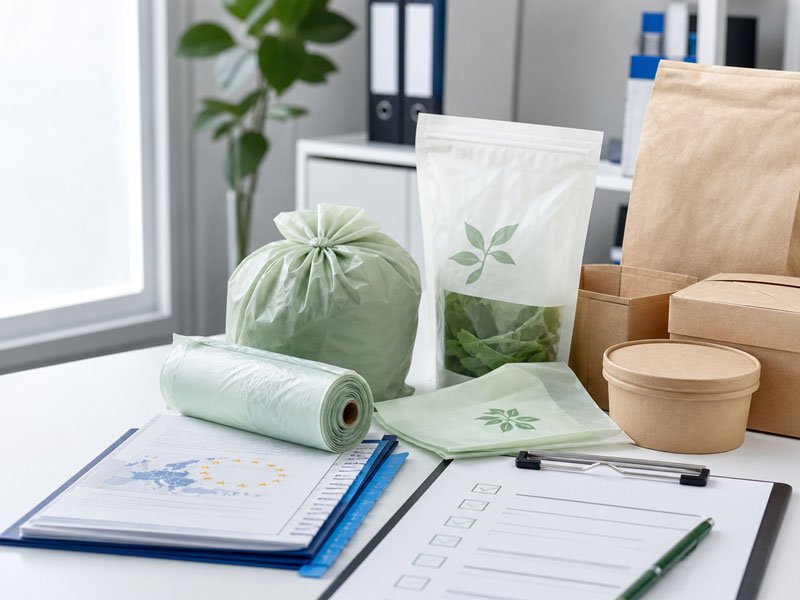
What Is PPWR?
PPWR stands for the EU Packaging and Packaging Waste Regulation.
It applies to packaging and packaging waste placed on the EU market, regardless of whether the packaging is manufactured inside the EU or imported from another country. The Regulation covers the packaging life cycle from design and composition through use and waste management.
The Regulation aims to reduce unnecessary packaging and packaging waste, improve circularity and recyclability, promote reuse where appropriate, reduce the use of primary raw materials and create more harmonised packaging rules across the European Union.
For compostable packaging buyers, the important point is that a sustainability claim alone is not enough.
A compostable package should not rely on a “green” claim alone.
It needs evidence.
That evidence may include compostability certification, product specifications, test reports, technical documentation, material information, traceability records and other documents relevant to the intended market and application.
Before choosing a supplier, it helps to understand whether the product is supported by recognised compostability standards and whether the available evidence applies to the finished packaging.
Does PPWR Support Compostable Packaging?
Yes—but only for specific applications and under defined conditions.
PPWR does not establish a general rule that packaging should become compostable. The overall direction of the Regulation remains strongly focused on packaging prevention, reuse and material recycling.
However, Article 9 gives compostable packaging a defined role in certain applications.
Article 9: Packaging That Must Be Compostable
Article 9 makes an important distinction between packaging that must meet compostability requirements across the EU and packaging that Member States may require to be compostable.
By 12 February 2028, packaging covered by Article 3(1)(1)(f), together with sticky labels attached to fruit and vegetables, must be compatible with industrially controlled composting in bio-waste treatment facilities.
Where required by individual Member States, these formats must also be compatible with the relevant home-composting standards.
The packaging covered by Article 3(1)(1)(f) includes certain permeable tea, coffee and other beverage bags and certain soft single-serve units that are intended to be used and disposed of together with the product.
Packaging That Member States May Require to Be Compostable
Member States may also introduce compostability requirements for certain other packaging where appropriate bio-waste collection and treatment infrastructure exists.
This may include:
- Certain non-metal packaging covered by Article 3(1)(1)(g)
- Very lightweight plastic carrier bags
- Lightweight plastic carrier bags
- Other packaging that the Member State already required to be compostable before PPWR became generally applicable
These national requirements depend on local bio-waste collection systems and treatment infrastructure.
This is why buyers should not assume that the same compostable bag specification is automatically suitable for every EU Member State.
What About Other Biodegradable or Compostable Packaging?
This is one of the most important parts of Article 9.
By 12 February 2028, packaging outside the specific cases covered by Article 9(1) and Article 9(2)—including packaging made from biodegradable plastic polymers and other biodegradable materials—must be designed for material recycling in accordance with Article 6, without negatively affecting the recyclability of other waste streams.
This means PPWR does not create a general preference for compostable packaging.
Instead, EU buyers need to distinguish between:
- applications where compostability is required;
- applications where a Member State may permit or require compostability; and
- applications that remain on a material-recycling pathway.
The correct approach depends on the packaging format, intended use, target country and waste-management route.
Compostable Does Not Mean Biodegradable
Buyers often use “biodegradable” and “compostable” as if they mean the same thing.
They do not.
Biodegradable is a broad term describing the ability of a material to break down through biological processes. By itself, the term may not specify the required environment, timeframe, disintegration performance or final residue.
Compostable is more specific.
A compostable packaging claim should be supported by defined test conditions, performance criteria and appropriate technical evidence.
EN 13432 and PPWR
EN 13432 remains an established European benchmark for assessing the industrial compostability of packaging and is widely used in certification schemes for compostable packaging.
However, buyers should not treat an EN 13432 certificate as automatic proof of full PPWR compliance.
PPWR requires harmonised standards to be prepared or updated for compostable packaging. The European Commission has specifically requested an update of EN 13432:2000 covering areas such as industrial compostability, anaerobic digestion, evaluation criteria, labelling and conformity evidence, as well as a new European standard for home compostability.
This means buyers should review both:
1. Compostability evidence
and
2. The wider PPWR requirements applicable to the finished packaging
Certification is important, but certification alone does not answer every PPWR question.
If you are new to industrial compostability standards, our EN 13432 compostable packaging guide explains what EN 13432 evaluates and why it remains relevant to compostable packaging sourcing.
What PPWR Means for Compostable Bag Buyers
If you are sourcing compostable bags for Europe, PPWR changes the questions that should be included in your RFQ and supplier review.
Price still matters.
But price alone is not enough.
Before placing an order, consider asking:
- Is the product actually packaging within the scope of PPWR?
- What is the intended use of the bag?
- Is the finished bag certified, or only the raw material?
- Does the certification scope include the film, ink, colour masterbatch and other relevant components?
- Is the product designed for industrial composting or home composting?
- What EN 13432 or equivalent compostability evidence is available?
- Which PPWR Article 9 category, if any, applies to the packaging?
- Are compostability claims appropriate for the target country?
- Will the local waste-management system accept this type of packaging?
- What technical documentation is available for the finished packaging?
- Can the product and production batch be traced?
One small detail can change the regulatory assessment.
A compostable produce bag is not automatically treated in the same way as a shopping bag.
A food-waste liner may not always qualify as packaging under PPWR.
A compostable e-commerce mailer is not automatically covered by the same Article 9 pathway as packaging specifically required to be compostable.
The use case matters.
If you are comparing bag formats for different applications, you can browse our compostable bag products for produce, retail, food-waste, shipping and other B2B applications.
Product Areas to Review Under PPWR
Compostable Produce Bags
Produce bags are commonly used for loose fruit and vegetables in supermarkets, grocery stores, wholesale markets and fresh-food departments.
Article 9 specifically identifies sticky labels attached to fruit and vegetables. It does not automatically require every produce bag to be compostable.
Depending on their thickness, format and use, some produce bags may instead fall within the rules applying to very lightweight or lightweight plastic carrier bags, where individual Member State requirements may become important.
PPWR defines very lightweight plastic carrier bags as bags below 15 microns and lightweight plastic carrier bags as bags below 50 microns. Member States also have obligations relating to reducing lightweight plastic carrier bag consumption.
For a compostable produce bag project, buyers should therefore confirm:
- Target EU Member State
- Intended use
- Bag thickness
- Roll or loose-packed format
- Compostability certification scope
- Printed environmental claims
- Local waste route
- Food-contact requirements, where applicable
If your project is for supermarkets, grocery stores or fresh-food packing, our compostable produce bags page shows common roll formats, sizes and wholesale options.
Compostable Shopping Bags
Shopping bags and carrier bags require particular attention because national rules may differ.
Under Article 9(2), Member States may require very lightweight and lightweight plastic carrier bags to be compostable where the necessary bio-waste collection and treatment conditions are met.
This means compostable shopping bags may be appropriate for some retail or grocery programs, but buyers should not assume that one bag, certification or printed claim is suitable for every EU country.
Before production, confirm:
- Target country
- Bag thickness
- Handle style
- Intended retail use
- Industrial or home-compostability claim
- Certification scope
- Local labelling requirements
- Printed disposal instructions
- Applicable national plastic-bag rules
For retail and grocery checkout projects, you can read our compostable shopping bags guide before finalising the specification.
Compostable Food Waste Bags: First Check Whether PPWR Applies
Not every compostable bag is necessarily packaging under PPWR.
A food-waste liner sold as a standalone waste-collection product may fall outside the PPWR packaging definition depending on its actual function, presentation and use.
That distinction should be checked before describing a food-waste bag as “PPWR-compliant packaging.”
Even where PPWR is not the main regulatory framework for the product, compostability standards, local bio-waste rules and disposal instructions remain highly relevant.
Food-waste bags are often designed to help collect organic waste and reduce conventional plastic contamination in bio-waste streams.
However, acceptance is local.
One municipality may accept industrially compostable liners, while another may require a specific certification mark, bag format or local approval.
For organic-waste programs, confirm the local collection and composting route before finalising artwork or environmental claims.
Our compostable bags for green bin page covers common food-waste and green-bin liner applications.
Compostable Mailer Bags
Compostable mailers require a different PPWR review.
E-commerce mailers are not among the packaging formats specifically required to be compostable under Article 9(1).
By 12 February 2028, packaging outside the cases covered by Article 9(1) and Article 9(2), including packaging made from biodegradable plastic polymers, must be designed for material recycling in accordance with Article 6 without affecting other recycling streams.
This means a compostability certificate alone does not establish that a compostable mailer is suitable for a particular PPWR application.
Buyers planning e-commerce packaging for the EU should review:
- The target EU market
- Packaging classification
- Material structure
- End-of-life route
- Article 6 recyclability requirements
- Packaging minimisation
- Labelling requirements
- Environmental claims
- Available technical documentation
Environmental claims should also remain precise.
Avoid suggesting that a compostable mailer will biodegrade anywhere or that compostability alone proves full PPWR compliance.
If you are planning an e-commerce project, see our compostable mailer bags for common formats and discuss the intended market and end-of-life route before finalising the specification.
PPWR Buyer Checklist for Compostable Packaging
Before placing a bulk compostable packaging order for the EU market, consider reviewing the following with your supplier:
- Product name and intended use
- Confirmation that the product falls within the PPWR packaging scope
- Target EU Member State
- Material structure
- Finished-product compostability evidence
- Certification scope—not only the raw-material certificate
- Industrial versus home-compostability positioning
- Relevant EN 13432 documentation or testing
- Film thickness and dimensions
- Printing coverage
- Ink and colour-masterbatch information where relevant
- Label artwork and environmental claims
- Waste-management and disposal instructions
- Carton and batch traceability
- PPWR technical documentation where applicable
- EU Declaration of Conformity where applicable
- Food-contact documentation where relevant
- Applicable Member State requirements
This checklist does not replace legal advice.
However, it can help reduce common sourcing mistakes.
Many problems begin when a buyer requests only a “compostable bag” without first defining the market, use case, packaging classification and disposal route.
What Documents Should You Ask From a Supplier?
PPWR places greater importance on technical documentation and conformity information.
Manufacturers must carry out or arrange the applicable conformity assessment before placing packaging on the EU market and prepare the technical documentation required under Annex VII. Once conformity with the applicable requirements has been demonstrated, an EU Declaration of Conformity must be drawn up in accordance with Article 39.
For single-use packaging, manufacturers must generally keep the technical documentation and EU Declaration of Conformity for five years from the date the packaging is placed on the market. Importers also have obligations to verify the conformity assessment and availability of the required documentation.
Depending on the packaging project, buyers may need to review documents such as:
PPWR and Technical Documents
- Technical documentation under Annex VII
- EU Declaration of Conformity under Article 39
- Product identification and traceability information
- Applicable conformity-assessment information
Compostability Documents
- EN 13432 certificate or related industrial-compostability evidence
- Compostability test reports
- Certificate scope
- Information showing whether certification applies to the finished product or only the material
- Home-compostability certification where relevant to the project
Product and Material Documents
- Material specification sheet
- Finished-product specification
- Film thickness and dimensions
- Printing specifications
- Ink information
- Colour-masterbatch information where relevant
- Food-contact documentation where applicable
Commercial and Shipping Documents
- Packing list
- Carton specifications
- Batch information
- Commercial invoice
- Other shipment-related documents required by the order
Do not rely on broad claims without supporting evidence.
A useful rule is:
If an environmental claim will be printed on the bag or packaging, the supporting evidence should be reviewed before mass production.
For a broader supplier-review framework, see our guide on what makes a compostable bag compliant.
How ORIZON Supports EU Compostable Bag Projects
ORIZON manufactures compostable bags for B2B buyers, including importers, distributors, private-label brands, packaging companies and other commercial buyers.
Our approach is practical.
Instead of treating PPWR as a marketing slogan, we encourage buyers to define the application first:
What is the bag used for?
Which EU market will it enter?
What environmental claim will appear on the packaging?
Which certification and technical documents are needed?
What waste-management route is available after use?
For EU compostable bag projects, our support can include:
- EN 13432-oriented compostable bag projects
- Custom bag sizes and thicknesses
- OEM and private-label printing
- Custom roll formats
- Retail packaging
- Carton marking
- Technical-document coordination
- Certification information
- Artwork review before mass production
- Product and order traceability support
For private-label projects, it is better to confirm the market, claims, certification scope, artwork and packaging specification before production starts.
You can learn more about our OEM compostable bags service if you need custom sizes, printing or packaging.
FAQ
What is PPWR compostable packaging?
“PPWR compostable packaging” is not an official EU certification or formal product category.
In practice, the term is commonly used to describe compostable packaging evaluated in the context of Regulation (EU) 2025/40.
Whether compostability is required, permitted or appropriate depends on the packaging format, intended use, target Member State, available waste-management infrastructure and applicable PPWR requirements.
Does PPWR ban compostable packaging?
No.
PPWR does not ban compostable packaging.
Article 9 specifically requires certain packaging formats to be compatible with industrial composting from 12 February 2028 and allows Member States to require compostability for certain additional packaging under defined conditions. Other biodegradable packaging generally remains subject to the material-recycling pathway established by Article 9(3).
What is PPWR Article 9?
Article 9 is the PPWR section specifically dealing with compostable packaging.
It identifies certain packaging that must meet compostability requirements by 12 February 2028, allows Member States to require compostability for certain additional packaging under specific conditions, and establishes the material-recycling pathway for other biodegradable packaging.
Does PPWR require all compostable bags to be industrially compostable?
No.
PPWR does not create one rule for all compostable bags.
The answer depends on whether the item qualifies as packaging, the specific packaging category, the intended application and any additional requirements adopted by the relevant Member State.
How does EN 13432 relate to PPWR?
EN 13432 is an established European standard used to assess the industrial compostability of packaging and remains an important reference for compostable packaging projects.
However, EN 13432 certification alone should not be treated as proof of full PPWR compliance.
PPWR requires updated harmonised standards for compostable packaging, and the European Commission has requested an update of EN 13432:2000 as part of that standardisation work.
Compliance also depends on other applicable factors such as packaging type, intended use, technical documentation, labelling and the relevant PPWR requirements.
Does an EN 13432 raw-material certificate prove that the finished bag complies?
Not necessarily.
The certification or test scope must be checked carefully.
A raw-material certificate does not automatically prove that the finished bag—including its thickness, printing, ink, additives, colour masterbatch and other relevant components—is covered by the same certification.
Buyers should confirm the scope before printing compostability claims on the finished product.
Are compostable bags accepted everywhere in Europe?
No.
Acceptance can depend on the Member State, municipality, local bio-waste collection system, treatment infrastructure and waste operator.
A bag accepted in one market may require different labelling, certification or disposal instructions in another.
Always check the target market before finalising artwork.
Are compostable plastic packages subject to PPWR recycled-content targets?
Article 7 specifically excludes compostable plastic packaging from the minimum recycled-content percentages established in Article 7(1) and Article 7(2).
This exemption should not be interpreted as an exemption from all other PPWR requirements.
Are compostable mailers automatically PPWR compliant?
No.
Compostable e-commerce mailers are not automatically considered PPWR compliant simply because they have a compostability certificate.
They must be assessed according to the relevant PPWR requirements, including the Article 9 pathway, packaging classification, recyclability requirements, end-of-life route, labelling and technical documentation.
Should I use “biodegradable” or “compostable” on my packaging?
Environmental claims should be specific and supported by appropriate evidence.
If you use a “compostable” claim, confirm the applicable standard, certification scope, composting environment and target-market requirements before production.
Avoid broad claims suggesting that packaging will biodegrade in any environment.
Conclusion
PPWR does not make every package compostable.
Instead, it makes the correct packaging classification, end-of-life pathway, technical evidence and environmental claim increasingly important.
For EU buyers sourcing compostable packaging, the practical process is:
- Identify the packaging type and intended use.
- Confirm whether Article 9 applies.
- Determine whether compostability is required, permitted or appropriate.
- Check the target Member State and local waste-management system.
- Review finished-product certification and technical evidence.
- Confirm the applicable PPWR technical documentation.
- Review artwork and environmental claims before production.
The goal is not simply to buy a bag labelled “compostable.”
The goal is to source the right packaging for the right application, market and waste-management route.
That is the more practical way to approach PPWR compostable packaging for the European market.
If you are developing a compostable bag project for Europe, you can also explore our compostable bags for distributors or contact ORIZON with your target country, bag size, application, certification requirements and estimated order quantity.
This article provides general information for packaging buyers and is not legal advice. Regulatory requirements may vary depending on the product, application and EU Member State.
Official References
European Commission standardisation work for updated industrial and home-compostability standards under PPWR Article 9.
Regulation (EU) 2025/40 on packaging and packaging waste — EUR-Lex.
European Commission — Packaging and Packaging Waste Regulation overview and implementation timeline.