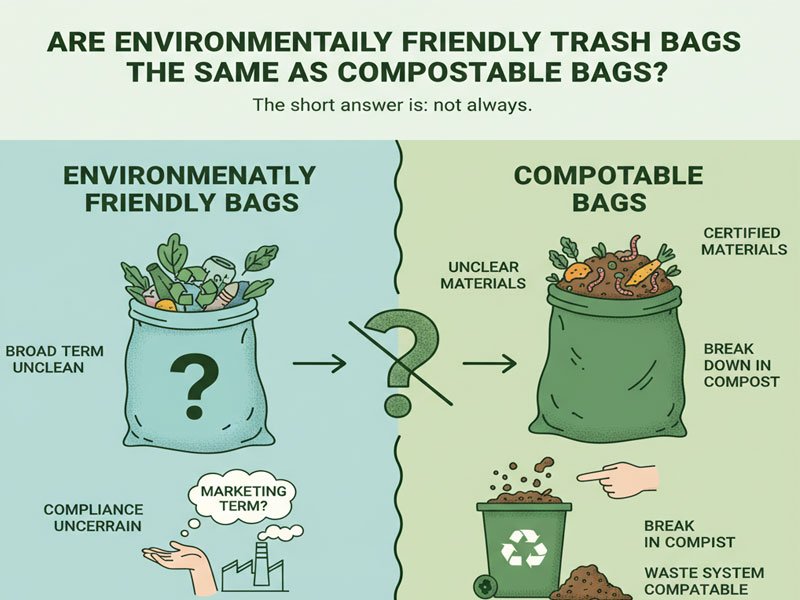
An eco-friendly trash bag is not automatically a compostable trash bag.
“Eco-friendly” or “environmentally friendly” is a broad description that may refer to recycled content, renewable feedstocks, reduced material use, compostability, or another environmental attribute.
“Compostable” is more specific. It describes how a finished product is designed to break down under defined composting conditions.
So, are environmentally friendly trash bags the same as compostable trash bags?
No. They can overlap, but the terms describe different product characteristics.
This comparison explains the differences in materials, certification, composting, recycling, disposal and suitable waste streams.
What Does “Eco-Friendly Trash Bag” Actually Mean?
There is no single material called an “eco-friendly trash bag.”
The term can be used for several different product strategies.
For example, a trash bag may be described as environmentally preferable because it:
- contains post-consumer recycled plastic;
- uses partly renewable or plant-derived feedstocks;
- uses less material than a previous design;
- is reusable;
- is certified compostable for an appropriate waste stream.
These are not the same environmental claim.
A recycled-content PE bag and a certified compostable bag can both be marketed around environmental benefits, but they have different materials, disposal routes, and intended applications.
This is why buyers should look beyond words such as:
green
eco
earth-friendly
sustainable
and identify the specific product attribute behind the claim.
The U.S. Federal Trade Commission has specifically cautioned against broad, unqualified “environmentally friendly” or “eco-friendly” claims because consumers can interpret them as implying many environmental benefits that may be difficult to substantiate.
What Does “Compostable Trash Bag” Mean?
A compostable trash bag is designed to break down under specified composting conditions while meeting defined performance requirements.
Depending on the standard or certification system, testing may consider factors such as:
- biodegradation;
- disintegration;
- heavy-metal limits;
- compost quality;
- ecotoxicity.
Common standards and certification programs include ASTM D6400, EN 13432, BPI certification, TÜV OK compost programs, AS 4736 and AS 5810.
However, certification scope matters.
A raw material being certified does not automatically mean every finished bag made from it is covered.
Thickness, color, printing, additives and other components may need to fall within the applicable certificate scope.
For certification information, see our Manufacturer & Certification Verification Center.
Eco-Friendly vs Compostable Trash Bags: Key Differences
| Feature | Eco-Friendly / Environmentally Friendly Trash Bags | Compostable Trash Bags |
|---|---|---|
| Definition | A broad environmental description | Bags designed to meet defined composting requirements |
| Material | May include recycled plastic, bio-based materials, reduced-material designs or other alternatives | Usually made from compostable polymer blends |
| Is it one specific material? | No | No |
| Certification | Not automatically required by the term itself | Compostability claims may be supported by applicable standards and certification programs |
| Can it contain recycled PE? | Yes | Conventional PE is generally not part of a compostable formulation |
| Can it contain plant-derived material? | Yes | Yes, depending on the formulation |
| Recycling | Depends on the material | Generally not intended for conventional plastic recycling |
| Industrial composting | Not automatically suitable | Applicable products are designed for defined industrial/commercial composting conditions |
| Home composting | Not implied | Only where the finished product is specifically suitable or certified for home composting |
| Landfill | Depends on the product | Compostability does not mean rapid breakdown in landfill |
| Organics collection | Depends on the product and local program | Can be suitable where the specific liner is accepted by the receiving program or facility |
| Main buyer question | What environmental attribute is actually being claimed? | Does the exact finished product meet the required compostability criteria? |
The key difference is simple: “eco-friendly” describes a broad environmental positioning, while “compostable” describes a specific end-of-life characteristic that should be supported by defined evidence.v
What Types of Trash Bags Are Commonly Called Eco-Friendly?
Three categories appear frequently in the market.
Recycled-Content Trash Bags
These are normally conventional plastic bags containing a percentage of recycled resin.
For example:
50% post-consumer recycled plastic
or:
65% certified post-consumer recycled plastic.
They are still plastic trash bags and generally are not compostable.
The environmental strategy is based on using recovered material rather than relying entirely on virgin resin.
Plant-Based Trash Bags
These contain some material made from renewable biological feedstocks.
However:
A plant-derived material is not automatically compostable, and a compostable product is not automatically 100% plant-based.
Material origin and end-of-life performance are separate questions.
For a detailed comparison, see Plant-Based Trash Bags vs Compostable Bags.
A plant-derived polyethylene, for example, can be bio-based while remaining chemically similar to conventional polyethylene.
Certified Compostable Trash Bags
These are designed for composting applications and may use blends containing materials such as PLA, starch and compostable polymers such as PBAT.
Their main distinction is not simply where the feedstock comes from.
It is whether the finished product meets the required compostability criteria for its intended system.
Are Compostable Trash Bags More Eco-Friendly Than Recycled Plastic Bags?
Not in every situation.
This is one of the most important distinctions on this page.
Imagine two trash bags:
Bag A: Made with 65% post-consumer recycled polyethylene.
Bag B: Certified compostable and designed for collecting food waste.
Which one is environmentally preferable?
There is no universal answer.
If Bag B is used to collect accepted food waste and is sent to an appropriate composting facility, compostability has a clear functional purpose.
But if the same bag is filled with mixed household garbage and sent to landfill, the intended composting route is no longer being used.
Bag A cannot be composted, but its recycled content may reduce demand for virgin resin.
The best environmental choice therefore depends on factors such as:
| Factor | Question to Ask |
|---|---|
| Waste stream | Food waste, mixed trash, pet waste or general refuse? |
| Disposal route | Composting, landfill, incineration or another system? |
| Local acceptance | Does the facility accept compostable liners? |
| Recycled content | How much recycled material is actually used? |
| Material weight | Is one bag substantially heavier than another? |
| Performance | Will the bag perform without double-bagging or excessive failures? |
| Certification | Is the compostability claim supported for the finished product? |
“Compostable” should therefore not automatically be translated as:
better in every environmental category.
The waste system matters.
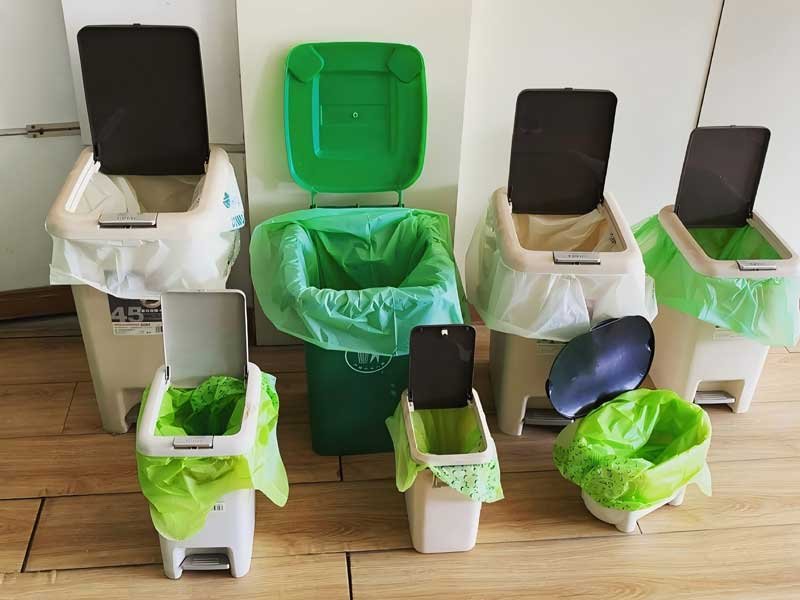
Compostable vs Recycled-Content Trash Bags: A Practical Comparison
YoCompostable and recycled-content trash bags represent two different environmental strategies.
A recycled-content polyethylene bag aims to reduce demand for virgin plastic by incorporating recovered plastic material.
A compostable bag is designed for an appropriate biological treatment route under defined composting conditions.
Neither option is automatically environmentally preferable in every situation.
For example, a compostable liner may have a clear functional role when it is used for accepted food-waste collection and enters an appropriate composting system. If the same bag is filled with mixed household waste and sent to landfill, its intended composting route is no longer being used.
A recycled-content bag is not compostable, but it may reduce the amount of virgin plastic required for applications where conventional plastic remains appropriate.
The better choice therefore depends on:
- the waste stream;
- the disposal route;
- local facility acceptance;
- recycled or bio-based content;
- bag weight and performance;
- the finished-product specification;
- applicable certification requirements.
Environmental performance should be evaluated in context rather than by treating “compostable” or “recycled” as universally better.

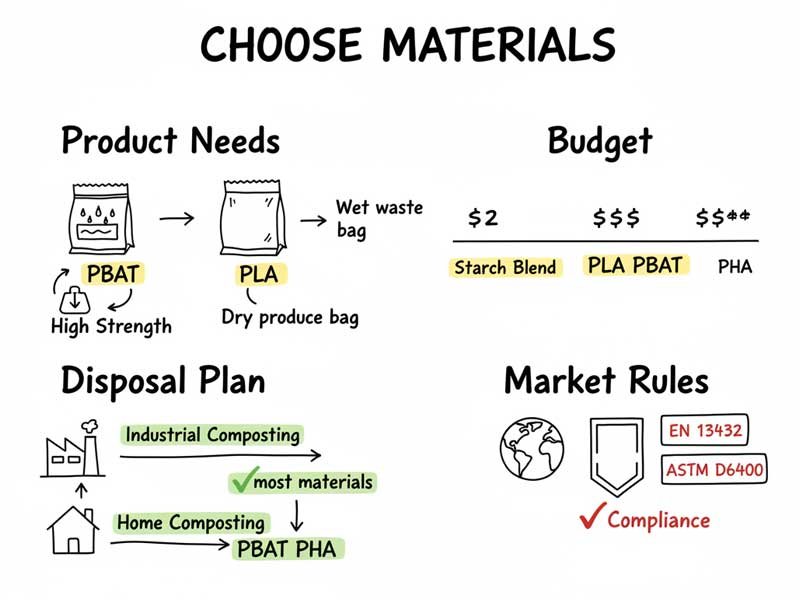
What Materials Are Compostable Trash Bags Made From?
There is no single universal formulation for compostable trash bags.
Compostable film may use combinations of materials such as:
- PBAT, which can provide flexibility and toughness;
- PLA, which can contribute stiffness and may be derived from renewable feedstocks;
- starch-based components, which may provide renewable-content material in certain formulations.
The final formulation depends on the required strength, flexibility, thickness, sealing performance and compostability requirements.
Importantly, a PLA/PBAT/starch formulation should not automatically be described as 100% plant-based, because conventional PBAT is generally fossil-derived.
For a detailed explanation of compostable bag materials, see What Are Compostable Bags Made Of ?
What About Eco-Friendly Trash Bags for Commercial Use?
Eco-friendly or compostable trash liners can be used in commercial applications, but environmental claims should not replace normal performance requirements.
Commercial buyers should still evaluate:
- bag dimensions and bin fit;
- film thickness;
- seal strength;
- puncture and tear resistance;
- leak resistance;
- closure style;
- storage conditions;
- the intended waste stream.
For compostable liners, buyers should also confirm whether the receiving facility accepts the specific product and whether the applicable finished-product certification matches the intended specification.
For a detailed sourcing and specification guide, see Eco-Friendly Trash Bags: B2B Buyer Guide.
Compostable vs Conventional Trash Bags for Commercial Use
Commercial buyers often worry that compostable automatically means weak.
That is too simple.
Bag performance depends on:
- formulation;
- thickness;
- bag dimensions;
- seal construction;
- load type;
- storage;
- manufacturing quality.
A compostable film and a conventional HDPE or LLDPE film should not be compared only by micron thickness.
For example:
20 μm compostable film and 20 μm HDPE film do not necessarily have identical mechanical properties.
Commercial buyers should test the finished bag under real use conditions.
For large projects, sample testing is more useful than choosing a liner from one specification number alone.
How Should You Compare the Price and Quality of Eco-Friendly Trash Bags?
Retail price alone can be misleading.
Different packs may have:
- different bag counts;
- different sizes;
- different thicknesses;
- different closures;
- different certification;
- different recycled content;
- different performance.
A better comparison uses:
cost per usable bag
rather than just package price.
For B2B purchasing, compare:
- Price per bag
- Price per kilogram
- Bag weight
- Thickness
- Dimensions
- Load performance
- Failure rate
- Certification requirements
- Packing configuration
A cheaper liner that frequently leaks or requires double-bagging may not have the lowest operating cost.
Likewise, paying more for a certified compostable liner makes little sense if the final waste stream does not accept it.
Does “Compostable” Automatically Mean Lower Environmental Impact?
No.
Compostability describes a specific end-of-life characteristic. It does not automatically establish:
- lower carbon emissions;
- lower energy use;
- lower water use;
- lower material consumption;
- lower transportation impact;
- lower overall life-cycle impact.
Those comparisons require appropriate evidence and a clearly defined comparison.
A more accurate statement is:
Appropriately certified compostable bags can support organic-waste collection where the receiving system accepts the specific product.
For a broader environmental analysis, see Are Compostable Bags Really Eco-Friendly?
What Should B2B Buyers Ask Before Choosing a Trash Liner?
For B2B sourcing, buyers should separate three questions:
- What environmental attribute is being claimed?
- Does the finished product meet the required performance and certification requirements?
- Does the intended waste system accept it?
For detailed specification, supplier and procurement considerations, see our Eco-Friendly Trash Bags: B2B Buyer Guide.
FAQ
Are eco-friendly trash bags compostable?
Not necessarily. “Eco-friendly” is a broad environmental description. A trash bag may use recycled plastic, renewable feedstocks or another environmental strategy without being compostable.
Are compostable trash bags environmentally friendly?
They can provide an environmental benefit in suitable applications, particularly where the bag supports an accepted organics-collection and composting system. Compostability alone does not prove lower environmental impact in every category.
Are compostable bags better than recycled plastic bags?
Not universally. Compostable bags may be appropriate for accepted organics collection, while recycled-content bags may reduce virgin plastic use where conventional plastic remains suitable. The waste stream and disposal system should guide the comparison.
Are recycled plastic trash bags compostable?
No. Conventional recycled polyethylene bags remain plastic and are not compostable simply because they contain recycled material.
Can compostable trash bags go in recycling?
Generally, no. Compostable bags are not intended for conventional plastic recycling streams and may interfere with recycling if mixed with recyclable plastics.
Which Trash Bag Should You Choose?
Start with the waste stream.
For food waste and accepted organics collection, a certified compostable liner may make sense.
For general mixed waste going to conventional disposal, a recycled-content liner may be another option to evaluate.
If renewable feedstock content matters, ask separately about bio-based content.
If compostability matters, ask for the applicable finished-product certification.
And if performance matters—as it always does for commercial buyers—test the actual liner.
There is no single “greenest” trash bag for every application.
The best specification connects:
material → performance → waste stream → disposal system.
Looking for Custom Compostable Trash Bags?
ORIZON manufactures compostable trash bags and bin liners for B2B, OEM and private-label projects.
Custom options include bag dimensions, thickness, film color, printing, closure style, roll configuration and packaging.
Explore 13 Gallon Compostable Trash Bags or review our Manufacturer & Certification Verification Center before starting a custom project.