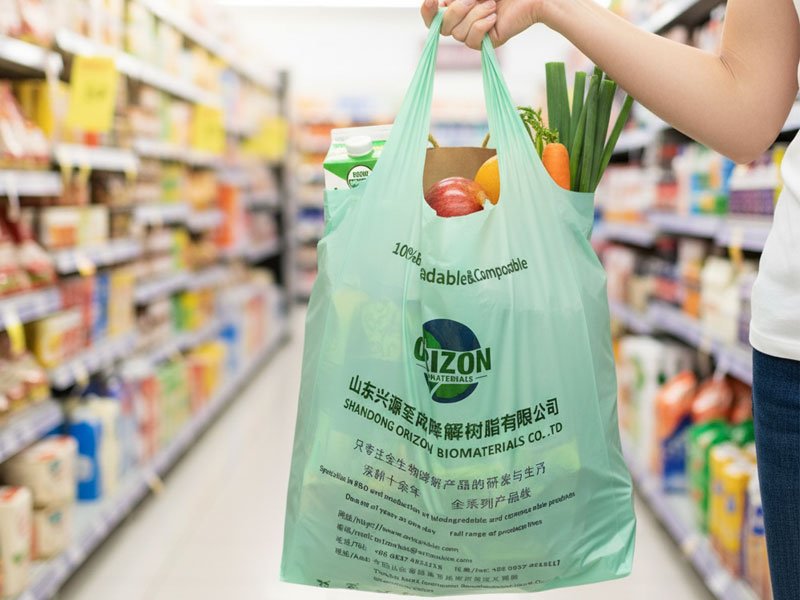
If you import packaging into the EU, the PPWR Declaration of Conformity is not just another supplier document.
It is the signed statement that says a packaging type meets the relevant requirements of the EU Packaging and Packaging Waste Regulation, Regulation (EU) 2025/40.
For B2B buyers, the key question is simple:
Can your supplier give you the right evidence before you place the packaging on the EU market?
This matters for importers, distributors, wholesalers, private-label brands, retail groups, and packaging buyers who buy compostable bags from outside the EU.
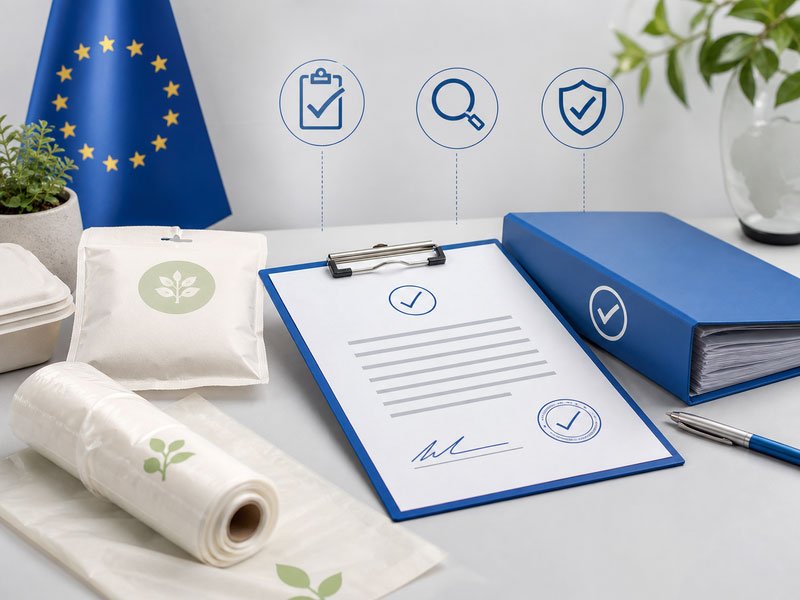
What Is a PPWR Declaration of Conformity?
If you import packaging into the EU, the PPWR Declaration of Conformity is not just another supplier document.
It is the signed statement that says a packaging type meets the relevant requirements of the EU Packaging and Packaging Waste Regulation, Regulation (EU) 2025/40.
For B2B buyers, the key question is simple:
Can your supplier give you the right evidence before you place the packaging on the EU market?
This matters for importers, distributors, wholesalers, private-label brands, retail groups, and packaging buyers who buy compostable bags from outside the EU.
What Is a PPWR Declaration of Conformity?
A PPWR Declaration of Conformity, or PPWR DoC, is a formal document for packaging placed on the EU market.
Under Article 39 of Regulation (EU) 2025/40, the EU Declaration of Conformity must state that the packaging meets the requirements laid down in, or under, Articles 5 to 12 of the PPWR.
In plain English, the DoC says:
“This packaging type has been checked against the relevant PPWR rules, and the manufacturer takes responsibility for that statement.”
The DoC is not the same as a test report.
It sits on top of the evidence file.
That evidence file is called PPWR technical documentation.
When Does the PPWR DoC Requirement Apply?
The PPWR entered into force on 11 February 2025. The European Commission states that the Regulation generally applies from 12 August 2026.
The PPWR covers all packaging placed on the EU market, whether made in the EU or imported from a third country.
For a wider view of EU packaging duties, read our PPWR packaging regulation guide.
For importers, this means empty packaging and packaged products both matter.
Examples include:
- Compostable garbage bags
- Compostable shopping bags
- Compostable fruit and vegetable bags
- Compostable mailer bags
- Compostable garment bags
- Dog waste bags
- Private-label packaging
- Service packaging supplied to retailers
If the packaging is placed on the EU market, the importer should check whether a valid PPWR DoC and supporting technical documentation exist.
Who Prepares and Signs the PPWR Declaration of Conformity?
The manufacturer is normally responsible for drawing up the technical documentation and the EU Declaration of Conformity.
But in real B2B trade, roles can shift.
Manufacturer
Under Article 15, manufacturers must carry out the conformity assessment procedure, draw up the technical documentation, and then draw up the EU Declaration of Conformity when conformity has been shown.
Manufacturers must keep the technical documentation and DoC:
| Packaging Type | Retention Period |
|---|---|
| Single-use packaging | 5 years |
| Reusable packaging | 10 years |
For compostable bags, most products are single-use packaging, so the 5-year rule is often relevant.
Importer
Under Article 18, importers must only place compliant packaging on the EU market.
Before placing packaging on the market, importers must ensure that:
- The manufacturer has carried out the conformity assessment.
- The manufacturer has drawn up the technical documentation.
- The packaging is labelled as required.
- The packaging is accompanied by required documents.
- Manufacturer identification requirements are met.
Importers must keep a copy of the EU Declaration of Conformity. They must also make sure technical documentation can be made available to authorities on request.
If an authority asks, documents may need to be provided within 10 days.
Distributor
Distributors do not normally prepare the DoC.
But they must act with due care. They should check that required labelling and identification are in place before making packaging available on the market.
Authorised Representative
A manufacturer may appoint an authorised representative in the EU by written mandate.
The authorised representative can keep the DoC and technical documentation available for market surveillance authorities. But the duty to draw up the technical documentation does not transfer away from the manufacturer under Article 17.
Private-Label Buyer
This is where many buyers make mistakes.
If an importer or distributor places packaging on the market under its own name or trademark, or changes packaging in a way that affects compliance, Article 21 may treat that importer or distributor as the manufacturer.
For private-label compostable bags, ask this early:
Whose brand is on the bag, carton, label, and sales documents?
If it is your brand, your compliance role may be larger than you expect.
What Must Be Included in a PPWR DoC?
Annex VIII gives the model structure for the EU Declaration of Conformity.
A practical PPWR DoC should include:
| DoC Field | What It Means for Buyers |
|---|---|
| DoC number | Unique document ID |
| Packaging identification | SKU, bag type, size, thickness, material, print version |
| Manufacturer details | Legal name and address |
| Authorised representative | If applicable |
| Responsibility statement | Manufacturer takes responsibility |
| Object of declaration | Clear packaging description |
| Relevant EU laws | PPWR and any other applicable Union acts |
| Standards or specifications | EN standards, test methods, internal specs |
| Signature | Name, role, date, place, signature |
The DoC should be kept updated. If the bag size, thickness, resin blend, ink, additive, or factory process changes, the supporting evidence may need review.
DoC vs Technical Documentation vs Certificate vs Test Report
Importers often receive many documents from suppliers.
They are not the same.
| Document | What It Is | Who Usually Provides It | Is It Enough Alone? |
|---|---|---|---|
| PPWR Declaration of Conformity | Signed legal statement of conformity | Manufacturer | No |
| Technical documentation | Evidence file behind the DoC | Manufacturer, with supplier input | No, it supports the DoC |
| Certificate | Third-party certification, such as compostability mark | Certification body | No |
| Test report | Lab result for a specific material or product | Laboratory | No |
| Supplier declaration | Supplier’s written statement | Raw material or component supplier | No |
| Food-contact DoC | Document for food-contact compliance | Material or packaging supplier | Only for food-contact rules |
A compostability certificate is useful.
But it does not replace the PPWR Declaration of Conformity.
A raw material certificate is also not the same as a finished bag certificate. A resin may be certified, but the final bag still has thickness, printing ink, additives, sealing, and dimensions.
That finished packaging needs its own compliance logic.
What Importers Should Check Before Buying Compostable Bags
For compostable bags, the document review should cover both material and finished packaging.
Raw Material Evidence
Ask for:
- Resin grade name
- Material supplier declaration
- Compostability certificate, if available
- Heavy metal or restricted substance data
- Food-contact suitability, if used for food
- Batch traceability
Raw material evidence helps prove the starting point.
But it does not prove the finished bag by itself.
Finished Packaging Evidence
Ask for:
- Finished bag specification
- Size, thickness, color, and print details
- Finished product compostability evidence
- Test reports linked to the exact bag type
- Manufacturing process controls
- Quality control records
- PPWR DoC or draft DoC structure
- Technical documentation availability statement
If the final bag is printed, the ink matters.
If the bag is thicker than the tested sample, the test may not cover it.
If the bag is for fruit, vegetables, or food service, food-contact rules may also apply.
For produce packaging projects, see our compostable fruit and vegetable bags for B2B buyers.
Food-Contact Use
Compostable fruit and vegetable bags may contact food.
The European Commission explains that food contact materials in the EU must comply with Regulation (EC) No 1935/2004. Materials should not release substances into food at levels that endanger health or change food quality.
For food-contact compostable bags, request:
- Food-contact declaration
- Migration test report, where relevant
- Material composition
- Intended use conditions
- Temperature and contact-time limits
Do not rely only on a compostability logo.
Decision Table for Importers
| Situation | What You Should Do |
|---|---|
| Supplier gives only EN 13432 raw material certificate | Ask for finished bag evidence |
| Supplier gives finished bag compostability certificate | Still ask for PPWR DoC and technical documentation |
| You sell bags under your own brand in the EU | Check whether Article 21 makes you the manufacturer |
| Bag is for loose fruit or vegetables | Check food-contact documents |
| Bag design, thickness, or ink changes | Ask whether the technical file and DoC must be updated |
| Supplier refuses document traceability | Treat as a procurement risk |
Buyer Checklist
Before placing an order, ask your supplier:
- Can you provide a PPWR Declaration of Conformity for this packaging type?
- Is the DoC linked to a specific SKU or product family?
- Can you confirm technical documentation exists under Annex VII?
- What standards or test methods were used?
- Is the evidence for raw material or finished packaging?
- Are inks, colors, and additives included?
- Is the bag intended for food contact?
- Can documents be provided in the language needed by the EU market?
- Who signs the DoC?
- What happens if the formula, thickness, or print design changes?
Supplier Red Flags
Be careful if a supplier says:
- “Our resin is certified, so the finished bag is compliant.”
- “EN 13432 is enough for PPWR.”
- “We do not provide technical documentation.”
- “All our bags use the same certificate.”
- “The certificate does not need to match the final thickness.”
- “PPWR compliant” with no article-by-article evidence.
- “The importer can prepare the DoC later” without role mapping.
These answers may not mean the supplier is dishonest.
But they do mean you need more proof before shipment.
B2B Procurement Case
A European distributor wants to import compostable fruit and vegetable bags from China.
The first supplier sends only a resin certificate. The certificate covers the raw material, but not the printed finished bag.
The distributor asks for more documents.
A stronger supplier provides:
- Finished bag specification
- Material composition
- Compostability certificate linked to the finished product or tested structure
- Food-contact declaration
- Migration test report, if needed
- Batch traceability
- PPWR DoC draft based on Annex VIII
- Statement that technical documentation is available
The second supplier gives the buyer a better compliance trail.
The price may not be the lowest.
But the import risk is lower.
How We Support Importers With Document-Ready Compostable Bags
For B2B buyers, compliance work starts before production.
As a compostable bag manufacturer, we support importers, distributors, wholesalers, retailers, and private-label brands with practical document preparation.
Our production setup includes 16 years of manufacturing experience, about 20,000 square meters of factory space, 16 fully automatic production lines, and monthly capacity of about 500 tons.
We manufacture:
- Compostable garbage bags
- Shopping bags
- Fruit and vegetable bags
- Courier bags
- Garment bags
- Dog waste bags
- OEM and ODM compostable packaging
If you need custom compostable bags with traceable production data, work with an experienced compostable bags manufacturer.
For private-label projects, our OEM compostable bags can be made by size, thickness, print, and packing format.
For EU-focused orders, we can help prepare the product information buyers usually need for technical documentation, including material data, product specifications, batch traceability, and relevant test or certificate references.
We do not make unsupported “PPWR compliant” claims.
Instead, we help buyers build a clear evidence package for each packaging type.
That is more useful in real procurement.
FAQ
What is a PPWR Declaration of Conformity?
A PPWR Declaration of Conformity is a signed document stating that a packaging type meets the relevant requirements of Regulation (EU) 2025/40. It is based on a conformity assessment and supporting technical documentation.
Who prepares the PPWR Declaration of Conformity?
The manufacturer normally prepares and signs the PPWR Declaration of Conformity. Importers must check that it exists before placing packaging on the EU market.
Does an importer need to keep the PPWR DoC?
Yes. Under Article 18, importers must keep a copy of the EU Declaration of Conformity and ensure technical documentation can be made available to authorities on request.
Is an EN 13432 certificate enough for PPWR?
No. EN 13432 evidence may support compostability, but it does not replace the PPWR Declaration of Conformity or the technical documentation required under Annex VII.
What is the difference between technical documentation and a DoC?
Technical documentation is the evidence file. The DoC is the signed legal statement based on that evidence.
Do raw material certificates cover finished compostable bags?
Not always. A raw material certificate may not cover the final bag thickness, printing ink, additives, sealing, or finished product design. Importers should ask for finished packaging evidence.
Conclusion
The PPWR Declaration of Conformity is a key document for EU packaging imports. But the DoC is only useful when it is backed by clear technical documentation.
For compostable bags, importers should check both raw material evidence and finished packaging evidence. They should also confirm who signs the DoC, whether food-contact rules apply, and whether the documents match the exact SKU being imported.
A good supplier will not only sell bags.
A good supplier will help you build a traceable compliance file before the shipment leaves the factory.