Private-label packaging gives buyers more control over brand, artwork, claims, and retail presentation.
Under PPWR, that extra control can also mean extra responsibility.
If your logo, trademark, disposal claim, certification mark, or carton information appears on the packaging, you should check the compliance trail before mass production.
This guide gives EU OEM buyers a practical PPWR private label packaging checklist.
It covers artwork, certification scope, carton marking, supplier documents, and the questions to ask before approving production.
Short Answer
Private-label packaging needs a stricter PPWR review than standard off-the-shelf packaging.
The reason is simple:
Your brand and artwork can affect your role, your claims, and your document duties.
Under Article 21 of Regulation (EU) 2025/40, an importer or distributor may be treated as the manufacturer if it places packaging on the market under its own name or trademark, or modifies packaging in a way that could affect compliance.
For OEM buyers, this means artwork approval is not only a design step.
It is a compliance step.
Why Private-Label Packaging Needs Extra PPWR Review
PPWR applies to packaging placed on the EU market, whether made in the EU or imported from a third country.
For private-label packaging, the buyer often controls:
- Brand name
- Logo placement
- Bag size and thickness
- Printing design
- Environmental claims
- Certification logos
- Retail box artwork
- Master carton marking
- Target EU market
Each of these choices can affect compliance.
A small change in thickness, ink, claim wording, or carton label can break the link between the certificate and the finished packaging.
That is why OEM buyers should review PPWR before artwork is locked.
When an OEM Buyer May Be Treated as the Manufacturer
Article 21 is the key private-label rule.
If an importer or distributor places packaging on the market under its own name or trademark, that importer or distributor may be considered the manufacturer for PPWR purposes.
The same can happen if the importer or distributor modifies packaging in a way that could affect compliance.
This can apply to:
- Retailer-branded compostable shopping bags
- Private-label dog waste bags
- Supermarket produce bags
- Custom printed compostable mailer bags
- Branded garment bags
- OEM garbage bags sold under an EU brand
For EU buyers sourcing from China, this does not mean the factory has no responsibility.
It means the buyer should confirm who prepares, signs, stores, and updates the conformity evidence.
EU buyers sourcing from China should also review our PPWR importer requirements guide.
What to Check Before Artwork Approval
Artwork is often the first place where PPWR risk appears.
Before approving artwork, check:
- Product name
- Brand name and trademark
- Material description
- Compostability claim
- Biodegradable claim
- Recycled-content claim
- Certification logo
- Disposal wording
- Sorting label
- QR code destination
- Importer information
- Batch or product identification
Avoid broad claims such as “eco-friendly,” “green,” “planet safe,” or “100% sustainable” unless you have strong evidence and a clear legal basis.
If the packaging says “compostable,” the artwork should make clear whether the claim is industrial compostable or home compostable, where relevant.
Artwork-sensitive buyers can also review our custom printed compostable bags guide before approving claims.
Certification Scope: Raw Material vs Finished Packaging
Many private-label mistakes start with certification scope.
A raw material certificate is useful.
But it does not automatically cover the finished private-label bag.
The finished packaging may include:
- Different thickness
- Custom size
- Printing ink
- High print coverage
- Color masterbatch
- Adhesive strip
- Drawstring
- Retail box
- Custom roll format
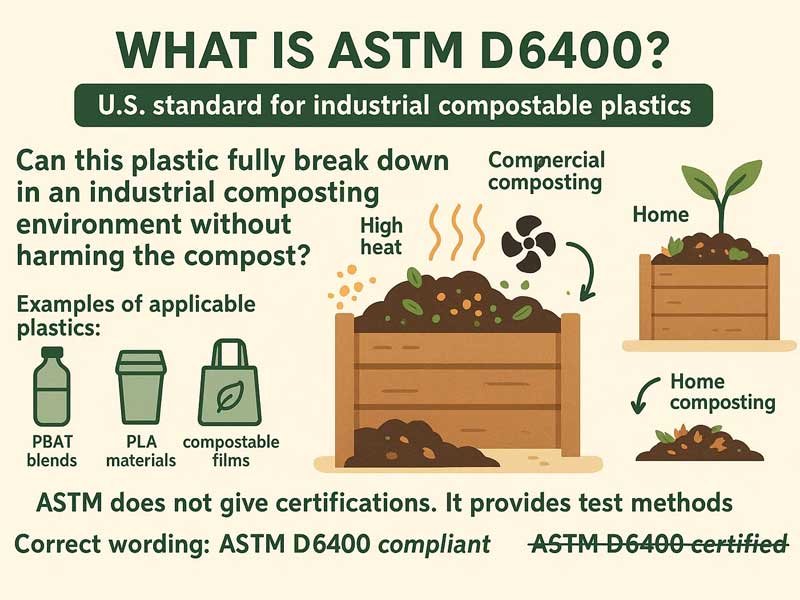
For compostable bags, ask whether the certificate covers the finished product, the tested structure, or only the resin.
Buyers should compare certificate scope in our compostable certifications guide before using certification logos.
Carton Marking and Importer Information
Carton marking is not just logistics information.
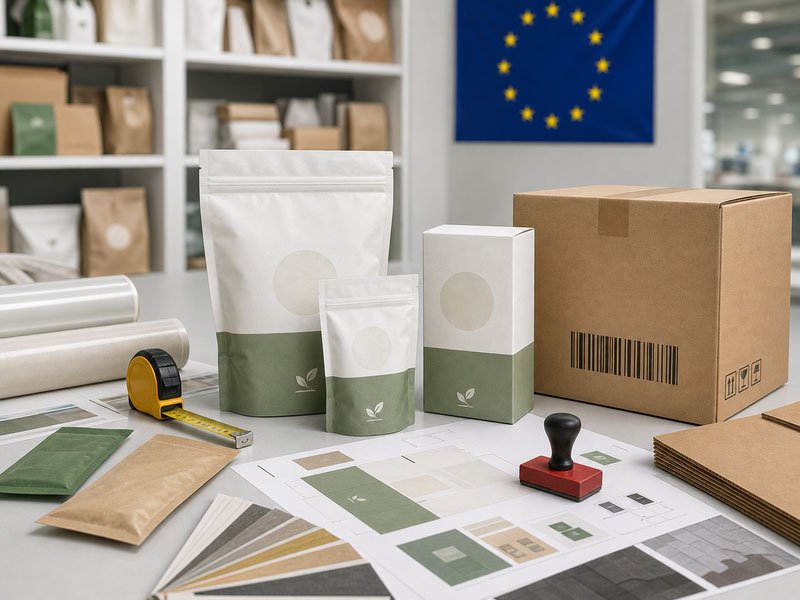
For private-label packaging, cartons and retail packs may carry claims, certification logos, batch codes, importer details, and market information.
Check three levels:
| Packaging Level | What to Check |
|---|---|
| Bag or primary packaging | Claims, logo, sorting label, material wording, batch or type ID |
| Retail box or inner pack | Brand, SKU, certification logo, disposal wording, importer information |
| Master carton or shipping carton | SKU, quantity, batch number, PO number, carton number, destination, traceability code |
Article 18 also requires importers to indicate their name, registered trade name or trademark, postal address, and where available, electronic contact details on the packaging.
If this is not possible, the information may be provided through a standardised digital data carrier or accompanying document.
The information should be clear, understandable, and legible.
Documents an OEM Supplier Should Prepare
A strong OEM supplier should help buyers prepare a clear document trail.
For PPWR private label packaging, ask for:
- Finished product specification
- Material composition summary
- Artwork file version
- Retail box artwork version
- Carton marking template
- Certification scope confirmation
- Test reports linked to product structure
- Supplier declarations
- Batch traceability method
- Technical documentation inputs under Annex VII
- Declaration of Conformity information
- Change control record
- Final inspection report
Do not wait until shipment to ask for these.
They should be checked before mass production.
Decision Table for Private-Label Buyers
| Situation | PPWR Risk | Buyer Action |
|---|---|---|
| Your trademark appears on the packaging | You may be treated as manufacturer under Article 21 | Map roles before production |
| Supplier gives only raw material certificate | Finished packaging may not be covered | Ask for finished product evidence |
| Artwork includes compostable claim | Claim must match certificate and disposal route | Review wording and evidence |
| Carton has certification logo | Logo use may be restricted | Check licence and certified scope |
| Bag thickness changes after sample approval | Certificate or test report may not apply | Recheck evidence before production |
| Importer information is missing | Article 18 issue | Add correct importer details or approved data carrier |
OEM Buyer Checklist Before Mass Production
Before approving mass production, check:
- Who is the manufacturer under PPWR?
- Who is the importer?
- Does Article 21 apply to this private-label project?
- Is the final artwork approved for claims?
- Does the certificate cover the finished packaging?
- Is the certification logo authorised for this SKU?
- Does the retail box match the approved claim wording?
- Does the master carton include correct SKU and batch information?
- Is importer information present where required?
- Is there a technical documentation file or supplier data package?
- Can the supplier link production batches to material batches?
- What happens if size, thickness, ink, or packing changes?
- Who signs or supports the Declaration of Conformity?
This checklist should be completed before printing plates, retail box production, and final carton marking are confirmed.
Supplier Red Flags
Be careful if an OEM supplier says:
- “Your private label does not affect PPWR.”
- “Raw material certification is enough for all finished bags.”
- “You can print any certification logo.”
- “Carton marking is only for shipping.”
- “No need to check importer information.”
- “Artwork claims are the buyer’s problem.”
- “The same DoC can cover every custom bag.”
- “PPWR compliant” without technical documentation support.
These answers do not always mean the supplier is dishonest.
But they show that the supplier may not have a strong OEM compliance process.
B2B Procurement Case
A Spanish private-label brand wants to order compostable dog waste bags from China.
The buyer sends artwork with:
- Brand logo
- “100% eco-friendly” claim
- Compostable logo
- Retail box design
- Master carton label
The supplier sends a raw material certificate only.
This is not enough for PPWR private label packaging review.
A stronger process would check:
- Whether Article 21 changes the buyer’s role
- Whether the finished bag is within the certificate scope
- Whether the logo can be printed
- Whether the claim should be changed from broad eco wording to specific compostability wording
- Whether importer information appears correctly
- Whether carton marking links to batch traceability
- Whether technical documentation inputs are available
The buyer may decide to remove “100% eco-friendly” and use a more specific compostability statement.
That is a safer choice.
How Orizon Supports PPWR-Ready OEM Projects
Orizon manufactures compostable bags for importers, distributors, wholesalers, retailers, and private-label brands.
For private-label projects, review our OEM compostable bags options before confirming artwork and packaging format.
We support OEM and ODM projects for:
- Compostable garbage bags
- Compostable shopping bags
- Compostable produce bags
- Compostable mailer bags
- Compostable garment bags
- Compostable dog waste bags
- Custom printed compostable packaging
For OEM projects, we help buyers review bag size, thickness, material selection, printing details, certification scope, carton marking, and batch traceability before production.
Our factory has 16 years of manufacturing experience, about 20,000 square meters of production space, 16 fully automatic production lines, and monthly capacity of about 500 tons.
We do not recommend approving claims or certification logos before checking the finished packaging evidence.
If you are planning a private-label EU packaging program, contact Orizon for an OEM quote.
FAQ
What is PPWR private label packaging?
PPWR private label packaging is packaging sold under a buyer’s own brand, trademark, or artwork and placed on the EU market. It may create extra responsibility for the importer or distributor under Article 21.
Can a private-label importer be treated as the manufacturer under PPWR?
Yes. If an importer or distributor places packaging on the market under its own name or trademark, or modifies packaging in a way that could affect compliance, it may be treated as the manufacturer under Article 21.
Is a raw material certificate enough for private-label compostable bags?
No. A raw material certificate may not cover the finished bag, printing ink, thickness, adhesive, retail box, or final packaging format. Buyers should ask for finished packaging evidence.
What should buyers check before approving OEM artwork?
Buyers should check claims, certification logos, disposal wording, importer information, QR codes, sorting labels, product identification, and whether the artwork matches the technical evidence.
What carton marking should private-label buyers check?
Buyers should check SKU, quantity, batch number, PO number, carton number, destination, importer information where relevant, and traceability links to production and material records.
Should PPWR checks happen before or after mass production?
PPWR checks should happen before mass production. Artwork, certificate scope, carton marking, claims, and technical documentation should be reviewed before printing plates and final packing are approved.
Conclusion
PPWR private label packaging needs careful review before mass production.
For OEM buyers, the key checks are artwork, claims, certification scope, carton marking, importer information, and supplier documents.
If your brand or trademark appears on the packaging, Article 21 may affect your role.
The safest process is to review the finished packaging evidence before approving printing, retail boxes, and cartons.
A clear checklist reduces delays, claim risk, and document gaps in EU supply programs.