PLA PBAT blend is one of the most common material systems used in commercial compostable bags today.
For B2B buyers, this matters because compostable bags must do more than break down under the right conditions. They also need to seal well, stretch, hold weight, tear cleanly from rolls, and stay stable during storage.
This guide explains why PLA and PBAT are often blended for compostable bags, what each material does, and what buyers should check before approving a supplier.
Short Answer
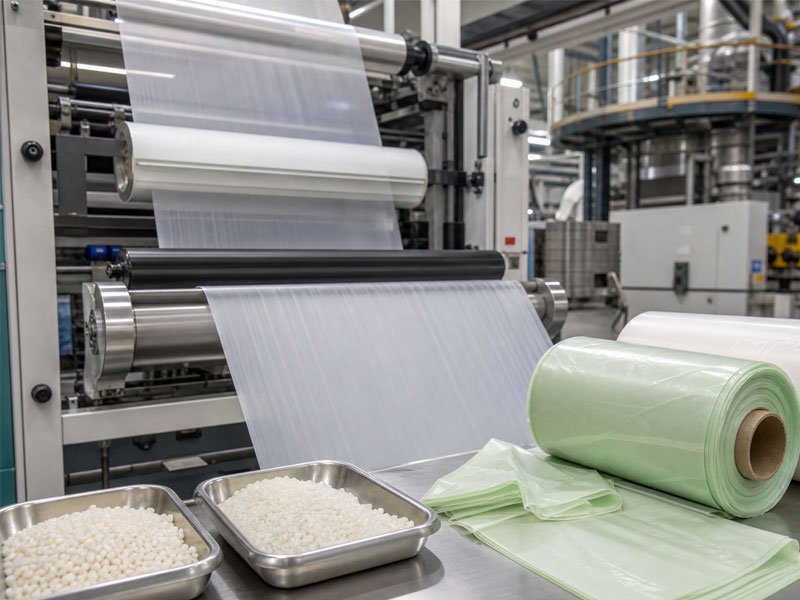
PLA adds stiffness and bio-based content. PBAT adds flexibility, tear resistance, and better blown-film processing. In many compostable bags, starch or other approved components are also used to balance cost, feel, and compostability.
Pure PLA is usually too brittle for flexible bags. PBAT alone may not give the right stiffness or bio-based positioning. A tested PLA PBAT blend can give a more practical balance for bulk compostable bag production.
What Is a PLA PBAT Blend?
A PLA PBAT blend is a material formula that combines PLA and PBAT, often with starch and processing additives.
PLA means polylactic acid. It is usually made from renewable resources such as corn, sugarcane, or other starch-rich crops.
PBAT means polybutylene adipate terephthalate. It is a flexible biodegradable polyester. PBAT is often fossil-based, but it can be used in certified compostable products when the finished product meets the right standard.
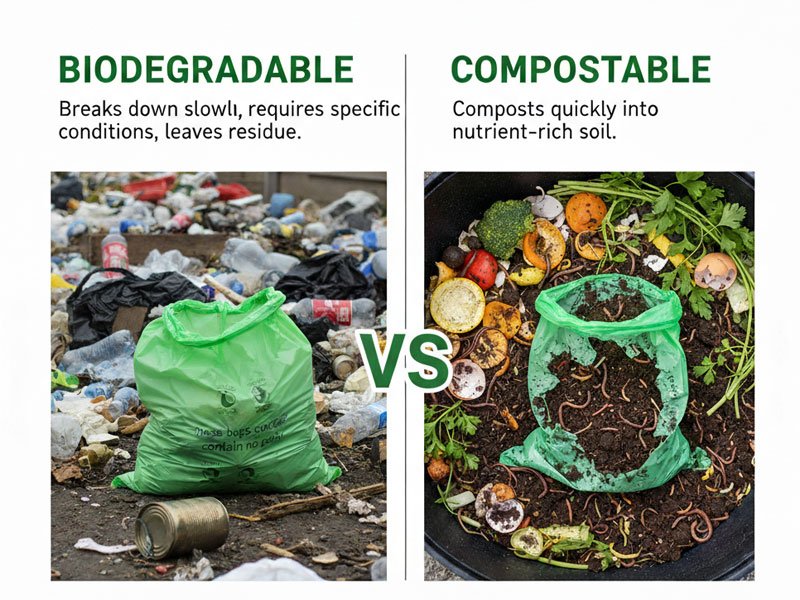
The European Commission also notes that biobased, biodegradable, and compostable plastics are different terms. A biobased plastic is not automatically biodegradable or compostable.
Why Pure PLA Is Not Enough for Flexible Bags
PLA has useful stiffness, but it is not ideal by itself for soft compostable bags.
Pure PLA can be:
- Too brittle
- Easy to crack under stress
- Difficult for soft bag film
- Less suitable for heavy or wet waste
This is why pure PLA is more common in rigid packaging, cups, trays, and molded products than in flexible garbage bags or food waste bags.
What PBAT Adds to Compostable Bags
PBAT helps compostable bags feel and perform more like conventional flexible plastic bags.
PBAT can improve:
- Flexibility
- Tear resistance
- Elongation
- Blown-film stability
- Heat sealing
- Puncture resistance
For compostable garbage bags, shopping bags, produce bags, mailer bags, and food waste bags, flexibility and sealing are critical. This is why PBAT is often an important part of the blend.
Why Starch Is Often Used in PLA PBAT Blends
Many compostable bag formulas also include starch or starch-based components.
Starch can help adjust:
- Cost
- Film feel
- Opacity
- Processing behavior
- Compostability performance
But high starch content can also affect moisture resistance, strength, and shelf life. The formula must match the product use.
PLA PBAT Blend Comparison
| Component | Main Role | Buyer Notes |
|---|---|---|
| PLA | Adds stiffness and bio-based content. | Useful in blends, but often too brittle alone for soft bags. |
| PBAT | Adds flexibility, tear resistance, and film processing stability. | Important for bags that need stretch, sealing, and load performance. |
| Starch | Helps with cost, feel, and formula adjustment. | Too much starch may affect strength and storage stability. |
| Additives | Support processing, sealing, color, or film behavior. | Must be covered by certification and test scope where needed. |
Different Bag Types Need Different Blends
There is no single PLA PBAT blend that fits every compostable bag.
| Bag Type | Key Performance Need | Material Focus |
|---|---|---|
| Compostable garbage bags | Load strength, puncture resistance, sealing. | Balanced flexibility and toughness. |
| Food waste bags | Wet-load strength, leak resistance, storage life. | Strong seal and moisture control. |
| Shopping bags | Handle strength, stiffness, printability. | Good hand feel and tensile strength. |
| Produce bags | Clarity, light weight, roll converting. | Thin film stability and tear-off quality. |
| Mailer bags | Impact resistance, sealing, courier handling. | Higher flexibility and puncture resistance. |
| Dog waste bags | Soft feel, easy tear-off, leak resistance. | Flexible film and good sealing. |
Compostability Depends on the Finished Bag
A PLA PBAT blend does not automatically make a bag certified compostable.
Compostability depends on the finished product, including:
- Material formula
- Film thickness
- Bag size
- Color
- Printing ink
- Additives
- Sealing structure
- Composting condition
ASTM D6400 covers plastics and products designed to be composted in municipal or industrial aerobic composting facilities. BPI also uses ASTM D6400 as a base standard for its commercial compostability certification process.
For B2B buyers, this means one thing: ask for finished product scope, not only raw material certificates.
Raw Material Certificate vs Finished Bag Certificate
A raw material certificate can be useful, but it does not always prove that your finished bag is covered.
The finished bag may have a different thickness, color, print, additive package, or structure from the certified raw material.
Buyers should ask suppliers for:
- Certificate
- Test report
- Material declaration
- Finished bag scope
- Thickness range covered
- Color and printing scope
- Supplier declaration
- Batch traceability information
B2B Buyer Checklist
- What is the target bag type?
- Is the formula for garbage bags, food waste bags, shopping bags, mailers, or produce bags?
- Is the certificate for raw material or finished bags?
- Which standard applies: EN 13432, ASTM D6400, BPI, OK compost, or another standard?
- Does the certificate cover the thickness and color?
- Has the supplier tested sealing, puncture, wet load, and tear-off performance?
- What is the storage life?
- Can the supplier support OEM artwork and certification mark rules?
- Can the supplier provide repeat production with batch control?
Red Flags
- The supplier says the bag is compostable but gives no test standard.
- The supplier only provides a raw material certificate.
- The formula is described as PLA PBAT, but no material declaration is available.
- The bag claims home compostable but only has industrial composting proof.
- The supplier cannot explain why the formula fits your bag type.
- The product uses certification marks without approval.
- The supplier cannot explain storage conditions or shelf life.
How This Relates to PHA Film
PHA is another material option that is gaining attention. It may offer broader biodegradation potential in selected applications, but it can still face cost, supply, and processing challenges in film production.
If you are comparing material systems, read our PLA PBAT vs PHA film comparison.
For a deeper technical view, you can also review our article on PHA film processing challenges.
How Orizon Supports PLA PBAT Blend Bag Projects
Orizon manufactures compostable bags for global B2B buyers, including importers, distributors, wholesalers, retailers, private-label brands, packaging buyers, and procurement teams.
We produce compostable garbage bags, food waste bags, shopping bags, produce bags, mailer bags, garment bags, dog waste bags, toilet bags, and OEM custom compostable packaging.
For PLA PBAT blend bag projects, we can support:
- Material formula discussion
- Custom size and thickness
- OEM and private-label printing
- Sample testing
- Certification document support
- Batch traceability
- Export carton marking
- Long-term wholesale supply
You can review our compostable bag products or contact us for OEM support.
FAQ
What is a PLA PBAT blend?
A PLA PBAT blend is a material formula that combines PLA and PBAT, often with starch or other approved components, to make flexible compostable films and bags.
Why is PBAT used with PLA?
PBAT adds flexibility, tear resistance, sealing performance, and better blown-film processing. PLA alone is often too brittle for flexible bags.
Are PLA PBAT bags compostable?
They can be compostable when the finished bag meets a recognized standard such as EN 13432, ASTM D6400, BPI, or OK compost. Buyers should check finished product certification.
Is PLA PBAT blend bio-based?
PLA is usually bio-based, while PBAT is often fossil-based. The bio-based content depends on the exact formula and any starch or other bio-based components used.
Is PLA PBAT better than PHA?
PLA PBAT blends are usually more practical for bulk compostable bag production today because they offer stable processing, better cost control, and more mature supply. PHA may be useful for selected premium or special projects.
Do buyers need a finished bag certificate?
Yes. A raw material certificate does not always prove that the finished bag is certified. Buyers should check the finished product scope, thickness range, color, printing, and test report.
Conclusion
PLA PBAT blend is widely used in compostable bags because it balances stiffness, flexibility, sealing, processing, cost, and supply. PLA adds structure, PBAT adds toughness, and starch can help adjust cost and film behavior. For B2B buyers, the key is not the material name alone. Check the finished bag certificate, test report, thickness scope, application fit, and supplier production control before approving a compostable bag project.
Official and Reference Sources
- European Commission: Biobased, biodegradable and compostable plastics
- ASTM D6400 Standard Specification for Compostable Plastics
- BPI Compostability Certification
- Advances in PLA/PBAT-based blend film in food packaging applications: A review
- Anaerobic digestion of commercial PLA and PBAT biodegradable plastic bags