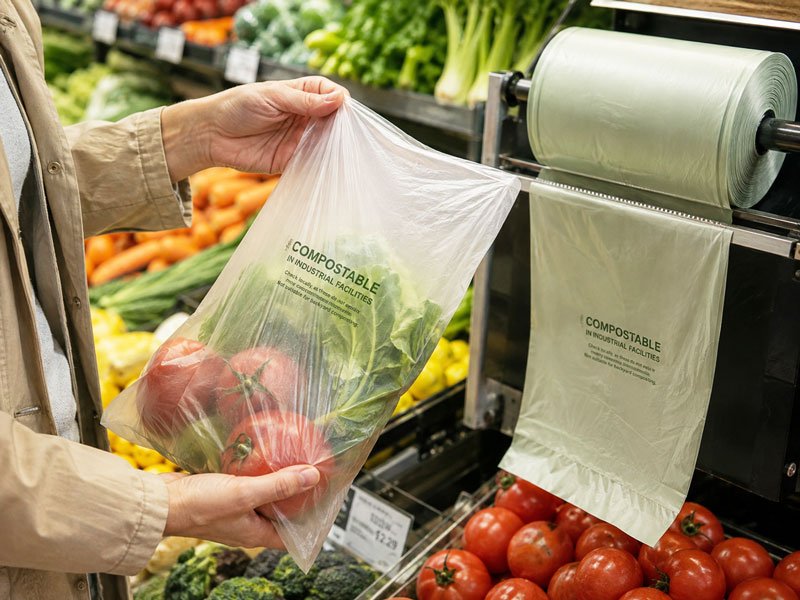
A compostable produce bag can meet the required compostability standard and still look more hazy than another bag.
This matters for supermarket and fresh-produce packaging.
Buyers often want consumers to see the color and condition of the fruit or vegetables inside the bag. At the same time, the film still needs to meet requirements for strength, thickness, roll size, printing and compostability.
So how should you judge compostable produce bag transparency?
The first point is simple:
Compostability and optical clarity are different performance requirements.
A compostability certificate does not tell you how clear a film will look.
And the word “transparent” alone does not tell you enough about film quality.
In this guide, I will explain what haze means, why some compostable films look cloudy, how starch and film structure can affect clarity, and how we recommend comparing samples before approving a bulk order.
If you are already looking for a commercial high-clarity product, see our clear compostable produce bags.
What Does “Transparency” Mean in Compostable Film?
In everyday sourcing, buyers often use words such as:
- clear
- transparent
- high clarity
- low haze
- see-through
These words sound similar.
Technically, however, they do not describe exactly the same thing.
Two useful terms are luminous transmittance and haze.
ASTM D1003 is a standard test method used to evaluate haze and luminous transmittance in transparent plastics. It treats light transmission and wide-angle light scattering as measurable optical properties.
Light Transmittance
Light transmittance describes how much visible light passes through a film.
A film can allow a large amount of light through it but still appear cloudy.
That is where haze becomes important.
What Is Haze?
Haze is linked to light scattering.
Instead of light passing through the film in a clean path, some of it is scattered. This reduces the sharpness of objects viewed through the film.
In practical terms:
More haze usually means a cloudier appearance.
For a laboratory comparison, haze and luminous transmittance can be measured with methods such as ASTM D1003 rather than judged only by eye.
For routine supplier sampling, however, buyers often need a simpler visual comparison before deciding whether formal optical testing is necessary.
I will explain a practical method later in this guide.
Why Do Some Compostable Produce Bags Look Hazy?
There is no single answer.
A compostable blown film may contain more than one polymer or component. Its final appearance can depend on the formulation, how well the different phases work together, the level of crystallization, dispersion and processing conditions.
This is why it is risky to judge clarity only from a material name such as:
PLA
or
PBAT + starch.
Researchers studying biodegradable blends have found that changes in blend morphology and compatibility can affect transparency. Better compatibility can reduce the size of dispersed phases and change the way visible light passes through a film.
PLA also has its own optical behavior. Research has found that PLA can have good optical properties in its glassy state, while crystallization can make it look more hazy.
This means the question should not simply be:
“What material is this bag made from?”
A better B2B question is:
“Does this finished film meet our target for clarity, strength, thickness and compostability?”
The finished bag matters more than one material name.
How Film Formulation Can Affect Produce Bag Clarity
For flexible compostable bags, manufacturers often need to balance several properties.
These may include:
- film strength
- elongation
- sealing
- processability
- cost
- compostability
- thickness
- visual clarity
Changing one part of a formulation can affect another property.
That is why a high-transparency formulation should not be treated as simply a “clearer version” of the same bag.
It still needs to work as a bag.
PBAT
PBAT is widely used in flexible biodegradable and compostable film blends because it provides flexibility and toughness.
But the appearance of a PBAT-based blend depends on what PBAT is blended with and how the phases are distributed.
The final film can therefore look different from another PBAT-based film even when the two products use similar material names.
PLA
PLA can provide useful mechanical and optical properties, but its morphology and crystallization also affect film appearance.
A review of PLA as an optical material notes that crystallization can make PLA more hazy.
So simply increasing PLA does not give a universal recipe for a clear produce bag.
Thermoplastic Starch
Thermoplastic starch, often called TPS, is starch that has been processed so it can be used as a thermoplastic material.
Starch can help increase renewable content and can be used in compostable film systems.
But it may also change optical properties.
A 2024 study comparing PBAT with PBAT/TPS composite films reported a haze value of about 47.4% for pure PBAT, while the tested PBAT/TPS composite films exceeded 96% haze.
That is a large difference.
But there is an important warning for buyers:
This does not mean every starch-containing commercial bag will have 96% haze.
Those figures came from specific laboratory formulations and processing conditions. They show that starch formulation and plasticization can strongly affect optical appearance; they are not a universal specification for all compostable produce bags.
Does Starch Make Compostable Produce Bags Cloudy?
It can contribute to haze, but the correct answer is more complex than “yes.”
The visual result also depends on:
- how the starch is processed
- how well it is dispersed
- polymer compatibility
- blend morphology
- crystallization
- additives
- extrusion conditions
- finished film thickness
The PBAT/TPS study mentioned above found that starch plasticization affected film morphology as well as optical and mechanical performance.
So when a buyer says:
“I need a more transparent compostable produce bag,”
I would not recommend solving the problem only by asking:
“How much starch does it contain?”
That is only one part of the picture.
Ask to see the finished film sample.
Does Film Thickness Affect Transparency?
Yes, thickness can affect how a film looks.
But thinner does not automatically mean clearer.
Optical appearance is also affected by the material structure, crystallinity and the way different components are dispersed through the film. Research on PLA and biodegradable polymer blends shows that film structure and morphology can change haze and transparency even when the base polymer family is similar.
This matters when sourcing produce bags.
Imagine two suppliers both quote:
11 μm compostable produce bags.
The thickness may be the same.
The visual result may not be.
That is why I recommend treating thickness and clarity as two separate approval points.
Thickness answers questions about material use and part of the physical-performance requirement.
Clarity answers a different question:
Can shoppers see the produce well enough for your retail program?
If you are still deciding the correct film gauge, see our compostable bag thickness guide. For produce bags, thickness should later be checked together with bag dimensions, loading, roll diameter and dispenser requirements.
Why Can Two Certified Compostable Bags Look Different?
This is a common source of confusion.
A certification tells you that a product has been assessed against a compostability standard.
It does not mean all certified films have the same:
- transparency
- tensile strength
- thickness
- color
- surface feel
- roll diameter
For example, BPI uses ASTM D6400 as the base standard for commercial compostability assessment of eligible plastic items. BPI describes its compostability assessment in terms such as biodegradation, disintegration and ecotoxicity.
In Australia, the Australasian Bioplastics Association verifies eligible products against AS 4736 for commercial composting and AS 5810 for home composting.
These are compostability requirements.
Optical haze is a different property. ASTM D1003, for example, specifically addresses haze and luminous transmittance in transparent plastics.
So it is possible for two products to meet the same compostability route while showing different optical performance.
For Australian sourcing projects, you can read our separate AS 4736 compostable produce bags guide.
Does Compostability Certification Guarantee Film Clarity?
No.
This distinction is worth putting directly into your RFQ.
A buyer may need both:
Compostability requirement: AS 4736
and
Commercial requirement: higher-clarity film suitable for fresh-produce presentation.
One requirement does not replace the other.
The same principle applies in other markets. The compostability standard defines the relevant end-of-life performance; your product specification defines the commercial performance you expect from the finished bag.
For this reason, we recommend approving the finished bag specification, not just a resin description or certificate.
How B2B Buyers Should Compare Produce Bag Samples
You do not need a laboratory to make the first comparison.
For supplier selection, I recommend using a simple controlled test first.
These checks are not a replacement for ASTM D1003 laboratory measurement. They are practical purchasing checks that can help you decide which samples deserve further testing. ASTM D1003 should be used when you need measured haze and luminous-transmittance values.
1. Compare Samples Under the Same Lighting
Do not compare one supplier’s photo with another supplier’s photo.
Camera exposure, background and lighting can change how clear a film appears.
Instead, place all samples:
- in the same room
- under the same light
- against the same background
Simple, but important.
2. Use Printed Text Behind the Film
Place one layer of film over printed black text.
Use the same font size and the same distance for every sample.
Ask:
Can I still read the small text easily?
Do the edges of the letters look sharp or blurred?
You are not creating an official haze value.
You are creating a repeatable visual comparison.
3. Test the Film with Real Produce
A clear film is being purchased for a reason.
Use it with the product it will actually carry.
Try several colors, such as:
- green vegetables
- tomatoes
- apples
- citrus fruit
Look at color visibility and surface detail through the film.
A sample that looks acceptable on an empty table may perform differently when it is wrapped, folded or placed around real produce.
4. Compare One Layer, Not Only a Folded Sample
This is easy to miss.
If you compare a folded sample, you may be looking through two or more film layers.
That can make the sample appear more hazy than it will when a shopper is looking through one layer at produce.
So record whether you are testing:
one layer
or
multiple layers.
Keep the test condition the same for every supplier.
5. Compare the Same Thickness
Do not compare a very thin sample from Supplier A with a much thicker sample from Supplier B and call it a formulation comparison.
First compare like with like.
For example:
11 μm vs 11 μm
or
your current specification vs the proposed replacement.
6. Check Printing Separately
Printing changes the visual appearance of a bag.
If your final produce bag uses one-color printing, compare:
unprinted film
and
final printed film.
This helps separate film clarity from artwork and ink coverage.
7. Check More Than One Production Sample
One good sample is useful.
Repeatability matters more.
For a long-term supermarket or distributor program, ask how the supplier controls:
- film thickness
- formulation
- color
- printing
- roll dimensions
- batch consistency
If visual clarity is an important buying requirement, put it into the approved product specification.
Do not leave it as:
“Please make the bag clear.”
That is too open to interpretation.
A Simple Produce Bag Clarity Approval Checklist
| Buyer Check | What You Are Checking | Why It Matters |
|---|---|---|
| Visual Clarity | How clearly produce can be seen | Important for retail presentation |
| Haze | Cloudy appearance caused by light scattering | Helps explain why objects look less sharp |
| Light Transmittance | Light passing through the film | Different from haze |
| Film Thickness | μm specification | Should be controlled separately from clarity |
| Single-Layer View | Actual film layer comparison | Avoids misleading folded-sample comparisons |
| Printing | Printed vs unprinted appearance | Ink can change visual presentation |
| Batch Consistency | Repeat production appearance | Important for ongoing supply |
| Certification | Applicable compostability scope | Separate from optical requirements |
For an instrument-based specification, discuss whether a formal haze or transmittance limit should be measured using an agreed method such as ASTM D1003.
When Should Buyers Specify High-Transparency Film?
Not every produce bag project needs the highest possible clarity.
This is where purchasing should stay practical.
Higher clarity may be worth specifying when:
- consumers inspect produce through the bag
- produce color is important to purchase decisions
- the retailer wants an appearance closer to its current conventional film
- the bag is used for premium fresh produce
- your existing customers have already rejected cloudy film
- clarity is part of an approved retail specification
But high transparency should not be treated as the only performance target.
A produce roll also has to run properly.
For roll-packed programs, buyers need to consider bag dimensions, thickness, perforation, core size, roll diameter and dispenser fit at the same time.
See our compostable produce bags on a roll for roll-format and dispenser specifications.
Clarity Is Only One Part of Produce Bag Approval
A very clear bag that tears badly is not a good result.
Neither is a strong bag that does not fit the supermarket dispenser.
For a complete produce bag project, we normally look at several requirements together:
Optical performance
Clarity and haze.
Mechanical performance
Tensile behavior, puncture resistance and tear performance.
Bag conversion
Sealing, perforation and dimensions.
Roll configuration
Bags per roll, roll width, core dimensions and outer diameter.
Printing
Color, registration and coverage.
Compostability
The required certification route for the target market.
Packing
Rolls per carton, carton dimensions, pallet configuration and shipment efficiency.
This is why we prefer to approve a complete specification before mass production.
For a broader view of available formats, see our compostable produce bags wholesale range.
What Should You Put in a Produce Bag RFQ?
If transparency matters, say so before the supplier quotes and samples.
A useful RFQ can include:
- Bag width × length
- Film thickness in μm
- Bag style
- Bags per roll
- Roll width
- Core inside diameter
- Maximum roll outer diameter
- Perforation requirement
- Printing colors
- Required compostability certification
- Transparency or clarity requirement
- Existing reference sample, if available
- Estimated annual or order volume
- Destination market
If your current PE or compostable bag already has the visual appearance you want, send a physical reference sample.
That gives both sides a common target.
For Australian distributors sourcing complete programs, our guide to sourcing compostable produce bags in Australia covers the wider specification and compliance process.
What If I Need a Measured Haze Specification?
Visual testing is useful during early sourcing.
For a formal specification, numbers are better.
ASTM D1003 provides methods for measuring haze and luminous transmittance in transparent plastics.
If clarity is a critical acceptance criterion for your retail program, you can discuss an agreed test method and target with the supplier or an independent laboratory.
This is especially useful when several factories are bidding for the same specification.
Instead of writing:
“High transparency required.”
you may eventually define:
agreed film thickness + agreed optical test method + agreed acceptance limit.
That gives procurement, the supplier and QC teams a clearer standard.
Clear Film Does Not Automatically Mean Better Film
This is probably the most important point in this guide.
A produce bag is a system.
Transparency has to work together with:
strength + thickness + roll design + perforation + printing + certification + cost.
If improving one feature creates a problem somewhere else, the finished specification may not be better.
The right question is therefore not:
“Which film is the clearest?”
It is:
“Which film gives us the clarity we need while still meeting the rest of our commercial specification?”
That is a much better question for B2B sourcing.
FAQ
Can compostable produce bags be transparent?
Yes. Compostable produce bags can be made with good visual clarity, but the result depends on the finished film formulation, thickness, polymer blend and processing conditions.
For B2B sourcing, it is better to compare actual film samples rather than assume that all compostable bags will have the same transparency.
Why do some compostable produce bags look cloudy?
The cloudy appearance is usually related to haze, which occurs when light is scattered as it passes through the film.
Film formulation, polymer compatibility, starch systems, crystallization, dispersion, additives and processing conditions can all affect the final appearance.
This is why two compostable produce bags with the same thickness can still look different.
Does starch make compostable film less transparent?
Starch can increase haze in some compostable film formulations, but starch content alone does not determine clarity.
The final result also depends on how the starch is processed and dispersed, how well the materials work together, the film thickness and extrusion conditions.
For this reason, buyers should evaluate the finished film rather than judge transparency only from the material composition.
Is a thinner compostable produce bag always clearer?
No.
A thinner film may sometimes appear clearer, but thickness is only one factor. Film formulation, crystallinity, polymer morphology, dispersion and processing also affect transparency and haze.
We recommend treating film thickness and visual clarity as separate approval requirements.
What is the difference between haze and transparency?
Transparency describes how clearly you can see an object through the film.
Haze is related to how much light is scattered as it passes through the film.
A film can allow plenty of light through while still looking cloudy if its haze is high. For formal testing, haze and luminous transmittance can be measured using an agreed method such as ASTM D1003.
Does AS 4736 or BPI certification guarantee high transparency?
No.
AS 4736 and BPI certification based on ASTM D6400 relate to compostability requirements. They do not guarantee a particular level of optical clarity.
Two certified compostable produce bags can therefore have different haze, transparency, thickness and physical performance.
If clarity is important for your supermarket or retail program, it should be included separately in the finished product specification.
How should B2B buyers compare compostable produce bag samples?
Compare samples under the same conditions.
Use the same film thickness, lighting and background. Place one layer of each film over printed text and real produce to compare visibility.
It is also useful to check printed and unprinted samples separately and review more than one production sample when batch consistency is important.
Do not compare supplier photos alone, because lighting and camera settings can make one film appear clearer than another.
How can compostable produce bag haze be measured?
For formal specifications, haze and luminous transmittance can be measured using an agreed optical test method such as ASTM D1003.
This is more reliable than using descriptions such as “clear” or “high transparency” when optical performance is an important acceptance requirement.
For an OEM project, buyers can define the film thickness, test method and agreed optical target before mass production.
Need Higher-Clarity Compostable Produce Bags?
If your current compostable produce bag is too hazy for your retail program, start with the finished specification rather than the material name alone.
Send us:
- current bag dimensions
- film thickness
- roll specification
- core dimensions
- printing requirement
- target certification
- a reference film or sample, if available
We can review the specification and prepare samples for comparison before bulk production.
View Clear Compostable Produce Bags
Explore All Compostable Produce Bags
B2B and OEM supply only.