When a buyer asks me:
“What thickness should our compostable produce bag be?”
I normally do not answer with a micron number first.
I ask about the bag size, what it will carry, how many bags are required on each roll, the current dispenser, and what problem the buyer is trying to solve.
That gives us a much better starting point.
A compostable produce bag thickness of 10 μm may work well for one supermarket program and poorly for another.
The correct gauge is part of a complete specification.
It is not the specification by itself.
Is There a Standard Thickness for Compostable Produce Bags?
No single micron value works for every produce bag.
Commercial examples already show this variation.
Novamont states that its compostable fruit and vegetable film can be produced at around 10 μm minimum thickness, while an Australian commercial produce bag from Because We Care is listed at 13 μm. Another supplier shows completed customer projects at 13, 14 and 15 μm.
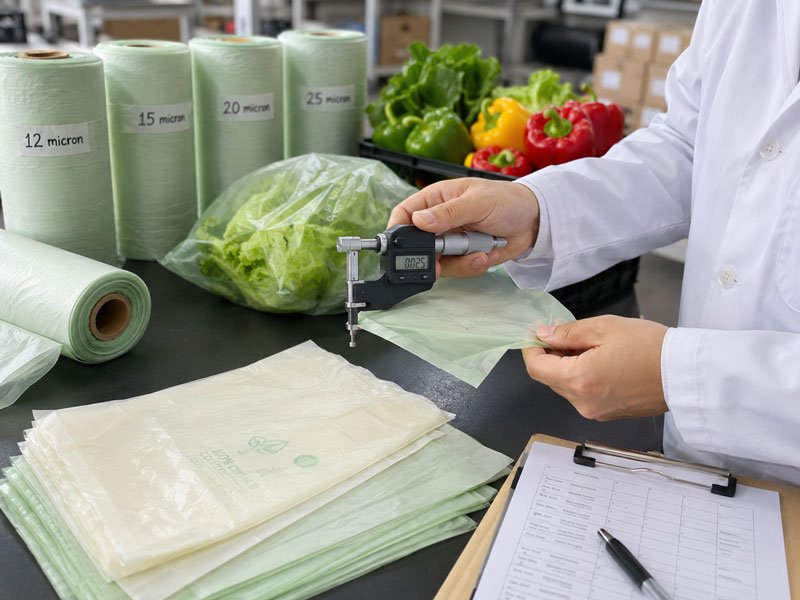
Our own compostable produce bags on a roll currently use the following production reference ranges:
| Bag Format | Starting Thickness Range |
|---|---|
| Flat produce bags on roll | 10–15 μm |
| C-fold produce bags | 12–18 μm |
| Vest / handle produce bags | 15–25 μm |
| Custom OEM produce bags | 10–30 μm |
These are manufacturing reference ranges, not universal industry standards.
The right number still has to be confirmed against the finished bag.
Do Not Treat 15 μm as a Magic Number
Buyers sometimes see 15 μm in regulations and assume it is also a technical recommendation.
It is not.
For example, the EU Packaging and Packaging Waste Regulation defines a “very lightweight plastic carrier bag” as one with a wall thickness below 15 μm. That is a legal classification, not a statement that every produce bag should be 14 or 15 μm.
Your product specification and your regulatory classification are related questions, but they are not the same question.
What Does Produce Bag Thickness Actually Mean?
Film thickness is normally stated in micrometres, written as μm or micron.
One micrometre is:
0.001 mm.
So an 11 μm film is 0.011 mm thick.
For formal thickness measurement of plastic film and sheeting, standards such as ISO 23559 describe mechanical scanning methods.
If you need a basic micron-to-mil conversion, use our compostable bag thickness guide.
For this article, the more important question is what happens after you change that number.
A Practical Thickness Guide for Compostable Produce Bags
There is no single thickness that works for every produce bag.
For supermarket and B2B projects, we normally select the starting gauge according to the bag format, produce load and expected secondary use.
| Produce Bag Type | Practical Thickness Range | ORIZON Starting Recommendation |
|---|---|---|
| Supermarket Produce Bags on Roll | 10–15 μm | 12 or 15 μm |
| Standard Loose Produce Bags | 15–18 μm | 15 μm |
| Bags for Heavier Fruit or Market Use | 18–20 μm | 18 or 20 μm |
| Produce Bags Reused for Food Waste | 20–25 μm | 20 or 25 μm |
| Handle / T-Shirt Produce Bags | 20–30 μm | Based on load requirement |
These ranges are practical starting points for specification development, not universal industry standards.
The finished thickness should still be confirmed through sample testing against the actual bag dimensions, produce load, roll design and end use.
What Do Current Market Products Tell Us?
Commercial products show that compostable produce bags are already made across a fairly wide thickness range.
OrangeBio lists a 15 × 18 inch produce bag at 0.39 mil, or roughly 10 μm, with 500 bags per roll.
Green Paper Products lists a heavier 16 × 19 inch produce bag at 0.6 mil, or roughly 15 μm, and describes it for grocery stores, farmers markets and heavier produce use.
GreenStar BioPackaging lists a customizable produce bag thickness range of 15–25 μm.
At the material level, NUREL states that its INZEA fruit and vegetable bag grades can be processed at less than 15 μm. It also notes that suitable high-viscosity grades can help maintain a stable thickness profile during film production while preserving the mechanical properties needed for cutting and sealing.
These examples show why it is difficult to name one “standard” produce bag thickness.
A better question is:
What is the lowest practical thickness that still meets the buyer’s load, handling, roll and quality requirements?
7 Factors That Should Decide Produce Bag Thickness
1. Bag Size
Start with dimensions.
A 230 × 400 mm bag and a much larger produce bag should not automatically use the same gauge just because they are both called “produce bags.”
A larger bag contains more film area.
It can also be loaded with more produce.
This changes both the material weight per bag and the forces placed on the film during use.
When you send an RFQ, always provide:
width × length + gusset, if any.
Do not send only:
“15 μm produce bag.”
That is not enough information.
2. Produce Load and Shape
Weight matters, but shape matters too.
Leafy vegetables create a different loading condition from:
- apples
- citrus
- potatoes
- onions
- mixed heavy produce
A bag may carry the total weight but still fail when a hard or irregular item presses against a small area of film.
This is why I prefer to test with the actual produce type whenever possible.
Film performance can be measured in several ways. ASTM D882 covers tensile properties of thin plastic films, while ASTM D1709 addresses impact resistance under a falling-dart test. These tests measure different properties, which is another reason “thicker = stronger” is too simple.
3. Film Formulation
Two 15 μm films are not necessarily equal.
That matters with compostable films because formulation and film processing affect:
- flexibility
- elongation
- puncture behavior
- sealing
- feel
- optical appearance
So when comparing Supplier A and Supplier B, do not compare only:
15 μm vs 15 μm.
Compare finished samples.
The material system and manufacturing consistency matter too.
4. Seal and Perforation
A thicker film cannot repair every weak point.
The bag may fail at:
the film
or:
the bottom seal
or:
the perforation.
Those are different failure modes.
ASTM F88/F88M is used to measure seal strength in flexible materials and notes that seal strength is relevant to both package integrity and process consistency.
For produce bags on roll, perforation is equally practical.
Too strong:
customers struggle to tear the bag off.
Too weak:
bags separate before they should.
Thickness has to work with the perforation design.
5. Transparency
Fresh produce is visual.
A supermarket may want shoppers to see the color and condition of the product through the film.
Thickness can affect visual appearance, but it is not the only factor.
Film formulation and structure matter too.
So I recommend keeping:
thickness
and:
clarity
as separate approval points.
If film haze is already a concern in your project, see our Compostable Produce Bag Transparency Guide.
That page explains why two films of similar thickness can still look different.
6. Roll Diameter and Dispenser Compatibility
This is where supermarket projects often become more complicated.
Suppose your existing program requires:
500 bags per roll.
If you increase film thickness but keep:
- bag width
- bag length
- core size
- bags per roll
the same, you are winding more material onto the core.
The finished roll will normally become larger.
If the dispenser has limited space, that may create a problem.
BioBag gives a useful real-world example: one of its fruit and vegetable bag dispensers requires a specially customized roll and is not compatible with its standard produce bags.
So when replacing an existing supermarket roll, measure:
- core inside diameter
- core wall thickness
- roll width
- maximum roll outer diameter
- bags per roll
before finalizing thickness.
Our Produce Bags on a Roll page explains this roll and dispenser specification in more detail.
7. Material Cost
Thickness has a direct relationship with material consumption.
For the same:
- bag dimensions
- film formulation
- density
- construction
film mass is broadly proportional to thickness.
This creates a simple sourcing reality.
Moving from:
10 μm → 15 μm
uses about 50% more film material per same-size bag.
Moving from:
15 μm → 20 μm
uses about 33% more.
That does not mean the final bag price rises by exactly the same percentage.
The final price also includes:
- conversion
- printing
- cores
- cartons
- labour
- production yield
- freight
But raw material use changes substantially.
This is why adding thickness “just to be safe” can become expensive across millions of bags.
Why a Thicker Bag Is Not Automatically a Better Bag
I would be cautious with this specification:
“Our old bag broke, so please add 5 μm.”
First find where it broke.
If the problem was:
poor bottom sealing,
changing film thickness may not solve the root cause.
If the problem was:
bad perforation,
the customer may still struggle with the bag.
If the problem was:
sharp produce puncturing one point,
formulation and puncture performance matter.
And if the bag already performs well at 13 μm, moving to 18 μm simply because the higher number sounds safer may add unnecessary material, cost and roll size.
So I would ask:
What failure are we trying to fix?
That question is more useful than:
How thick can you make it?
How Thickness Changes Roll Diameter and Bags per Roll
A produce roll has limited physical space.
Think of three variables:
Thickness × Bags per Roll × Roll OD
They are connected.
If thickness goes up while the bag count stays fixed:
roll OD normally goes up.
If thickness goes up but maximum roll OD must stay fixed:
bags per roll normally need to go down.
This matters because reducing a 500-bag roll to a lower count may change:
- replenishment frequency
- carton configuration
- warehouse handling
- cost per roll
- store staff workload
So do not approve film thickness independently from roll design.
Your RFQ should treat them as one specification.
A Simple Example
Suppose a supermarket already uses:
250 × 450 mm
250 bags/roll
fixed paper core
fixed dispenser
The buyer asks to change the film from a thinner specification to a thicker one.
Before production, we should check:
Will 250 bags still fit within the allowed roll OD?
If yes, the current format may remain practical.
If no, the buyer has three main options:
reduce bags per roll,
change the core or dispenser,
or:
reconsider whether the extra thickness is actually required.
That is why the cheapest technical change is sometimes not changing thickness.
How Thickness Changes Cost
There is another reason to avoid over-specification.
A large distributor may order hundreds of thousands or millions of bags.
A small increase in film weight becomes a large increase in total resin consumption when multiplied across the program.
I recommend asking suppliers to quote at least two validated gauges when the project is new.
For example:
Option A — lighter specification
and:
Option B — higher safety margin.
Then compare:
- sample performance
- per-bag weight
- roll count
- roll OD
- carton configuration
- unit cost
Do not compare price before confirming that both options actually meet the same use requirement.
Does Thickness Affect Compostability Certification?
This is an important point.
A supplier should not assume that a certified material can be made into an unlimited film thickness and automatically stay within the same certification scope.
BPI explains that finished products and resins are certified up to a maximum thickness, with the tested thickness used to determine the certified maximum for disintegration purposes.
So if you substantially increase film thickness on a BPI-certified product, ask:
Is this finished thickness still covered by the applicable certificate?
The same practical rule applies more broadly:
Confirm the finished product configuration, not only the resin name.
For Australian projects, see our AS 4736 Compostable Produce Bags Guide.
How We Recommend Testing a Produce Bag Sample
Before approving mass production, I recommend testing the actual finished bag.
Not just a film swatch.
Step 1 — Confirm Thickness
Measure multiple points across several bags.
One number from one location does not tell you enough about gauge consistency.
Formal plastic-film thickness can be assessed using recognized measurement methods such as ISO 23559.
Step 2 — Use Real Produce
Load the bag with the same type and approximate quantity of produce expected in the store.
Do not test only with smooth laboratory weights.
An apple and a steel weight may weigh the same but contact the film differently.
Step 3 — Check Film Failure
Look for:
- stretching
- pinholes
- puncture
- tearing
Record where the failure starts.
Step 4 — Check the Bottom Seal
If the film survives but the bottom opens, you may have a seal problem rather than a thickness problem.
Seal performance can be evaluated separately from film tensile or impact properties.
Step 5 — Test the Perforation
Put the roll into the actual dispenser.
Tear off bags repeatedly.
Check whether:
the bag separates cleanly
without:
tearing the next bag.
Step 6 — Check Opening
Thin compostable films can sometimes create handling complaints unrelated to pure strength.
Retail users care about getting the bag open quickly.
Social discussions around produce bags repeatedly show this type of usability concern, including complaints about bags being difficult to open.
So include easy opening in sample approval.
Step 7 — Check Roll OD
Measure the final roll.
Do not assume the new roll will fit simply because the bag dimensions stayed unchanged.
Produce Bag Thickness Sample Approval Checklist
| Check | What to Confirm |
|---|---|
| Thickness | Target μm and acceptable tolerance |
| Bag Dimensions | Width × length × gusset |
| Actual Produce Load | Real product and expected quantity |
| Film Strength | Stretching / tearing |
| Puncture | Irregular or hard produce |
| Bottom Seal | No failure under intended load |
| Perforation | Clean tear from roll |
| Bag Opening | Practical for supermarket customers |
| Clarity | Produce remains visible if required |
| Bags per Roll | Correct count |
| Core | ID and wall thickness |
| Roll OD | Fits existing dispenser |
| Certification | Finished specification remains covered |
What to Put in Your Produce Bag RFQ
A useful supermarket produce bag RFQ should include more than:
“Please quote 15 micron.”
Send your supplier:
- Bag width × length × gusset
- Bag style
- Target film thickness
- Current reference sample, if available
- Typical produce types
- Expected load range
- Bags per roll
- Roll width
- Core inside diameter
- Core wall thickness
- Maximum roll OD
- Perforation requirement
- Printing requirement
- Transparency requirement
- Certification and destination market
- Estimated order or annual volume
If you already have a successful conventional PE roll, sending the current roll and dispenser dimensions can save a lot of trial and error.
Australian distributors can also review our Produce Bag Sourcing Guide for Australia.
The Practical Rule
If you remember one point from this guide, use this:
Choose the thinnest validated specification that reliably meets your real performance requirements. For many standard supermarket produce bag projects, 15 μm is a practical starting point, while 12 μm may be considered for lightweight programs and 18–20 μm where more load margin is required.
Not simply the thinnest possible bag.
And not the thickest bag the factory can produce.
The goal is a finished specification that balances:
performance + store handling + roll compatibility + certification + cost.
That is a better purchasing decision.
FAQ
What thickness should compostable produce bags be?
There is no single standard thickness for every compostable produce bag.
Lightweight flat produce bags may start around 10–15 μm, while larger, handle-style or custom applications may require a higher gauge. The final thickness should be confirmed against bag dimensions, produce load, film performance, roll configuration and dispenser requirements.
Is 10 μm thick enough for a compostable produce bag?
It can be for some lightweight produce applications. Novamont reports fruit and vegetable film applications at around 10 μm minimum thickness. However, a 10 μm specification should still be tested against the actual bag size, produce load, seal, perforation and retail handling conditions.
Is a 15 μm produce bag stronger than a 10 μm bag?
If the material, dimensions and manufacturing conditions are the same, a 15 μm bag contains more film material and may provide more load margin.
However, finished performance also depends on formulation, seal quality, perforation and puncture resistance. Film tensile and impact properties are separate measurable characteristics.
Does bag size affect the thickness I should choose?
Yes.
A larger bag uses more film area and may also be used for a larger produce load. That is why width, length and gusset should be reviewed together with thickness rather than selecting gauge from litre or product category alone.
Does film thickness affect produce roll diameter?
Yes.
If bag dimensions, core and bags per roll remain the same, increasing thickness increases the amount of wound film and normally increases roll outer diameter.
If the dispenser has a fixed maximum roll size, the bag count may need to change.
Does a thicker produce bag cost more?
Usually, yes.
For the same dimensions, material and construction, film material use is broadly proportional to thickness. A thicker specification therefore uses more resin per bag, although the final selling price also includes conversion, printing, cores, cartons and other costs.
Does thickness affect produce bag transparency?
It can affect visual appearance, but thickness is not the only factor.
Film formulation and structure also affect clarity and haze. Buyers should approve thickness and optical appearance separately when produce visibility is important.
Can changing film thickness affect compostability certification?
Yes, potentially.
For example, BPI states that finished products and resins are certified to a maximum thickness determined through disintegration testing. Buyers should therefore confirm that the final requested thickness remains within the applicable certification scope.
Need Help Comparing Produce Bag Thicknesses?
If you are replacing an existing supermarket produce roll, send us:
- current bag size
- current thickness
- roll count
- core dimensions
- roll OD
- dispenser photo or sample
- typical produce load
We can compare suitable specifications before bulk production.
B2B and OEM supply only.