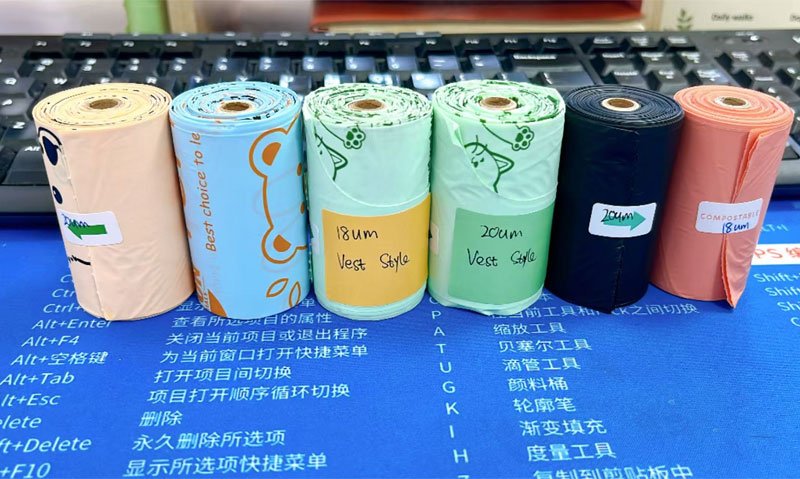
When you order custom dog poop bags, a Pantone color gives your manufacturer a clear color reference. But the final color on compostable film may not look exactly the same as the color on your screen, paper guide, or design file. Material, film thickness, opacity, masterbatch, printing ink, and lighting can all affect the final result.
Why Does Pantone Color Look Different on Compostable Dog Poop Bags?
There are several possible reasons:
- The Pantone reference and the finished film use different substrates.
- The natural color of the film can affect the final shade.
- Film thickness can change opacity and color depth.
- Masterbatch concentration affects the film color.
- Printed ink behaves differently from color built into the film.
- White ink can change how light colors appear on dark film.
- Lighting changes how people see the same color.
- A computer screen does not show the physical film color accurately.
- Normal production variation can affect the final result.
This is why I recommend using a physical sample when the brand color is important.
1. Pantone Is a Color Target, Not a Finished Film Color
Pantone gives buyers and suppliers a common color reference.
For example, a brand may specify:
Pantone 7606 C
That is useful.
But the letter C matters.
In the Pantone Graphics system, C means Coated and U means Uncoated. These references describe how the color appears when printed on different paper surfaces.
A compostable dog poop bag is not coated paper.
It is a flexible film with its own material structure, surface and optical properties.
So I treat the Pantone number as:
the target → not a guarantee of the exact finished-film appearance.
If your brand color is important, the better process is:
Pantone reference → factory color sample → buyer approval → production reference
For the full range of film color, thickness, printing and packaging options, see our Custom Dog Poop Bags guide.
2. The Film Already Has Its Own Base Color
Before we add a custom color, the film itself has an appearance.
Depending on the material and finished construction, compostable film may look:
- Natural
- Slightly milky
- Translucent
- Opaque
- White
- Colored
That base appearance can affect the final custom color.
Think about painting a wall.
The same paint will not look exactly the same on a white wall and a gray wall.
Film color works in a similar way.
This is why compostable film color matching needs to consider the actual film, not only the Pantone number.
3. Masterbatch Can Change the Final Color
A masterbatch is a concentrated color additive used during film production to create a specific film color.
The Pantone number is not the same thing as a masterbatch formula.
When we develop a custom film color, we need to consider:
- Material formulation
- Color masterbatch
- Masterbatch concentration
- Film thickness
- Film opacity
- Production conditions
- Physical color target
Two films can use the same Pantone reference and still produce slightly different visual results if the production conditions are different.
That is why I would not recommend sending only:
“Please make the bag Pantone XXX.”
A better specification is:
Pantone XXX + target film appearance + physical reference where available
This gives the factory more useful information.
4. Does Film Thickness Affect Pantone Color?
Thickness is usually discussed as a strength or cost issue.
It can also affect appearance.
For example, a custom color may look different on:
18 μm film
and
20 μm film
because the amount of material changes the visual opacity and color depth.
The effect depends on the color and film formulation.
I would not say that 20 μm always makes a color darker. That is too simple.
The practical approach is to compare the actual finished samples.
If you are choosing between 18 μm and 20 μm for a private-label product, see our 18 μm vs 20 μm dog poop bags guide for the relationship between thickness, material use, roll diameter and product cost.
5. Film Color and Printed Logo Color Are Different
This is an important distinction in custom dog poop bag production.
There are usually two separate color questions.
Film Color
The color is built into the film during production.
It mainly depends on:
material + masterbatch + film production
Printed Color
The logo or artwork is printed onto the finished film.
It depends on:
ink + film surface + print process + print coverage
For example:
Film: Pantone 7606 C
Logo: Pantone 2252 C
These are two different production requirements.
The film color should not be treated as if it were simply another printed spot color.
For a complete review of size, thickness, film color, printing and packaging options, see our Custom Dog Poop Bags guide.
6. Why Can a Light Logo Look Different on Dark Film?
Suppose you want a cream logo on a dark green dog poop bag.
The logo may not look the same as it does on a white design file.
The film underneath the ink affects what the eye sees.
For some designs, a white ink base may be needed under a light-colored logo.
This can improve contrast and reduce the effect of the dark film underneath.
A simple way to think about it is:
Light logo + dark film ≠ light logo on white paper.
The substrate matters.
This is especially important for:
- White logos
- Cream logos
- Pastel colors
- Light green
- Light blue
- Yellow
- Other light artwork
7. Transparent and Opaque Film Can Look Very Different
Opacity means how much light can pass through a material.
A more transparent film allows more light to pass through.
An opaque film blocks more light and gives the color a more solid appearance.
This can make a large difference for light colors.
For example, a pastel pink may look strong on a white card but much softer on a translucent film.
So when you request a custom color, do not specify only:
Pantone number
Also consider:
Pantone + opacity + film color + thickness
That is a much more useful production brief.
8. Why Does Pantone Look Different Under Different Lighting?
You may look at a sample in your office and think:
“This looks right.”
Then you take it outside.
It looks different.
The factory may not have changed the color.
The lighting changed.
Human vision responds differently under different light sources. Pantone also recommends controlled lighting when accurate color comparison is important.
For an important brand color, I would not approve the sample only from:
- A phone photo
- A computer monitor
- A website screenshot
Use a physical sample whenever possible.
For accurate production approval, the physical reference is much more useful.
9. Do Not Choose the Final Film Color From Your Screen
A digital screen uses light to display color.
A physical Pantone guide is a printed reference.
They are not the same thing.
This creates a common problem.
A designer chooses a color on a monitor.
The factory receives a Pantone number or digital file.
The finished film looks different.
Then both sides think:
“But this is the color we approved.”
The problem started earlier.
If your brand manual specifies:
Pantone XXX C
send that exact reference.
If you have a physical Pantone guide or physical brand sample, tell the supplier.
If you only have a digital reference, tell the supplier that too.
That creates a more realistic expectation.
10. Why Can Two Suppliers Produce Slightly Different Colors?
Even when two suppliers receive the same Pantone reference, their final results may not be identical.
Color depends on the complete production system.
Important variables can include:
- Film substrate
- Film thickness
- Opacity
- Masterbatch
- Ink
- White ink
- Print coverage
- Production settings
- Lighting
- Color measurement method
Pantone itself distinguishes between master standards and dependent standards because the appearance of a color can change when the substrate, printing method or ink system changes.
So I would not judge a supplier only by asking:
“Can you match Pantone?”
A better question is:
“How do you approve and control the color on the actual production material?”
That tells you much more about the process.
11. What Is a Physical Color Reference?
A physical color reference is a real sample that the buyer and supplier agree to use as the visual production target.
It can be:
- A Pantone physical swatch
- An approved film sample
- An approved printed bag
- A previous production sample
- Another physical product used as a brand reference
For a new private-label project, I prefer an actual film sample whenever possible.
The process can be simple:
Pantone reference
↓
Factory color sample
↓
Buyer review
↓
Approved physical reference
↓
Mass production
↓
Repeat-order comparison
This gives both sides something real to compare.
For a complete branded product development process, see our Private Label Dog Poop Bags program.
12. How I Recommend Approving a Custom Film Color
For a B2B project, I would keep the process practical.
Step 1 — Send the Pantone Reference
Give the exact Pantone number.
If you have a physical Pantone guide, use it as the reference.
Step 2 — Confirm the Film
Tell the supplier:
- Material direction
- Thickness
- Desired opacity
- Natural or colored base
- Desired finish
Step 3 — Send a Physical Reference
If your existing product already has the correct brand color, send a physical sample.
This can be very useful.
Step 4 — Develop the Sample
The factory develops the film color based on the target reference.
Step 5 — Compare the Physical Sample
Compare the sample under suitable lighting.
Do not rely only on photographs.
Step 6 — Approve the Reference
Once the buyer approves the physical sample, record it with the product specification.
Step 7 — Use the Same Reference for Repeat Orders
The approved reference should remain with the production file.
This makes repeat production easier to control.
13. What Information Should I Give a Dog Poop Bag Manufacturer?
If you want a better Pantone color matching result, send more than one line of information.
A useful color brief includes:
| Item | What to Provide |
|---|---|
| Pantone | Exact Pantone number |
| Physical reference | Available or not |
| Film color | Natural / green / black / custom |
| Thickness | For example 18 μm or 20 μm |
| Opacity | Translucent or opaque |
| Printing | Unprinted / one-side / two-side |
| Print colors | Pantone or other reference |
| White ink | Required / not required / review |
| Finish | Standard film appearance or specified finish |
| Target market | USA / Europe / Australia / other |
| Sample | Required before production |
The more complete the brief, the fewer assumptions the factory has to make.
For a broader product and production checklist, see our OEM Dog Waste Bags Checklist.
14. Pantone C vs U: Which One Should I Send?
If your brand manual already specifies a Pantone reference, send that exact reference.
For example:
Pantone XXX C
Do not change it to:
Pantone XXX U
just because the final product is plastic film.
C and U describe different appearances on coated and uncoated paper in the Pantone Graphics system.
For a compostable film project, the more important point is:
“This is my brand color reference. Please develop the closest practical result on the specified film.”
If color is especially important, a physical sample is more useful than trying to convert a C reference into a screen color.
15. What About ΔE or Color Tolerance?
You may hear suppliers talk about ΔE.
ΔE is a numerical way to describe the difference between two colors as perceived by the human eye.
Pantone explains that smaller ΔE values represent smaller color differences, while also noting that visual sensitivity varies by color. Pantone uses the newer ΔE2000 method because it is designed to better reflect human color perception.
For most dog poop bag buyers, however, I would not start with:
“What is your ΔE?”
Start with:
“What physical reference will you use for production approval?”
If your project requires instrument-based color control, confirm:
- Measurement method
- ΔE formula
- Lighting condition
- Measurement surface
- Reference standard
- Acceptable tolerance
A number without these details can still be difficult to compare.
16. What Can Cause Color Variation During Mass Production?
Once the first sample is approved, the production process still needs to be controlled.
Color variation can come from normal production variables.
For example:
Raw material
→ affects the base film
Masterbatch
→ affects the film color
Film thickness
→ affects opacity and appearance
Printing
→ affects logo and artwork color
Ink coverage
→ affects printed color
Lighting
→ affects visual judgment
This is why an approved color reference should be part of the production file.
It should not exist only in an email from six months ago.
17. How to Reduce Pantone Color Problems
Here are the practical steps I would use for a new custom dog poop bag project.
1. Give the exact Pantone number
Avoid descriptions such as “dark green” or “similar to our website.”
2. Give a physical sample when possible
Especially when the color is a key part of the brand.
3. Confirm film thickness before color approval
Do not approve the color on one thickness and then change the product later without reviewing the color again.
4. Confirm opacity
A transparent film and an opaque film can present the same color differently.
5. Separate film color from print color
Specify both.
6. Confirm white ink when needed
This is especially important for light artwork on dark film.
7. Approve a physical sample
Do not approve only from a screen.
8. Record the approved sample
Keep it with the production specification for future orders.
These steps are simple.
They can prevent a long discussion after mass production.
18. A Practical Pantone Color Matching Example
Imagine a pet brand wants:
Bag size: 23 × 33 cm
Thickness: 18 μm
Bags per roll: 15
Film color: Pantone 7606 C
Logo: Light cream
The first question is not simply:
“Can you make Pantone 7606 C?”
The better production questions are:
- Is the film natural or opaque?
- What thickness will be used?
- What color masterbatch is required?
- How will the logo be printed?
- Does the cream logo need white ink?
- What physical sample will be approved?
- What reference will be used for repeat production?
Now imagine the buyer changes the film from 18 μm to 20 μm after the color sample has already been approved.
The product has changed.
So the film appearance should be reviewed again before mass production.
This is why color should be controlled together with the product specification.
19. Pantone Color Matching Should Be Part of the OEM Specification
A custom dog poop bag specification is not complete if it only says:
“Green bag with logo.”
A better specification looks like this:
Bag: 23 × 33 cm
Thickness: 18 μm
Film: Custom green
Color reference: Pantone XXX
Opacity: Opaque
Printing: One side
Logo color: Pantone XXX
White ink: Confirmed / not required
Bags per roll: 15
Sample: Physical color approved
Production reference: Approved sample retained
That is much easier for a factory to produce.
It is also much easier for a buyer to check.
If you are still defining the complete product, see our [Custom Dog Poop Bags] guide before requesting the final production quotation.
20. What I Would Not Promise With Pantone Matching
I would avoid a statement such as:
“Your Pantone number will be reproduced exactly.”
Production is not that simple.
A more realistic statement is:
We use your Pantone reference as the target and confirm the final film color through physical sampling and approval.
This gives both buyer and manufacturer a clear process.
It also makes repeat production easier to manage.
Pantone Color Matching FAQ
Can you match Pantone colors for compostable dog poop bags?
Yes. Custom film colors can be developed from a Pantone reference. The final appearance depends on the film formulation, thickness, opacity, masterbatch and other production variables, so a physical sample is recommended for important brand colors.
Why does my Pantone color look different on compostable film?
Pantone references are produced on specific substrates, while compostable dog poop bags use flexible film. Film color, opacity, thickness, material appearance and lighting can change how the color is seen.
Can I use a Pantone C color for compostable film?
Yes, you can provide it as your brand color reference. However, Pantone C describes a coated-paper appearance in the Pantone Graphics system. The final color should be checked on the actual film.
Does bag thickness affect color?
It can affect the visual appearance because thickness can change opacity, transparency and color depth. If thickness changes after color approval, the finished film should be reviewed again.
Does masterbatch affect Pantone color matching?
Yes. Masterbatch is used to create the film color, and its concentration is one of the factors that can affect the final shade and opacity.
Why does my logo look different from the Pantone color on my design file?
The printed logo is affected by the film underneath it, ink, print coverage and white-ink requirements. A digital design file does not show the exact appearance of printed ink on the finished film.
Should I approve a Pantone color from a photo?
For important brand colors, I would not use a photo as the only approval reference. A physical sample viewed under suitable lighting gives a more useful production reference.
What should I send for custom Pantone dog poop bags?
Send the Pantone number, physical reference if available, bag size, thickness, desired opacity, film color, printing colors, artwork and sample requirements.
Need Custom Pantone Dog Poop Bags?
If you are developing a branded dog waste bag, start with the complete product specification rather than the color alone.
We can review:
- Bag size
- Thickness
- Film color
- Pantone reference
- Opacity
- Printing
- Bags per roll
- Roll format
- Retail packaging
- Target market
- Certification requirements
For full product customization, see our [Custom Dog Poop Bags] guide.
For a complete branded retail product, see our [Private Label Dog Poop Bags] program.
If you already have a Pantone reference, send the color number and, where possible, a physical sample.
That gives us a much better starting point for the project.