A B2B Guide to Tack, Peel, Holding Power, Storage Aging and Seal Failure.
A compostable mailer can have suitable film thickness and good tear resistance but still fail as shipping packaging if the adhesive closure does not remain secure.
For e-commerce and fulfilment programs, adhesive performance depends on more than whether the strip feels sticky when the release liner is removed.
The finished sealing system involves:
adhesive + film surface + flap geometry + adhesive width + application pressure + temperature + storage age + parcel load + shipping conditions
A seal that appears strong immediately after packing may behave differently:
- several hours later;
- after warehouse storage;
- inside a warm delivery vehicle;
- under continuous flap tension;
- after prolonged inventory storage;
- when a second adhesive strip is used months later for a customer return.
For this reason, compostable mailer adhesive strength should be evaluated as a finished-packaging performance requirement rather than judged only by initial stickiness.
What Does Mailer Adhesive Strength Actually Mean?
The word “adhesion” is often used as if it describes one property.
In practice, buyers should distinguish at least three different behaviors:
| Adhesive Property | Practical Question |
|---|---|
| Initial tack | Does the strip grab the film quickly when the flap is pressed down? |
| Peel adhesion | How strongly does the bonded strip resist being peeled away? |
| Shear / holding power | Can the bond remain in place under sustained stress without creeping or sliding? |
A mailer can perform well in one area and poorly in another.
For example:
A strip can feel extremely sticky when first applied but slowly lift after several hours under continuous flap tension.
Likewise:
A strip may have moderate initial tack but develop a stable bond once correctly pressed and allowed sufficient contact time.
This is why “very sticky adhesive” is not a complete B2B specification.
Initial Tack: How Quickly Does the Seal Grab?
Initial tack describes how quickly a pressure-sensitive adhesive establishes contact after the flap is pressed against the mailer body.
For fulfilment operations, tack can affect:
- packing speed;
- whether the flap remains in position immediately after sealing;
- edge lifting during handling;
- whether warehouse workers feel the need to press the seal repeatedly; and
- whether bags can move directly to the next packing stage.
Low initial tack may be noticeable when:
- the flap lifts immediately;
- parts of the strip do not contact the film;
- the seal can easily slide after application;
- edges begin separating before the parcel leaves the packing station.
However, high initial tack does not automatically mean strong long-term holding power.
The complete adhesive system still needs to resist shipping and storage stresses after sealing.
Peel Adhesion: How Strongly Does the Seal Resist Opening?
Peel adhesion describes the force required to separate a bonded adhesive strip from the surface when it is pulled away at a controlled angle.
For mailers, this helps answer:
Once the strip has bonded, how easily can the flap be peeled away from the body of the bag?
A very weak peel bond may contribute to:
- flap opening;
- edge lift;
- tamper concerns;
- moisture entry;
- product loss.
But a peel value should not be treated as a complete prediction of real shipping performance.
The finished parcel also experiences:
- sustained tension;
- bending;
- compression;
- temperature changes;
- product movement;
- surface contamination.
For formal adhesive evaluation, peel testing should use an agreed method, substrate, conditioning period and acceptance criteria.
Shear Adhesion and Holding Power
Shear performance is especially important when the adhesive remains under continuous stress.
Imagine a filled mailer where the packed contents push outward against the flap.
The adhesive is not necessarily being peeled directly upward.
Instead, the bonded surfaces may experience continuous force that encourages the adhesive layer to move gradually.
This slow movement is commonly described as:
adhesive creep
A seal with insufficient holding power may:
- appear secure immediately;
- begin moving gradually;
- lift at an edge;
- open partially;
- eventually lose the required seal integrity.
This is why initial tack alone cannot predict whether a mailer will remain closed throughout the shipping cycle.
Tack, Peel and Shear Are Different
A useful way to remember the difference is:
Tack = How quickly does it stick?
Peel = How difficult is it to pull away?
Shear = How well does it resist movement over time?
A practical B2B mailer specification may need all three concepts.
The priority depends on the application.
For example:
High-Speed Fulfilment
Initial tack may be important because warehouse operators need the flap to remain closed immediately after pressing.
Heavy or Bulky Parcel
Holding power may become more important because the packed contents create continuous tension.
Tamper-Evident Outbound Mailer
Peel behavior and finished opening characteristics may become important.
Return Mailer
The second adhesive strip must remain usable after storage, outbound transport, customer possession and first opening.
Why Compostable Mailer Adhesive Seals Fail
A failed seal should not automatically be blamed on “bad glue.”
Several different failure modes can create a similar result.
Common Causes of Mailer Seal Failure
| Failure Factor | Possible Result |
|---|---|
| Insufficient application pressure | Incomplete adhesive contact |
| Dust or contamination | Reduced bonding area |
| Moisture on the surface | Poor initial contact |
| Low application temperature | Adhesive may not wet the surface effectively |
| High service temperature | Adhesive may soften and creep |
| Excessive flap tension | Continuous stress on the bond |
| Overfilled mailer | Seal pulled apart by packed contents |
| Incorrect flap geometry | Adhesive not positioned on a stable surface |
| Adhesive aging | Reduced performance after prolonged storage |
| Film or surface variation | Adhesive interacts differently with the contact surface |
| Incorrect sealing method | Gaps may remain even when the strip itself sticks |
The first step in troubleshooting should therefore be:
Identify how the seal failed.
Not:
Immediately specify stronger adhesive.
Failure Mode 1: The Seal Does Not Stick Immediately
If the flap lifts immediately after sealing, investigate:
- surface cleanliness;
- surface moisture;
- adhesive condition;
- application temperature;
- application pressure;
- liner removal;
- flap position;
- whether the mailer is overfilled.
A pressure-sensitive adhesive requires sufficient contact with the surface.
Simply touching the flap against the film may not create the same bond as applying controlled pressure across the entire adhesive area.
Failure Mode 2: The Seal Holds Initially but Opens Later
This is a different problem.
Possible causes include:
- insufficient holding power;
- adhesive creep;
- continuous flap tension;
- excessive fill ratio;
- elevated temperature;
- bag deformation;
- or a combination of these variables.
If failure occurs several hours after packing rather than immediately, record:
- time to failure;
- warehouse temperature;
- parcel weight;
- packed thickness;
- flap tension;
- adhesive age;
- whether failure begins at one edge or across the complete strip.
This information is more useful than simply reporting:
“The adhesive is weak.”
Failure Mode 3: Only the Edges Lift
Edge lifting can indicate:
- incomplete pressure near the ends of the strip;
- contamination;
- curled flap geometry;
- tension from the packed product;
- insufficient adhesive coverage;
- gradual creep.
Inspect whether the problem begins:
- at both ends;
- at one corner;
- along the full strip;
- only after the parcel has been stored.
Failure location can help identify the likely cause.
Failure Mode 4: The Adhesive Holds but the Film Tears
This is not necessarily an adhesive failure.
If the adhesive remains attached while the surrounding film tears, the weakest part of the closure system may be:
- film thickness;
- local film strength;
- flap geometry;
- perforation;
- opening design;
- excessive force during opening.
The finished mailer should therefore be evaluated as a system:
film + flap + adhesive + opening method
rather than maximizing adhesive strength independently.
Application Pressure Matters
Pressure-sensitive adhesive works by making intimate contact with the surface.
A seal that is lightly touched into place may not behave the same way as one that is firmly pressed along its full width.
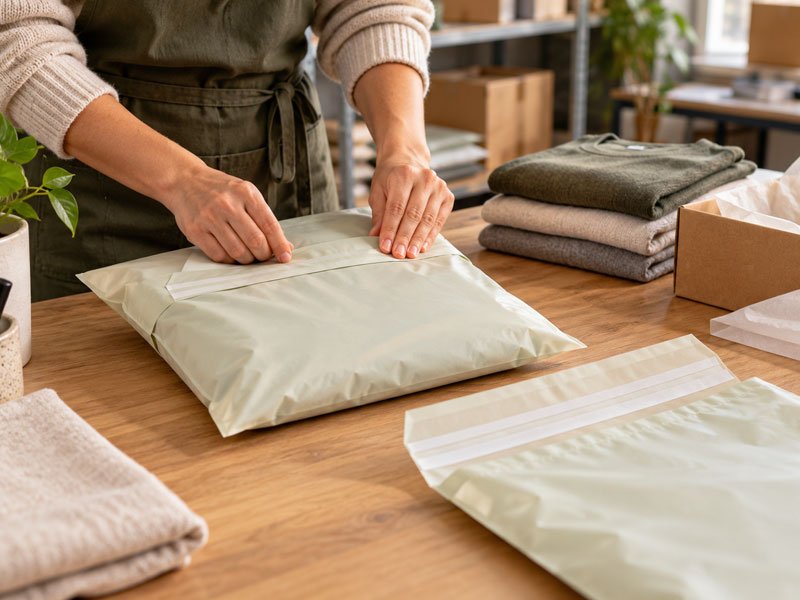
In manual fulfilment, packing procedures should define how the flap is sealed consistently.
For example:
- remove the release liner completely;
- position the flap correctly;
- press across the full adhesive strip;
- avoid wrinkles or folded film under the seal;
- confirm both ends of the strip are in contact.
For high-volume operations, the sealing workflow should be evaluated alongside packing speed.
The strongest adhesive specification is of limited value if operators cannot apply it consistently.
Dwell Time Can Affect the Observed Bond
An adhesive bond may behave differently immediately after application and after remaining in contact for a period of time.
For testing, buyers should therefore define when performance will be evaluated.
Possible checkpoints may include:
- immediately after sealing;
- after a short conditioning period;
- after 24 hours;
- after warehouse storage;
- and after transport simulation.
This helps distinguish:
initial tack performance
from:
longer-term bond stability.
Do not compare two adhesive samples if one is tested immediately and the other is tested after extended dwell time.
Temperature Can Change Adhesive Performance
Temperature affects both the adhesive and the flexible mailer.
Low Temperature During Application
At lower temperatures, some pressure-sensitive adhesive systems may become less able to wet the film surface effectively.
Possible symptoms include:
- weak initial tack;
- incomplete contact;
- edge lifting;
- the need for excessive pressure.
Higher Temperature During Storage or Transport
At elevated temperature, some adhesive systems may soften.
Under continuous stress, this can increase the risk of:
- creep;
- flap movement;
- edge lifting;
- gradual seal opening.
The important distinction is:
Application temperature and service temperature are not the same specification.
A mailer may be sealed in a climate-controlled fulfilment center and later experience a much warmer truck, warehouse or shipping container.
For temperature-sensitive shipping programs, test the finished parcel through the expected temperature range rather than relying only on room-temperature testing.
Humidity and Moisture Can Affect Seal Reliability
Humidity should also be considered as part of the shipping environment.
Moisture can influence:
- the contact surface;
- warehouse conditions;
- packed materials;
- and the long-term condition of compostable film.
Before sealing, the adhesive contact surface should be:
- clean;
- dry;
- free from condensation;
- and free from obvious contamination.
A mailer stored in a humid warehouse and then moved into a cooler area may behave differently from a mailer stored and applied under stable conditions.
For projects shipped through humid or tropical environments, include those conditions in sample evaluation.
Surface Cleanliness Is Part of Adhesive Performance
Adhesive cannot bond effectively to a surface it cannot properly contact.
Potential contaminants include:
- dust;
- powder;
- oil;
- moisture;
- handling residue;
- fibres;
- and manufacturing contamination.
A small amount of contamination may affect only one section of the strip, resulting in partial edge lift rather than complete seal failure.
During quality investigation, inspect both:
- the adhesive surface; and
- the film area receiving the adhesive.
If failure occurs inconsistently within the same carton, contamination or handling should be considered alongside adhesive formulation.
Film Surface and Adhesive Compatibility
The adhesive strip bonds to the mailer film, not to an abstract standard surface.
Changes in the film can therefore affect closure performance.
Relevant variables may include:
- material formulation;
- film color;
- additives;
- surface condition;
- printing near the sealing area;
- film treatment;
- thickness;
- and storage age.
For this reason, adhesive evaluation should be performed using the actual finished mailer film whenever possible.
A laboratory result measured on a standard test panel can be useful for controlled comparison, but the finished-product test remains important for real packaging decisions.
Adhesive Width and Position Matter
Adhesive performance is not only about chemistry.
The geometry of the adhesive strip also affects the sealing system.
Important variables include:
- strip width;
- strip length;
- distance from the flap edge;
- distance from the bag opening;
- flap length;
- body dimensions;
- and whether a second return strip is present.
If the adhesive is positioned too close to a highly stressed fold or an unstable area of the flap, the finished seal may experience unnecessary loading.
For custom mailers, adhesive position should therefore be confirmed together with:
mailer size + flap length + filling method + opening method
before final artwork or mass production.
Overfilled Mailers Can Create Adhesive Failure
One of the most important troubleshooting questions is:
Is the adhesive actually weak, or is the mailer too full?
An overfilled mailer can place continuous outward pressure on:
- the flap;
- adhesive strip;
- film;
- side seams;
- corners.
Even an adhesive system that performs well on a normally filled mailer may behave differently when the parcel is packed under constant tension.
If seals repeatedly fail on one SKU but not another, compare:
- packed dimensions;
- parcel depth;
- parcel weight;
- flap overlap;
- and tension across the closure.
The solution may be a larger mailer rather than a stronger adhesive.
For more guidance on the relationship between parcel dimensions, fill ratio and film performance, see our Compostable Mailer Thickness Guide.
Single-Seal Mailers: Test the Outbound Shipping Cycle
A single self-adhesive mailer normally needs to complete one primary sealing cycle:
packing → sealing → warehouse → carrier handling → delivery
For these projects, buyers should evaluate:
- immediate tack;
- secure flap position;
- holding stability;
- temperature exposure;
- transport vibration;
- and final delivery condition.
The seal should be tested with the real parcel, not only an empty mailer.
For the product structure itself, see our Self-Adhesive Compostable Mailer Bags.
Dual-Seal Return Mailers Need a Different Test
A dual-seal mailer has two adhesive systems serving two different moments.
The first strip may be used immediately at the fulfilment center.
The second strip may remain unused until:
- the first shipment is delivered;
- the customer opens the package;
- a return is required;
- the product is repacked;
- and the second seal is finally activated.
This creates a different question:
Will the unused return adhesive still perform when the customer needs it?
The test should therefore consider:
production → storage → outbound transit → customer holding period → opening → return sealing → second transit
For return-enabled brands, testing only the first adhesive strip does not fully evaluate the packaging system.
See our Dual-Seal Compostable Mailer Bags for the return-mailer structure.
Storage Aging Matters Before the Mailer Is Even Used
Compostable mailers should not be treated as indefinitely stable warehouse stock.
Both the film and the closure system can be affected by:
- time;
- temperature;
- humidity;
- sunlight;
- packaging condition;
- and stock rotation.
The correct storage period should be based on the specific finished mailer and supplier specification rather than a universal industry number.
For B2B programs, record:
- production date;
- batch;
- storage conditions;
- carton opening date where relevant;
- and first-in-first-out inventory sequence.
If stock has been stored for an extended period, repeat a practical sealing check before releasing large quantities into fulfilment.
For broader compostable-film storage guidance, see our How to Store Compostable Bags Correctly guide.
Do Not Assume Every Compostable Mailer Has the Same Shelf Life
Different suppliers publish different storage periods because the finished constructions are not identical.
Variables can include:
- film formulation;
- adhesive system;
- release liner;
- protective packing;
- climate;
- production method;
- and storage conditions.
Therefore:
“Compostable mailers last X months”
should not be treated as a universal engineering rule.
For procurement, ask:
- What is the recommended storage period?
- Under what temperature and humidity conditions?
- Does the recommendation apply to the finished adhesive mailer?
- Is the return adhesive covered by the same storage recommendation?
- What test should be performed on older stock before use?
How to Test Compostable Mailer Adhesive Performance
A useful B2B test program should combine controlled adhesive measurements with finished-mailer evaluation.
1. Immediate Seal Check
Seal the mailer using the intended packing method.
Check:
- complete adhesive contact;
- flap position;
- wrinkles;
- edge lift;
- and immediate opening.
Record how much pressure was applied.
2. Short-Term Hold Check
Leave the sealed mailer under normal packed-product tension.
Inspect again after an agreed conditioning period.
Look for:
- flap movement;
- edge lift;
- creep;
- adhesive transfer;
- and partial opening.
3. Packed-Parcel Test
Use the actual product or a representative load.
The sample should match:
- mailer dimensions;
- film thickness;
- flap;
- adhesive position;
- parcel depth;
- and parcel weight.
An empty-bag adhesive test cannot reproduce the tension created by a filled parcel.
4. Temperature Conditioning
If the shipping route may experience heat or cold, condition samples under the expected project-specific conditions.
After conditioning, evaluate:
- initial opening;
- peel behavior;
- edge lifting;
- holding stability;
- and film condition.
Do not invent one universal temperature test for every mailer project.
Use the buyer’s actual logistics environment or an agreed formal method.
5. Storage-Aged Sample Test
For programs holding several months of inventory, test samples representing aged stock.
Compare:
new production vs stored production
under the same:
- sealing procedure;
- parcel load;
- conditioning;
- and evaluation method.
This can reveal performance changes that cannot be identified from a new sample alone.
6. Return-Seal Test
For dual-seal mailers:
- use the first strip;
- simulate outbound transport and storage;
- open the package normally;
- activate the second strip;
- reseal with the intended parcel;
- test the return cycle.
The second strip should be evaluated as an independent functional requirement.
Tack, Peel and Shear Testing
For formal pressure-sensitive adhesive testing, different methods may be used for different properties.
Examples include:
| Property | What It Evaluates |
|---|---|
| Tack test | Immediate adhesive grab |
| Peel adhesion test | Force required to peel a bonded strip |
| Shear / holding test | Resistance to creep under sustained parallel load |
| Release-liner test | Force required to remove the protective liner |
| Aging test | Change in performance after storage or conditioning |
The exact standard, substrate, specimen dimensions, conditioning method and acceptance value should be agreed before testing.
A numerical peel value from one test setup should not automatically be compared with a value produced using another substrate or method.
For routine B2B development, physical finished-mailer testing should be used alongside any laboratory adhesive data.
Define Pass / Fail Criteria Before Testing
Testing is much more useful when the buyer and supplier agree on the acceptance criteria before the test starts.
Example criteria may include:
| Inspection Point | Example Project Requirement |
|---|---|
| Immediate tack | Flap remains fully positioned after application |
| Edge lift | No unacceptable lifting at agreed inspection time |
| Holding | No progressive seal opening under the agreed packed load |
| Peel behavior | Within the agreed project reference |
| Film around seal | No unacceptable tearing |
| Heat-conditioned sample | Closure remains functional after agreed conditioning |
| Aged stock | Performance remains within approved reference |
| Return strip | Remains usable after simulated outbound cycle |
| Finished parcel | No closure-related product exposure |
These should be treated as project-specific acceptance criteria, not universal ORIZON performance limits.
How to Diagnose a Failed Mailer Seal
If a mailer opens during testing, use the failure pattern to determine the next step.
| What You See | What to Investigate First |
|---|---|
| Seal never grabs | Tack, surface condition, application temperature, pressure |
| One edge lifts | Pressure, flap geometry, contamination, local tension |
| Seal slowly slides | Holding power, heat, creep, parcel tension |
| Full flap peels away | Peel adhesion, surface compatibility, sealing procedure |
| Film tears but adhesive stays | Film/flap strength rather than adhesive |
| Seal works empty but fails filled | Mailer size, fill ratio, parcel tension |
| New stock works; old stock fails | Storage age and warehouse conditions |
| First seal works; return seal fails | Second-strip aging and return workflow |
This approach prevents unnecessary specification changes.
A Stronger Adhesive Is Not Always the Correct Fix
When a seal fails, the natural reaction is:
“Use stronger glue.”
That may not solve the actual problem.
Consider alternatives:
If the parcel is overfilled
Use a larger mailer.
If the flap is under continuous tension
Review flap length and product fit.
If only one corner lifts
Review sealing pressure and geometry.
If failure appears only after heat exposure
Review the service-temperature requirement.
If old stock performs differently
Review storage and stock rotation.
If the film tears before the adhesive releases
Review the film and opening structure.
The objective is not maximum adhesive strength.
It is:
a balanced closure system that remains secure during the intended shipping workflow and opens in the intended way.
How Adhesive Performance Should Be Specified for Repeat Orders
For repeat B2B programs, the adhesive closure should be part of the written product specification.
Consider recording:
| Specification | Information to Confirm |
|---|---|
| Mailer type | Single-seal / dual-seal |
| Flap length | Approved dimension |
| Adhesive strip count | 1 / 2 |
| Strip position | Approved reference |
| Strip width | Approved specification |
| Release liner | Approved configuration |
| Intended use | Outbound / outbound + return |
| Storage conditions | Project-specific |
| Reference sample | Approved sample |
| Seal test | Agreed method |
| Acceptance criteria | Agreed |
| Stock rotation | FIFO where applicable |
This makes repeat production easier to evaluate than using descriptions such as:
“same strong glue as before.”
What Information Should a Buyer Send?
For a compostable mailer adhesive review, provide:
- mailer dimensions;
- film thickness;
- flap length;
- single- or dual-seal requirement;
- parcel type;
- packed dimensions;
- packed weight;
- fulfilment method;
- return requirement;
- expected inventory holding period;
- warehouse conditions;
- shipping climate;
- known seal failures;
- and any required adhesive test method.
If an existing mailer is failing, send:
- photos of the closed parcel;
- photos of the failed seal;
- how long after packing failure occurs;
- temperature/storage information;
- and a physical sample where possible.
A failure sample can often provide more useful information than the statement:
“We need stronger adhesive.”
Adhesive Performance and Compostability Are Separate Questions
Seal performance and compostability certification should not be treated as the same requirement.
A mailer may include:
- compostable film;
- adhesive;
- release liner;
- ink;
- and other finished-product components.
Certification applicability should therefore be confirmed against the applicable current certificate and final finished-product specification.
An adhesive performance test does not establish compostability certification.
Likewise, a compostability claim does not prove that the closure system will meet a particular shipping-performance requirement.
How ORIZON Reviews Compostable Mailer Seal Performance
For a B2B mailer project, adhesive performance should be reviewed together with the complete packaging system:
parcel → mailer size → film thickness → flap → adhesive → packing method → storage → shipping → return workflow
For an outbound self-seal mailer, the focus may be:
application efficiency + immediate tack + holding stability + transport seal
For a dual-seal return mailer, the evaluation also includes:
unused return-strip aging + customer resealing + second shipping cycle
For made-to-spec adhesive position, flap dimensions or return-strip layout, see our Custom Compostable Mailers page.
For standard bulk sourcing formats, see Compostable Mailer Bags Wholesale.
Compostable Mailer Adhesive FAQ
Why does a compostable mailer adhesive seal fail?
Possible causes include insufficient sealing pressure, surface contamination, moisture, temperature, overfilling, flap tension, adhesive aging or unsuitable adhesive-to-film compatibility.
The failure mode should be identified before changing the adhesive specification.
Is initial tack the same as adhesive strength?
No.
Initial tack describes how quickly the adhesive grabs the surface.
Peel adhesion and shear holding power describe different aspects of the bonded seal.
A high-tack adhesive does not automatically have the best long-term holding performance.
Why does a mailer seal hold at first and open later?
This may indicate continuous stress, adhesive creep, high temperature, excessive flap tension or insufficient holding power.
Record how long the parcel remains sealed before failure and under what conditions.
Can heat cause a mailer adhesive to open?
Temperature can affect pressure-sensitive adhesive behavior.
Some adhesives may soften under elevated temperatures, increasing the risk of creep under sustained load.
The relevant application and service-temperature range should therefore be reviewed for the actual project.
Does humidity affect mailer adhesive?
Humidity and surface moisture can affect sealing conditions and long-term packaging performance.
The bonding area should be clean and dry when the seal is applied.
Should I press the adhesive strip after closing the mailer?
Yes.
Pressure-sensitive adhesive requires sufficient contact with the surface.
Press across the complete adhesive strip rather than touching only the center of the flap.
What is peel adhesion?
Peel adhesion is the force required to remove an adhesive strip from a bonded surface at a defined angle and test condition.
It should not be confused with initial tack or shear holding power.
What is shear adhesion?
Shear adhesion describes the adhesive’s ability to resist sliding or creep while it remains under sustained load.
This can be particularly relevant when a filled parcel continuously pushes against the flap.
Can old compostable mailers lose sealing performance?
Storage age and environmental conditions can affect the finished mailer.
Long-held stock should be stored according to the approved product specification and checked before large-scale fulfilment use.
How should dual-seal return mailers be tested?
Test both adhesive strips separately.
The second strip should be evaluated after a simulated outbound cycle because it may remain unused for significantly longer than the first strip.
Should adhesive testing use an empty mailer?
Not only an empty mailer.
The finished parcel should also be tested with a representative product, packed depth, weight and flap tension.
Is the strongest adhesive always best?
No.
The adhesive must work with the film, flap, intended opening method and shipping workflow.
If the adhesive is stronger than the surrounding film, opening may cause film tearing rather than controlled separation.
Test the Finished Seal, Not Just the Adhesive Strip
Reliable compostable mailer closure performance comes from the complete system:
adhesive + film + flap + pressure + parcel load + temperature + storage + shipping workflow
A seal that feels sticky during sample inspection is not automatically proven for e-commerce logistics.
For B2B projects, the better process is:
define the shipping workflow → identify environmental risks → approve the finished mailer → define acceptance criteria → test new and aged samples → lock the approved specification
This approach helps distinguish genuine adhesive problems from problems caused by mailer size, filling, storage or sealing technique.
Review Your Mailer Seal Specification
Send us:
mailer size + thickness + flap + adhesive structure + parcel weight + storage conditions + return requirements
and we can review which closure variables should be evaluated during sample development.