Last reviewed: October 9, 2026
Biodegradable and compostable toilet bags are widely used with camping toilets, portable toilets, RV sanitation systems and temporary hygiene products.
But the most important question comes after use:
How should a used toilet waste bag actually be disposed of?
The answer depends on:
- what is inside the bag;
- the type of bag;
- local sanitation rules;
- campsite or park requirements;
- available waste facilities; and
- whether a composting facility specifically accepts both the bag and its contents.
In many portable sanitation situations, the safest practical approach is to seal the used bag, pack it out and place it in an approved waste collection system according to local rules.
Do not assume that a bag can be flushed, buried, placed in a green bin or sent to compost simply because it is described as biodegradable or compostable.
For the wider waste-handling process, see: Portable Toilet Waste Handling Systems
Quick Answer: How Do You Dispose of Camping Toilet Bags?
For most camping and portable toilet bag systems:
- Remove the bag carefully from the toilet.
- Close or seal the bag securely.
- Use secondary containment if required.
- Keep the bag away from food, water and public areas.
- Pack the waste out of the site.
- Use the waste collection or disposal route approved for that location.
Do not automatically:
- flush the bag;
- bury the bag;
- place it in a compost or green bin;
- leave it outdoors; or
- assume a commercial composting facility will accept human waste.
Local requirements always take priority.
Important ORIZON Certification Scope Notice
This article does not state or imply that ORIZON camping toilet bags, portable toilet liners, human-waste bags or sanitation bags are covered by ORIZON’s current TÜV AUSTRIA, DIN CERTCO, BPI, AS 4736 or AS 5810 certificates.
ORIZON’s existing compostability certifications apply only within the product and specification scopes stated in the relevant certification documents.
Where a toilet-bag project requires certification, the proposed finished product must be reviewed separately before certification claims or conformity marks are used.
For current certificate numbers, product scopes and validity information: ORIZON Evidence & Verification Center
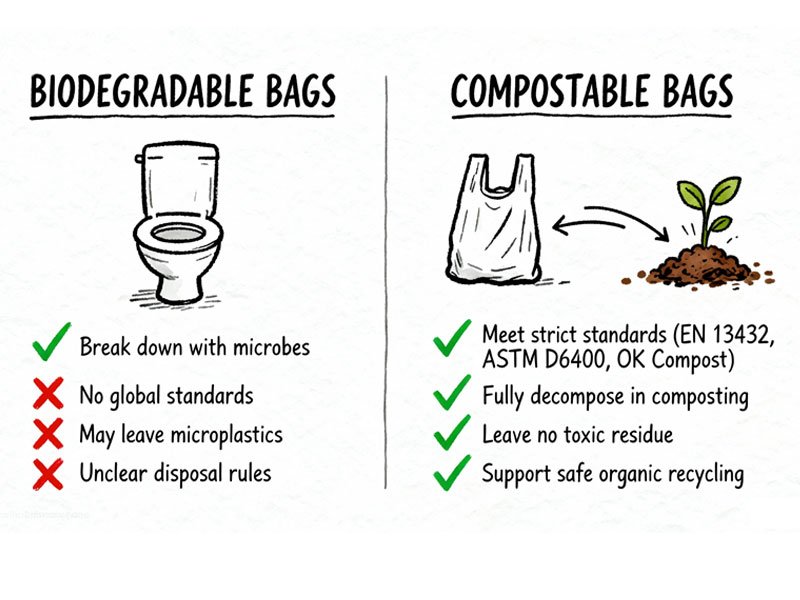
Biodegradable vs Compostable Toilet Bags
Biodegradable vs Compostable Toilet Bags
Before deciding how to dispose of a toilet bag, it is important to understand the claim being made.
What Does “Biodegradable” Mean?
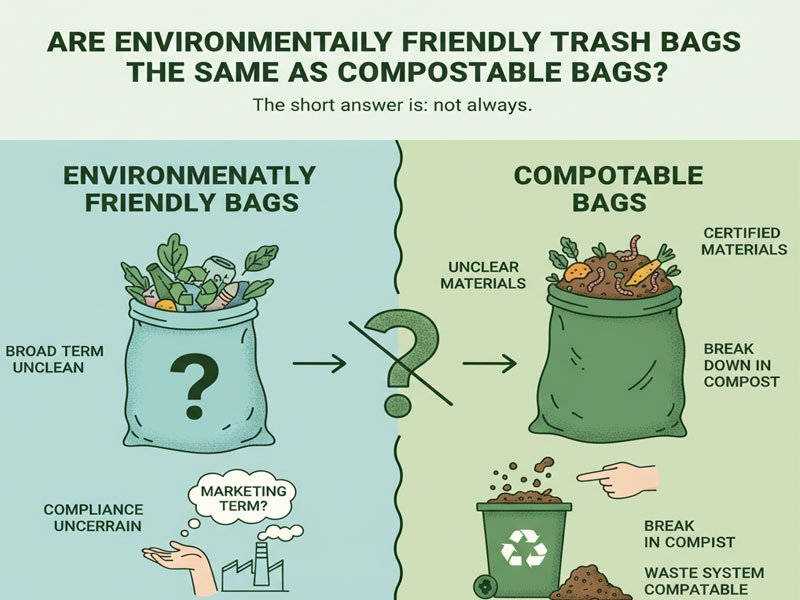
“Biodegradable” is a broad term.
It generally means that a material can be broken down by biological processes under certain conditions.
However, the word alone does not tell you:
- how long degradation takes;
- what environmental conditions are required;
- whether the material is suitable for composting;
- whether the finished bag has been independently tested; or
- what disposal system should be used.
For this reason, a biodegradable claim should not be treated as a disposal instruction.
What Does “Compostable” Mean?
Compostability relates to breakdown under defined composting conditions.
Depending on the product and market, buyers may encounter standards or certification programs relating to industrial or home composting.
However, even where the bag itself has appropriate compostability evidence, the used toilet bag and its contents may still be rejected by a composting facility.
For more information: Are Compostable Toilet Bags Really Compostable?
Can Biodegradable Toilet Bags Be Flushed?
No. Toilet waste bags should not be flushed.
A biodegradable or compostable bag does not behave like toilet paper.
Flushing a toilet bag may:
- obstruct plumbing;
- interfere with pumps;
- create problems in sewage systems; and
- release waste into systems not designed to receive bagged sanitation waste.
The word “biodegradable” should never be interpreted as “flushable.”
Remove the used bag from the portable toilet and follow an approved disposal route.
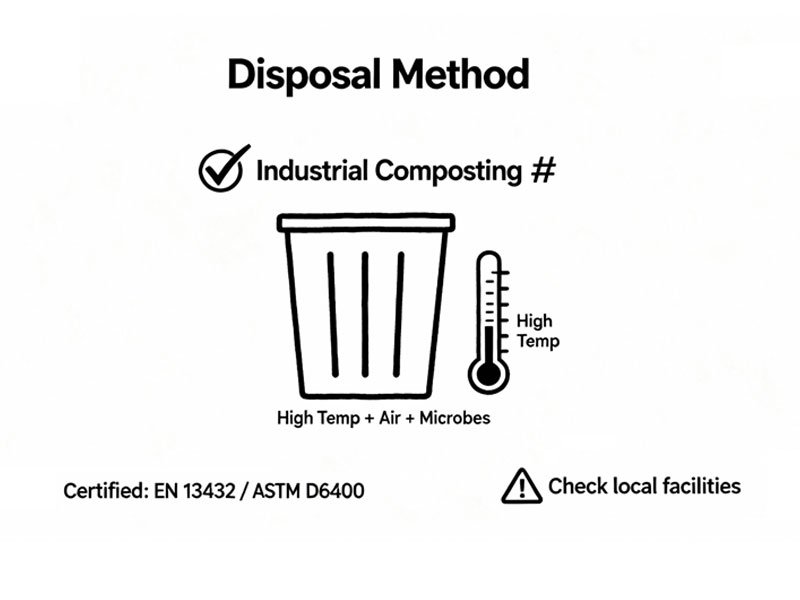
Where Should Biodegradable Toilet Bags Be Disposed Of?
This is the question generating the strongest search visibility for this page.
There is no single disposal route that applies everywhere.
The correct option depends on the site and local rules.
1. Designated Waste Receptacle
Many camping and outdoor sanitation systems are based on a pack-it-out approach.
The used bag is:
- securely closed;
- transported out of the campsite or activity area; and
- placed in an approved receptacle or waste system where permitted.
This is common with human-waste disposal bags used in backcountry and portable sanitation applications.
Always follow:
- campsite rules;
- park instructions;
- event procedures;
- sanitation-provider instructions; and
- local waste requirements.
2. Approved General Waste Route
Where local rules allow it, securely contained toilet waste bags may need to enter an approved general-waste collection system.
Requirements may include:
- a sealed inner bag;
- a second containment bag;
- a dedicated waste container;
- collection by an authorised contractor; or
- disposal at a designated facility.
Do not assume general-waste disposal is permitted in every jurisdiction.
3. Commercial Composting — Only When Specifically Accepted
A compostable bag should not automatically be sent to a commercial composting facility after toilet use.
Before doing so, confirm both:
- whether the facility accepts the particular compostable bag; and
- whether the facility accepts the human waste and every other material inside it.
Contents may include:
- human waste;
- toilet paper;
- absorbent powder;
- gelling agents;
- wipes;
- sanitary products;
- cleaning residues; or
- other materials.
If the facility does not accept the complete waste stream, another approved disposal route is required.
Can Toilet Waste Bags Go in a Green Bin?
Do not assume they can.
A green bin, food-organics bin or municipal organics program may have its own acceptance rules.
Even when a liner itself is compostable, the program may reject:
- human waste;
- sanitation bags;
- pet or toilet waste;
- absorbent products; or
- certain compostable plastics.
Only place a toilet waste bag into an organic-waste or green-bin system where the local program specifically allows both the bag and its contents.
Can Used Toilet Bags Be Home Composted?
In most portable sanitation situations, buyers and users should not assume that used human-waste bags belong in normal home compost.
There are two separate issues:
The Bag
A bag may have evidence relating to home-composting conditions.
The Contents
Human waste introduces separate sanitation and health considerations.
The fact that the empty bag may be suitable for a particular composting environment does not mean that the used bag and its contents are suitable for a household compost pile.
Local health and waste rules should always be checked.
Can You Bury Biodegradable Toilet Bags?
Do not assume that biodegradable or compostable toilet bags can be buried.
Natural soil is not the same environment as a controlled composting system.
Burying a bag may result in:
- incomplete degradation;
- disturbance by wildlife;
- contamination concerns;
- exposure of human waste; and
- violation of local park or environmental rules.
Some outdoor locations allow specific methods for burying human waste itself, while others require all human waste to be packed out.
Those rules should not be confused with permission to bury the waste bag.
For camping, the location-specific rule should always be checked before travel.
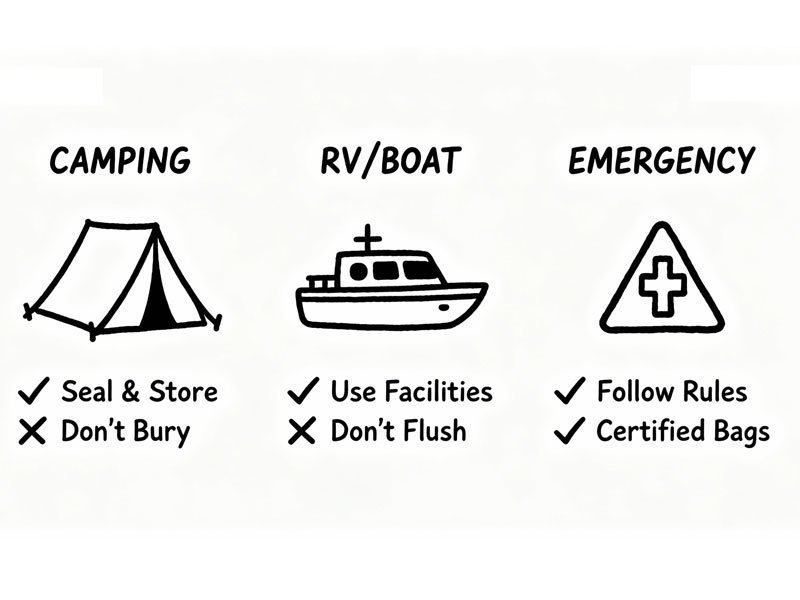
How to Dispose of Camping Toilet Bags
For camping toilet bag disposal, use this basic process.
Step 1 — Check the Local Rule First
Before using a bag-based toilet, identify:
- campsite requirements;
- national or state park requirements;
- local waste restrictions;
- available toilet facilities; and
- whether human waste must be packed out.
Different outdoor areas can have very different rules.
Step 2 — Use the Correct Toilet Bag System
Make sure the liner is compatible with the toilet.
Check:
- bag dimensions;
- film thickness;
- bottom seal;
- liner overhang;
- closure method;
- expected waste load; and
- absorbent material if used.
A bag designed for one portable toilet may not fit another system correctly.
For OEM product development: Compostable Toilet Bags for Camping Brands
Step 3 — Do Not Overfill the Bag
Overfilling increases stress on:
- film;
- seals;
- closures; and
- staff or user handling.
Replace the bag before it reaches its maximum practical load.
Step 4 — Seal the Bag Securely
Depending on the product, closure may involve:
- tying the bag;
- using handles;
- using a drawstring;
- using a separate tie; or
- placing the bag into secondary containment.
The bag should be closed before transportation.
Step 5 — Pack It Out
Do not leave the used bag beside the toilet, campsite or trail.
Place the sealed bag into an appropriate transport or storage container and move it to the approved disposal point.
Step 6 — Follow the Approved Disposal Route
Possible routes may include:
- a designated human-waste receptacle;
- an approved campground waste container;
- an authorised waste collection service; or
- another locally approved disposal system.
Never assume that the word biodegradable or compostable determines the final disposal route.
How to Dispose of Portable Toilet Waste Bags
Portable toilet bag disposal follows the same principle:
contain → seal → store → transport → dispose through an approved route.
For RV, van-life, emergency or temporary sanitation systems, consider:
- how long the bag will remain inside the toilet;
- how much liquid it will contain;
- whether absorbent material is used;
- storage temperature;
- secondary containment;
- transport distance; and
- disposal availability at the destination.
The disposal plan should be decided before selecting the bag.
How to Dispose of Human Waste Bags
Human-waste bags require more care than ordinary household rubbish bags.
Before disposal, confirm:
- that the bag is securely sealed;
- whether secondary containment is required;
- where the bag may legally be placed;
- whether the waste contractor accepts human waste;
- whether the site has a dedicated sanitation-waste point; and
- whether any absorbent or chemical products affect disposal.
If you are searching for “where to dispose of human waste bags near me,” the answer is location-specific.
Check with:
- the campsite or park authority;
- local council or municipality;
- waste-management provider;
- sanitation contractor; or
- facility operator.
What About WAG Bags?
WAG bags and similar human-waste kits are commonly used where people are required to pack human waste out of outdoor areas.
These systems may include:
- an inner waste bag;
- absorbent or gelling material;
- an outer containment bag; and
- closure components.
They should be used and disposed of according to the instructions for the specific product and location.
Do not assume that a WAG bag is compostable simply because it is used outdoors.
Likewise, a compostable toilet bag should not automatically be treated as a WAG bag system.
RV & Caravan Toilet Bag Disposal
Portable bag-based toilet systems may also be used in:
- RVs;
- caravans;
- camper vans;
- off-grid vehicles; and
- temporary mobile sanitation systems.
Used bags should not be flushed into:
- RV wastewater systems;
- marine sanitation systems; or
- ordinary toilets.
Instead:
- remove the bag;
- seal it;
- contain it during transport; and
- use an approved waste-disposal route.
Rules may vary between campgrounds, RV parks, municipalities and countries.
Festival & Outdoor Event Toilet Bag Disposal
Large outdoor events require a more structured waste-handling process.
Event organisers should plan:
- liner replacement frequency;
- staff handling procedures;
- secondary containment;
- temporary storage;
- contractor collection;
- transportation; and
- final disposal.
A festival should not rely on visitors deciding individually how to dispose of used toilet bags.
For detailed planning: Compostable Toilet Bags for Festivals & Outdoor Events
Emergency & Temporary Sanitation
Portable toilet bags may also be used in emergency hygiene and temporary sanitation systems.
In these situations, follow the instructions of:
- emergency-management authorities;
- sanitation providers;
- relief organisations;
- site operators; and
- waste contractors.
Uncontrolled dumping should always be avoided.
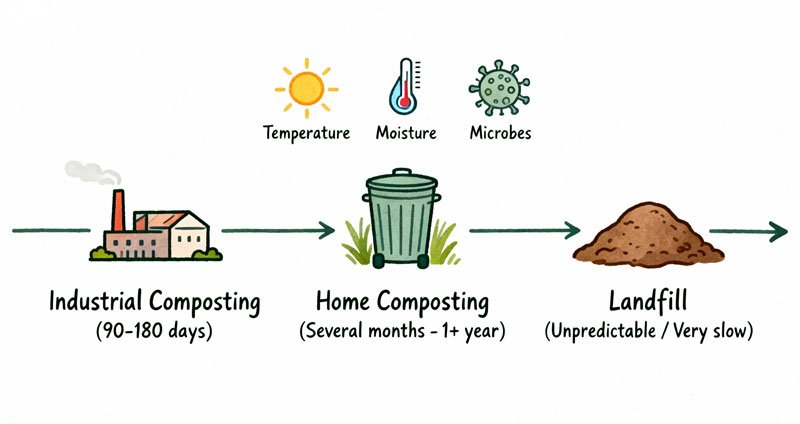
Industrial vs Home Composting: Why the Difference Matters
Industrial and home composting are different environments.
Industrial systems generally operate under more controlled conditions.
Home composting normally has lower and less consistent temperatures.
However, the most important point for toilet-bag disposal is:
Certification of the bag itself does not automatically establish an approved disposal route for the used bag and its contents.
A compostability standard should not be used as a substitute for local waste acceptance rules.
Certification & Disposal Claims
Buyers should separate three questions:
- What is the bag made from?
- What compostability evidence applies to the finished product?
- Where can the used bag legally and practically be disposed of?
These are different questions.
Common compostability standards and certification programs may include:
- EN 13432;
- ASTM D6400;
- BPI certification;
- OK compost INDUSTRIAL;
- OK compost HOME;
- AS 4736; and
- AS 5810.
Important
Mentioning these standards does not mean that ORIZON toilet bags are certified under all or any of these programs.
ORIZON’s current certifications apply only within the product and specification scopes stated in the relevant certification documents.
For ORIZON-specific certification verification: ORIZON Evidence & Verification Center
Raw Material Certification Does Not Automatically Certify the Toilet Bag
A compostable resin, material or film document does not automatically prove that every finished toilet bag is certified.
Finished-product variables can include:
- thickness;
- dimensions;
- sealing method;
- colour;
- masterbatch;
- printing;
- additives;
- perforation;
- roll format; and
- finished-bag construction.
For certification-sensitive B2B projects, buyers should ask:
Does the supporting certificate actually cover this finished toilet bag specification?
This distinction is explained in more detail here:
Are Compostable Toilet Bags Really Compostable?
Common Toilet Bag Disposal Mistakes
Flushing the Bag
Biodegradable does not mean flushable.
Burying the Bag Without Checking Local Rules
Natural soil is not automatically a valid composting environment.
Putting It in a Green Bin Automatically
Municipal organic-waste programs may reject human waste or sanitation bags.
Assuming “Compostable” Means Accepted Everywhere
A composting facility controls what materials it accepts.
Ignoring the Waste Inside the Bag
The contents affect disposal just as much as the liner.
Leaving Used Bags Outdoors
Used sanitation bags should be packed out or moved to an approved collection system.
Relying Only on a Certification Logo
Certification scope and local waste acceptance should both be confirmed.
Disposal Guide by Use Case
| Application | Recommended First Step | Key Disposal Consideration |
|---|---|---|
| Camping | Check park or campsite rules | Pack-out requirements may apply |
| Backcountry / hiking | Check land-manager guidance | Human waste may need to be packed out |
| Portable toilet | Confirm toilet and waste system | Use an approved collection route |
| RV / caravan | Check campground or local rules | Do not flush the bag |
| Festival / event | Confirm contractor plan | Centralised collection is preferable |
| Emergency sanitation | Follow official instructions | Use designated collection points |
| Home composting | Check local sanitation rules | Do not assume used human-waste bags are acceptable |
| Commercial composting | Contact receiving facility | Confirm acceptance of both bag and contents |
What B2B Buyers Should Confirm
Brands, distributors and sanitation-product buyers should define disposal requirements before mass production.
Confirm:
- product application;
- toilet system;
- bag dimensions;
- thickness;
- seal structure;
- expected waste load;
- absorbent material;
- destination market;
- disposal instructions;
- environmental claim;
- required documentation; and
- packaging wording.
Disposal instructions on retail packaging should reflect the real waste route available to users.
Avoid vague instructions such as:
“Dispose anywhere — biodegradable.”
or:
“Simply compost after use.”
Instead, use wording that reflects actual local acceptance requirements.
How ORIZON Supports Portable Sanitation Projects
ORIZON supports OEM and private-label manufacturing for portable sanitation and camping toilet bag projects.
Available manufacturing options may include:
- custom dimensions;
- custom thickness;
- star or flat seals;
- perforated rolls;
- compact rolls;
- film colour;
- custom printing;
- retail packaging;
- multilingual packaging; and
- export cartons.
Certification Is Reviewed Separately
Manufacturing capability does not mean that a toilet-bag product is automatically covered by ORIZON’s existing compostability certificates.
Where certification is required, the proposed finished product should be reviewed separately before claims or certification marks are used.
For OEM camping projects:
Compostable Toilet Bags for Camping Brands
For current certification information:
ORIZON Evidence & Verification Center
FAQ About Camping & Portable Toilet Bag Disposal
How do you dispose of camping toilet bags?
Check the rules for the campsite, park or outdoor area first.
Where a pack-out system is required, securely close the used bag, carry it out of the site and place it in the designated waste receptacle or other approved disposal system.
Do not automatically bury or compost the bag.
How do you dispose of portable toilet waste bags?
Remove the bag from the toilet, seal it securely, use secondary containment where required and follow the waste route approved for that location.
The correct disposal method may vary between campgrounds, councils, parks and sanitation systems.
Where do you dispose of human waste bags?
Use a designated human-waste disposal point, approved waste receptacle or other locally authorised system.
If you are unsure, contact the campsite, park authority, municipality or waste-management provider.
Can compostable toilet bags go in a green bin?
Only where the local organics program explicitly accepts both the compostable bag and the toilet waste inside it.
Do not assume that a compostability claim means the used bag belongs in a green bin.
Can biodegradable toilet bags be buried?
Do not assume they can.
Rules for burying human waste vary by location, and permission to bury human waste does not automatically mean a waste bag can also be buried.
Are ORIZON toilet bags TÜV AUSTRIA certified?
This page does not claim that ORIZON camping toilet bags, portable toilet liners or human-waste bags are TÜV AUSTRIA certified.
ORIZON’s current TÜV AUSTRIA certificates apply only within their stated certified product scopes.
A toilet-bag product requiring certification must be reviewed separately.
Can used toilet bags be commercially composted?
Only where the receiving facility confirms that it accepts the specific bag and the complete waste stream inside it.
Do not assume that commercial compostability of a material automatically means a used human-waste bag will be accepted.
Conclusion
Safe toilet-bag disposal depends on more than whether the bag is described as biodegradable or compostable.
For camping and portable sanitation, the safest planning sequence is:
Check local rules → use the correct bag → seal it → pack it out → use the approved disposal route.
Do not automatically:
- flush;
- bury;
- home compost;
- place in a green bin; or
- send human-waste bags to a commercial composting facility.
The correct disposal method depends on the location, sanitation system, contents and receiving waste facility.
Need a Custom Portable Toilet Bag?
Send us your bag size, thickness, quantity, application and destination market.
Request OEM Quote
https://orizonbags.com/contact-compostable-bags-supplier/