Usually, used nappy bags should not be assumed to go into compost bins.
Even when the bag itself is compostable.
That sounds confusing at first.
But the reason is simple: the bag and the used nappy are not the same product.
A compostable nappy bag claim applies to the bag material under specific conditions. A used disposable nappy inside the bag may still need general waste disposal, depending on local rules.
For baby-care brands, this is not only a waste question.
It is a packaging wording question.
If your retail box says the wrong thing, users may think the whole used product can go into compost. That can mislead people and create trouble for retailers, councils, waste processors, and your brand.
This guide explains how to separate the bag material claim from the used nappy disposal instruction.
For bag specifications and wholesale options, visit our compostable nappy bags wholesale product page.
A Clear Answer for Brands
A used nappy bag means a nappy disposal bag after it contains a used disposable nappy.
That is different from an empty compostable nappy bag.
An empty compostable nappy bag may be designed to break down under certain composting conditions.
But a used nappy bag contains hygiene waste.
That waste may include human waste, absorbent gel, plastic layers, adhesives, and other mixed materials.
So the safe answer is:
Do not tell users to put used nappy bags into compost bins unless the local waste service clearly accepts them.
The European Commission explains that compostable plastics are a subset of biodegradable plastics and usually decompose in industrial composting facilities after they are collected. It also notes that terms such as biobased, biodegradable, and compostable can confuse consumers if they are not clearly explained.
This is why packaging language matters.
What Does “Used Nappy Bag” Mean?
In this article, a used nappy bag means a disposal bag after a used disposable nappy has been placed inside.
It does not mean:
- An empty compostable nappy bag
- A baby changing bag
- A diaper backpack
- A travel tote
- A clean retail pack
It means the bag is now holding used nappy waste.
That changes the disposal question.
The empty bag may have one claim.
The used waste inside may have another disposal route.
This is the part many packaging pages miss.
To understand the empty bag material claim first, read our guide: are compostable nappy bags really compostable.
Why a Compostable Bag Claim Is Not the Same as Used Nappy Disposal
The bag material claim and the waste disposal instruction should be separated.
They answer different questions.
| Item | What It Means | What Brands Should Check |
|---|---|---|
| Empty compostable nappy bag | The bag material may compost under specific conditions | Material, thickness, printing, and certification scope |
| Used nappy inside the bag | Hygiene waste with mixed materials | Local waste rules and processor acceptance |
| Retail packaging instruction | What users should do after use | Clear wording, no overclaiming |
For example:
A bag may be industrial compostable.
But the used disposable nappy inside may still need to go into general waste.
That is not a product failure.
It is a disposal rule issue.
For private label brands, the packaging should make this clear.
If you are comparing claim wording, read our biodegradable vs compostable nappy bags guide.
Why Many Composting Systems May Reject Used Nappies
Many composting systems are built for accepted organic waste streams.
Used disposable nappies are different.
They may contain:
- Human waste
- Absorbent gel
- Plastic film
- Nonwoven layers
- Adhesives
- Elastic parts
- Fragrance or lotion residues
- Other mixed materials
These materials can create contamination concerns for some composting systems.
That is why brands should not assume that used nappies are accepted.
Rules can vary by country, city, council, and waste processor.
A simple packaging claim such as “compostable nappy bags” does not answer the full disposal question.
You still need to ask:
Where will the user dispose of the bag after it contains a used nappy?
Home Compost, Industrial Compost and FOGO Are Not the Same
Many people use these words together.
But they are not the same.
Home compost
Home compost means a small compost system at home.
The temperature is usually lower.
The process is less controlled.
The result can vary from one home to another.
Industrial compost
Industrial compost means a managed facility.
The facility can control heat, moisture, airflow, and time.
Many compostable packaging claims are linked to industrial composting conditions.
FOGO
FOGO means Food Organics and Garden Organics.
It is used in some Australian waste systems.
But FOGO acceptance rules can vary by local council and waste processor.
A home compostable bag does not automatically make the used nappy home compostable.
An industrial compostable bag does not automatically mean the used nappy can go into FOGO.
For more detail on the bag itself, see our home compostable nappy bags guide.
For Australian projects, review our compostable nappy bags wholesale Australia guide before printing FOGO or compost wording.
What Brands Should Say on Packaging
Packaging wording should be clear, careful, and easy to understand.
I would avoid wording like this:
| Avoid Saying | Why It Can Be Risky |
|---|---|
| Compost anywhere | It does not explain the composting condition |
| Safe for all compost bins | Local systems may not accept used nappies |
| Throw used nappies into compost | This may be wrong in many areas |
| Fully biodegradable waste | It can make the whole used product sound biodegradable |
| Naturally disappears after use | Too broad and hard to support |
| Eco-friendly disposal | Vague and not specific enough |
A safer direction is more specific:
| Safer Direction | Why It Is Better |
|---|---|
| Follow local disposal rules | It does not assume local acceptance |
| Bag made with compostable material | It keeps the claim on the bag |
| Compostability applies to the bag under specified conditions | It explains the condition |
| Used nappies may not be accepted by composting systems | It separates bag claim from waste disposal |
| Do not place used nappies in compost unless accepted by your local waste service | It gives a clear user instruction |
The ACCC says its environmental claims guide is meant to help businesses provide clear, accurate, and trustworthy information to consumers about environmental performance under Australian Consumer Law.
For nappy bags, that means the claim should not make the whole used product sound easier to compost than it really is.
Packaging Example Wording
The exact wording should be reviewed by your team, retailer, or local compliance adviser.
But these examples show a safer direction.
Conservative wording
Bag made with compostable material. Please dispose of used nappies according to local waste rules.
More detailed wording
Compostability applies to the bag under specified conditions. Used disposable nappies may not be accepted by composting systems. Check local disposal rules before placing in compost or organics bins.
Retail box wording
For used nappy disposal. Do not place used nappies in compost bins unless accepted by your local waste service.
Short pack instruction
After use, follow local waste disposal rules. Compostability applies to the bag only under specified conditions.
These examples are less dramatic than “eco-friendly disposal.”
But they are clearer.
That is usually better for a retail baby-care product.
What Private Label Brands Should Check Before Printing
Private label brands should check the disposal wording before artwork approval.
Do not wait until the box is ready to print.
Check these points first:
- Target country
- Local council or waste processor rules
- Bag compostability claim
- Home vs industrial compost claim
- Certification scope
- Certification logo permission
- Used nappy disposal instruction
- Warning wording
- Retailer requirements
- Barcode and claim placement
- Artwork proof
The UK Green Claims Code says environmental claims should be truthful, accurate, clear, not hide important information, and be supported by evidence. It also notes that claims can appear in words, symbols, colours, logos, graphics, and product names.
That is why small packaging details matter.
A leaf icon, green colour, or compostable logo can all shape what users believe.
For branded products, review our private label compostable nappy bags guide before artwork approval.
When to Link Disposal Wording Back to Product Specification
Disposal wording should not be written in isolation.
It should match the product specification.
For compostable nappy bags, the claim may depend on:
- Material
- Bag thickness
- Bag size
- Bag format
- Printing
- Ink coverage
- Colour
- Fragrance
- Additives
- Certification scope
- Target market
For example, a thicker bag may need a different review than a thinner bag.
A printed bag may need a different review than an unprinted bag.
A home compost claim may need different support than an industrial compost claim.
For certification scope and standards, see our compostable nappy bag certifications guide.
Compost Bin vs Landfill
Compost bins and landfill are not the same.
Composting is an active process.
It needs the right moisture, air, microbes, time, and temperature.
Landfill often lacks the same conditions.
So a compostable nappy bag should not be described as if it will simply disappear in landfill.
That can create another misleading impression.
If your market asks about landfill disposal, read our do compostable nappy bags break down in landfill guide.
Common Mistakes to Avoid
I see a few common mistakes in nappy bag packaging.
The first mistake is saying “compostable nappy bags” and then implying used nappies can go into any compost bin.
Those are different questions.
The second mistake is using broad words like “green,” “natural,” or “eco-friendly” without explaining the disposal condition.
The third mistake is putting a compostability logo on the box before checking the certificate scope and logo-use rules.
The fourth mistake is copying disposal wording from another market.
Waste rules vary.
The fifth mistake is hiding the disposal instruction in tiny text.
Users need clear guidance.
If the product is for retail, the wording should be easy to find.
Source Compostable Nappy Bags for Private Label
If you are developing compostable nappy bags for private label, start with the full product and packaging plan.
A useful inquiry should include:
- Bag size
- Thickness
- Bag format
- Colour
- Printing needs
- Retail packaging type
- Certification requirement
- Disposal wording target
- Destination market
- Shipping term
- Target order quantity
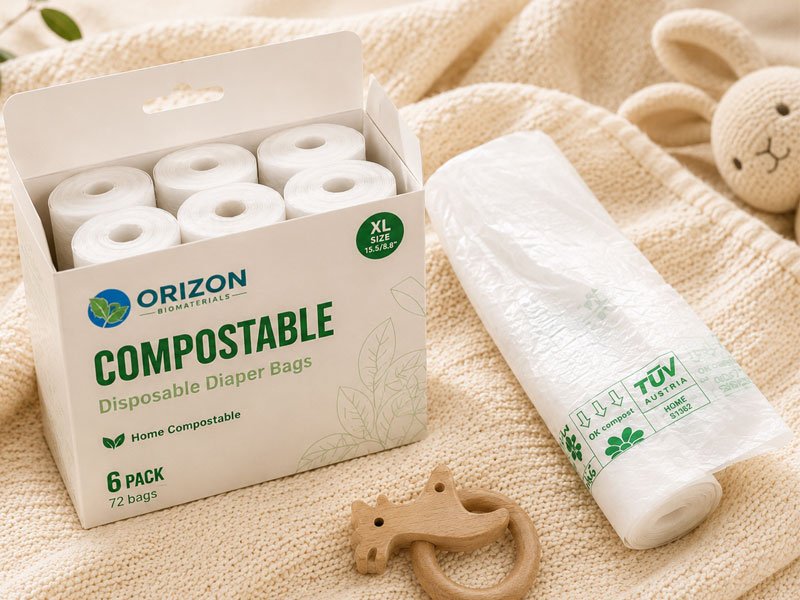
ORIZON supports compostable nappy disposal bags, private label packaging, custom printed nappy bags, sample review, and certification document support for overseas buyers.
For bag specifications and wholesale options, visit our compostable nappy bags wholesale product page.
FAQ
Can used nappy bags go into compost bins?
Usually, used nappy bags should not be assumed to go into compost bins. A compostable bag claim applies to the bag material under specific conditions, but the used disposable nappy inside may not be accepted by composting systems.
Can used nappies go into FOGO bins?
Do not assume they can. FOGO rules vary by local council and waste processor. Brands should check local rules before printing FOGO disposal instructions on nappy bag packaging.
Are compostable nappy bags home compostable?
Some may be, but only if they are designed and supported for home composting conditions. A home compostable bag does not automatically make the used nappy inside home compostable.
Does a compostable bag mean the used nappy is compostable?
No. The compostable claim applies to the bag material and its conditions. The used disposable nappy inside may contain mixed materials and may need general waste disposal.
What should brands say on nappy bag packaging?
Brands should use clear wording. For example: “Bag made with compostable material. Please dispose of used nappies according to local waste rules.”
Can private label brands print compostable claims?
Yes, but the claim should match the product specification, certification scope, target market, and disposal instruction. Artwork should be reviewed before printing.
What should buyers check before printing disposal instructions?
Buyers should check the target market, local waste rules, home or industrial compost claim, certification scope, logo permission, used nappy disposal instruction, and retailer requirements.
Are compost bins and landfill the same?
No. Compost bins and landfill have different conditions. A compostable bag is designed for composting conditions, not for uncontrolled landfill disposal.