Many dog poop bag OEM projects are delayed for a simple reason.
The factory can make the product, but the product details are not fully confirmed before sampling or mass production.
The bag size may be approved, but nobody confirms whether the size includes the handles.
The buyer may choose 15 bags per roll, but the finished roll diameter is not checked against the dispenser.
The retail box may be designed before the final roll size is known.
A digital proof may be approved even though nobody has tested the seal, perforation or actual film color.
Small gaps become expensive after printing plates, packaging and production have started.
This dog poop bag OEM checklist helps pet brands, distributors, importers and e-commerce sellers confirm the main product and packaging details before mass production.
It covers:
- Product specifications
- Film thickness and color
- Bag printing
- Roll structure
- Samples
- Retail packaging
- Quality control
- Carton packing
- Shipping
- Repeat-order records
Brands looking for a complete manufacturing service can also review our private label compostable dog poop bags page.
Start With the Target Market and Sales Channel
Do not start with the bag color.
Start with the market.
The destination country and sales channel can affect the product claim, certification, packaging text, barcode, shipping carton and final cost.
Confirm the destination market
State where the product will be sold.
Common markets include:
- United States
- Canada
- European Union
- United Kingdom
- Australia
- New Zealand
- Other regional markets
The destination market may affect:
- Compostability standards
- Certification logo requirements
- Packaging claims
- Required language
- Size units
- Import documents
- Local labeling rules
- Disposal instructions
Do not assume that artwork prepared for one market can be used in another market without review.
Confirm the sales channel
The same bag may need different packaging for different channels.
Common channels include:
- Amazon FBA
- Pet stores
- Supermarkets
- Brand websites
- Subscription boxes
- Distributor wholesale
- Commercial refill programs
An Amazon seller may need a barcode, FNSKU and specific carton labels.
A pet-store brand may focus more on shelf display, box size and front-panel claims.
A distributor may prefer bulk cartons and local repacking.
A commercial buyer may not need a full-color retail box at all.
Market and channel checklist
- Destination country confirmed
- Sales channel confirmed
- Target customer confirmed
- Target retail price considered
- Certification needs reviewed
- Barcode requirements reviewed
- Local packaging statements reviewed
Define the Bag Size Correctly
Bag dimensions should be written clearly.
Do not use only a product photo or a competitor listing.
Confirm the flat bag dimensions
The specification should state:
- Bag width
- Bag length
- Side gusset, if any
- Handle dimensions, if applicable
- Whether the total length includes the handles
- Whether the stated length includes the sealed area
A common retail dog poop bag size is about 9 × 13 inches, or 23 × 33 cm.
That does not make it the correct size for every product.
Consider:
- The target dog size
- The opening width
- The usable internal length
- Space needed for tying
- The dispenser size
- The retail-box dimensions
- The target price
- The number of bags per roll
Larger bags may be useful for large-dog products or bags with handles.
Smaller bags may reduce material use, but they may also be harder for some customers to use.
Check the usable length
The stated bag length may not equal the full usable length.
The bottom seal, tear line or handle area may reduce the space available for waste collection and tying.
Ask the supplier to show the measurement method on a drawing.
Confirm the finished roll dimensions
A flat bag can match the specification while the finished roll does not fit the intended dispenser or box.
Confirm:
- Roll height
- Roll diameter
- Core inner diameter
- Core outer diameter
- Core width
- Maximum dispenser cavity
I would not approve the final retail-box size until the finished roll dimensions are known.
Bag-size checklist
- Bag width confirmed
- Bag length confirmed
- Measurement method shown
- Gusset confirmed
- Handle dimensions confirmed
- Usable length reviewed
- Roll height confirmed
- Maximum roll diameter confirmed
- Dispenser compatibility checked
- Retail-box fit checked
Buyers comparing different structures can review our custom dog poop bags options.
Select Thickness Based on Performance
Thickness is important.
It is not the only measure of quality.
A dog poop bag must work as a finished product. Film formulation, seal strength, perforation and production consistency also affect performance.
Common thickness options
Private label dog poop bags may be produced in different thicknesses, such as:
- 15 microns
- 18 microns
- 20 microns
- 25 microns
The correct choice depends on:
- Bag dimensions
- Film formulation
- Seal design
- Puncture resistance
- Opacity
- Bags per roll
- Roll-diameter limit
- Target market
- Customer expectations
- Target price
A higher micron number does not automatically mean a better product.
For example, an evenly produced 18-micron bag with a stable seal may perform better than a thicker bag with poor sealing or uneven film.
Test the complete bag
A buyer should test more than the stated micron value.
Useful checks include:
- Ease of opening
- Hand feel
- Opacity
- Stretch
- Puncture resistance
- Seal strength
- Leakage
- Tear-line performance
- Ease of tying
- Finished roll diameter
When comparing a new sample with an existing product, send the physical reference sample to the factory where possible.
The stated specification alone may not explain the full product feel.
Thickness checklist
- Target thickness confirmed
- Finished sample tested
- Seal strength checked
- Leakage checked
- Opacity checked
- Ease of opening tested
- Tear line tested
- Roll diameter reviewed
- Customer-use test completed
Confirm the Bag Format and Seal
The product brief should clearly state the bag structure.
Do not write only “dog poop bags on rolls.”
Flat-top roll bags
Flat-top bags have a straight opening and are commonly supplied on perforated rolls.
They are compact and suitable for many retail and refill products.
Confirm:
- Opening width
- Bottom-seal type
- Perforation
- Roll direction
Star-sealed bags
A star seal gathers the film at the bottom and forms a sealed base.
The seal should be tested for:
- Strength
- Leakage
- Consistency
- Film gathering
Flat-bottom bags
Flat-bottom bags use a straight bottom seal.
They may be selected for:
- Specific product designs
- Printing layouts
- Manufacturing requirements
- Different bag-opening preferences
Dog poop bags with handles
Handle bags provide built-in tying points.
They may be easier for some customers to close, but they also change:
- Total bag dimensions
- Film weight
- Roll structure
- Roll diameter
- Packaging size
- Unit cost
The specification must state whether the quoted size includes the handles.
Perforation and tear line
The tear line is easy to overlook.
Check:
- Perforation position
- Tear strength
- Tear direction
- Whether the next bag is damaged
- Whether several bags pull out together
- First-bag access
A perforation that is too weak may separate during packing.
A perforation that is too strong may make the roll difficult to use.
Bag-format checklist
- Bag format confirmed
- Seal type confirmed
- Seal position confirmed
- Perforation position confirmed
- Tear performance approved
- Handle dimensions confirmed
- First-bag access reviewed
- Roll direction confirmed
Confirm Bags per Roll, Core and Roll Structure
The number of bags per roll affects more than the product count.
It can change the roll diameter, box size, dispenser fit and shipping weight.
Bags per roll
Common options include:
- 10 bags per roll
- 15 bags per roll
- 20 bags per roll
- Custom roll counts
Before increasing the roll count, check:
- Roll diameter
- Box dimensions
- Dispenser capacity
- Roll weight
- Retail pack weight
- Cost per roll
Adding more bags may sound like a simple value increase.
It may require a different box and dispenser.
Paper core or coreless roll
Confirm whether the product uses:
- Paper core
- Coreless winding
- Custom core dimensions
For a paper core, provide:
- Core inner diameter
- Core outer diameter
- Core width
- Core material
- Whether the core extends beyond the roll
Core dimensions may matter when the roll is used in a fixed dispenser.
Winding direction
The winding direction affects how the first bag appears and how printed artwork faces the customer.
Confirm:
- Printed side facing inward or outward
- First-bag position
- Tear direction
- Bag opening direction
- Artwork orientation
Roll-structure checklist
- Bags per roll confirmed
- Paper core or coreless confirmed
- Core inner diameter confirmed
- Core outer diameter confirmed
- Core width confirmed
- Winding direction confirmed
- First-bag position confirmed
- Roll diameter tested
- Dispenser fit approved
Confirm Film Color and Opacity
Film color affects branding, printing and product appearance.
Common options include:
- Green
- Black
- Natural shades
- Custom colors
Use a Pantone reference
For a custom film color, provide:
- Pantone reference
- Physical color sample, where available
- Desired opacity
- Desired finish
- Packaging reference
- Competitor sample or photograph
A Pantone number is a production reference.
It does not mean compostable film will look exactly the same as coated paper.
The final appearance may change because of:
- Film thickness
- Material formulation
- Opacity
- Lighting
- Photography
- Ink printed over the film
Confirm opacity
Some brands want a more opaque bag.
Others prefer a lighter or more natural appearance.
State the requirement before sampling.
Do not use color alone to describe opacity.
White ink on dark film
A light logo may not appear clearly on green, black or another dark film.
White ink may be needed under the printed color.
Without a white base, the logo may look dull, transparent or affected by the bag-body color.
Color checklist
- Pantone reference supplied
- Physical sample supplied where possible
- Opacity level confirmed
- Finish discussed
- White ink requirement confirmed
- Print color reviewed on the selected film
- Color tolerance discussed
- Physical color sample approved where required
Prepare the Bag Printing Artwork
Printing should be reviewed before the supplier gives a final quotation.
The number of print colors and print sides can affect plate cost, setup and MOQ.
Confirm the print structure
State whether the bag will be:
- Unprinted
- Printed on one side
- Printed on two sides
- Printed with the same design on both sides
- Printed with different designs on each side
Also confirm:
- Number of print colors
- Logo size
- Print position
- Repeat distance
- Print direction
- Film color
- White underprint
Supply editable artwork
Preferred file types include:
- Adobe Illustrator
- EPS
- Editable PDF
- Vector logo files
A JPG or PNG may help the supplier understand the design.
It is normally not the best final production file.
Review the repeat distance
The artwork repeat should work with:
- Bag length
- Perforation position
- Seal position
- Bag orientation
- Printing direction
A logo should not be cut by the perforation or placed too close to the bottom seal.
Printing plates and setup
Printing plates may be required for each print color or design area.
Confirm:
- Number of plates
- Plate cost
- Whether plates can be reused
- Plate-storage period
- Cost of artwork changes
- Whether two-side printing needs extra plates
For more detail, review our guide to custom printing for compostable bags.
Printing checklist
- Editable artwork supplied
- Print sides confirmed
- Number of print colors confirmed
- Pantone ink references supplied
- White ink confirmed
- Logo dimensions confirmed
- Print position confirmed
- Repeat distance confirmed
- Print direction confirmed
- Plate cost confirmed
- Final artwork version approved
Review Certification and Packaging Claims
Compostability claims should be reviewed before artwork approval.
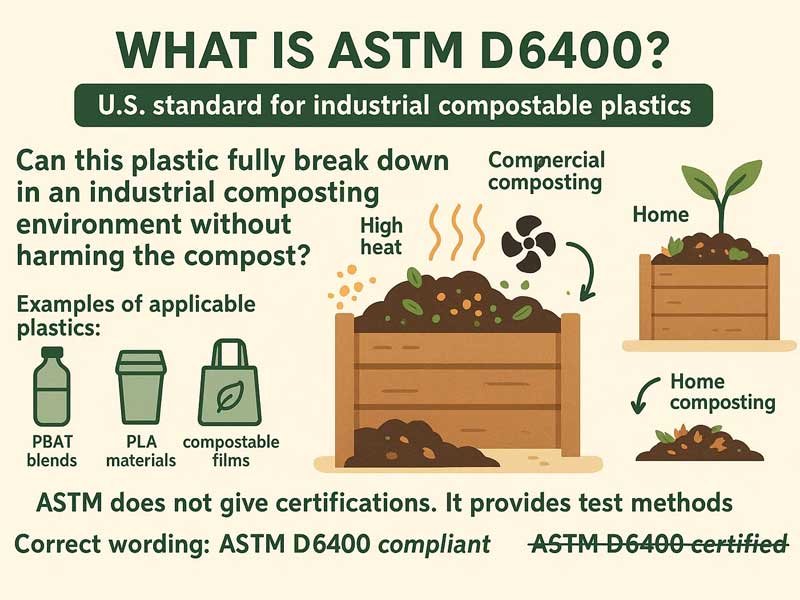
ASTM D6400 covers plastics and products designed for aerobic composting in municipal or industrial facilities. It also establishes requirements used when identifying and labeling products for those conditions.
BPI manages separate commercial-only and commercial-and-home compostability certification schemes. Its certification system also includes specific processes for sublicensing and use of the BPI mark.
This means a certification logo should not be added simply because the raw material supplier has a certificate.
Before approving the artwork, confirm:
- Destination country
- Intended compostability claim
- Applicable standard
- Finished-product certificate scope
- Certificate holder
- Logo-use permission
- Sublicense requirement
- Required wording
- Minimum logo size
- Clear-space requirement
- Disposal instructions
Avoid vague claims
“Biodegradable” and “compostable” are not the same claim.
A biodegradable statement may not explain:
- Which standard was used
- What conditions are required
- How long the process takes
- Whether third-party certification exists
- Whether the claim is allowed in the destination market
Define the required environmental claim before the packaging is designed.
Certification checklist
- Destination-market rules reviewed
- Applicable standard confirmed
- Finished-product scope checked
- Certificate holder confirmed
- Logo-use permission confirmed
- Sublicense requirement reviewed
- Packaging wording approved
- Disposal wording reviewed
- Final artwork checked before plate production
Choose the Retail Packaging Structure
Retail packaging must fit the actual rolls.
Do not complete the box design before confirming the roll diameter, roll height and dispenser dimensions.
Printed retail box
A box may contain:
- Individual rolls
- Multipacks
- Rolls with a dispenser
- Subscription sets
- Gift sets
Confirm:
- Rolls per box
- Roll arrangement
- Box dimensions
- Box style
- Board material
- Printing method
- Opening method
- Barcode location
- Certification marks
- Product statements
- Export-carton quantity
Paper sleeve
Paper sleeves may suit simple multipacks.
They can use less board than a full box, but they must still hold the rolls securely during handling and transport.
Check:
- Sleeve width
- Sleeve tension
- Roll movement
- Barcode position
- Product information space
Printed or transparent outer bag
Outer bags may be used for:
- Roll multipacks
- Refill packs
- E-commerce products
- Promotional kits
Confirm:
- Outer-bag material
- Size
- Seal
- Warning text
- Barcode
- Closure
- Product visibility
Bulk carton
Bulk packing may suit:
- Distributors
- Local repacking
- Commercial customers
- Refill programs
Confirm:
- Rolls per inner pack
- Rolls per carton
- Inner protection
- Carton weight
- Carton dimensions
- Shipping marks
Dispenser-kit packaging
When the retail set includes a dispenser, confirm:
- Dispenser dimensions
- Dispenser shape
- Leash clip
- Logo
- Color
- Product arrangement
- Empty space
- Box strength
- Separate dispenser MOQ
A dispenser may have a different MOQ from the bag rolls.
Packaging checklist
- Retail pack type confirmed
- Rolls per pack confirmed
- Roll dimensions confirmed
- Dispenser dimensions confirmed
- Internal arrangement tested
- Box style approved
- Barcode location confirmed
- Certification statements reviewed
- Master-carton quantity confirmed
- Carton gross weight estimated
Decide Which Sample You Actually Need
Not every sample answers the same question.
Choose the sample type based on what you need to confirm.
Existing stock sample
A stock sample may help you check:
- Material feel
- Common thickness
- Bag opening
- Seal structure
- Perforation
- Roll format
It normally cannot confirm:
- Final custom color
- Final logo printing
- Final roll count
- Final retail packaging
Custom unprinted sample
A custom unprinted sample may confirm:
- Bag size
- Thickness
- Seal style
- Perforation
- Bags per roll
- Core
- Finished roll dimensions
It does not confirm the final printed appearance.
Custom printed sample
A printed sample may help check:
- Logo appearance
- Print position
- Film and ink combination
- White ink
- Repeat distance
- Print direction
Printing plates or setup charges may apply.
Packaging prototype
A packaging prototype may confirm:
- Box dimensions
- Product arrangement
- Dispenser fit
- Artwork placement
- Barcode position
- Opening method
A digitally printed prototype may not look exactly like mass-produced offset or flexographic packaging.
It is still useful for checking structure and layout.
Pre-production sample
A pre-production sample may be used to confirm the final setup before mass production.
The approval record should state:
- What has been approved
- Which sample is the reference
- Which tolerances still apply
- Whether any item remains pending
| Sample type | What it can help confirm | Main limitation |
|---|---|---|
| Stock sample | Material, seal, perforation | Does not match the full custom product |
| Custom unprinted sample | Size, thickness, roll structure | Does not confirm final printing |
| Custom printed sample | Bag print and color combination | Does not represent every mass-produced unit |
| Packaging prototype | Box size and product arrangement | May use a different printing process |
| Pre-production sample | Final approved setup | Production tolerances still apply |
Understand What a Digital Proof Can Confirm
A digital proof is useful.
It is not a physical product.
A digital proof can confirm:
- Text
- Logo position
- Print direction
- Artwork repeat
- Barcode location
- Bag count
- Roll count
- Box statements
- Certification-mark position
- Basic color references
A digital proof cannot fully confirm:
- Actual film color
- Film hand feel
- Opacity
- Printed ink appearance
- Roll diameter
- Perforation feel
- Seal strength
- Leakage resistance
- Box strength
A digital proof approves the layout.
It does not replace a physical product test.
Create a Pre-Production Approval Checklist
Before production starts, bring the final information into one approved specification sheet.
Do not leave important details across:
- Chat messages
- Voice notes
- Separate emails
- Old quotations
- Different artwork files
Product approval
- Bag width
- Bag length
- Thickness
- Bag format
- Seal
- Perforation
- Film color
- Opacity
- Bags per roll
- Core
- Roll height
- Roll diameter
Printing approval
- Artwork version
- Print sides
- Number of colors
- Pantone references
- White ink
- Logo position
- Repeat distance
- Print direction
Packaging approval
- Rolls per pack
- Box, sleeve or outer bag
- Dispenser
- Barcode
- Certification marks
- Product statements
- Carton quantity
- Carton marks
Commercial approval
- Order quantity
- Unit price
- Plate cost
- Sample cost
- Packaging cost
- Payment terms
- Lead time
- Shipping term
- Delivery destination
Our broader OEM manufacturing pocess explains how these approvals connect with sampling, production and export preparation.
Quality Control Checklist for Mass Production
Quality control should follow the approved specification.
A general statement such as “good quality” is not enough.
Film and bag QC
Check:
- Bag width
- Bag length
- Thickness
- Individual bag weight
- Film color
- Opacity
- Surface condition
Seal and perforation QC
Check:
- Seal position
- Seal strength
- Leakage
- Tear-line position
- Tear consistency
- Separation between bags
- Damage to the next bag
Finished-roll QC
Check:
- Bags per roll
- Roll height
- Roll diameter
- Core dimensions
- Winding
- First-bag access
- End-of-roll condition
Printing QC
Check:
- Logo position
- Repeat distance
- Print clarity
- Ink adhesion
- Missing print
- Color comparison
- One-side or two-side accuracy
- White-ink coverage
Retail-packaging QC
Check:
- Rolls per pack
- Dispenser quantity
- Box dimensions
- Barcode
- Artwork version
- Certification wording
- Pack closure
- Product arrangement
Export-carton QC
Check:
- Packs per carton
- Carton dimensions
- Net weight
- Gross weight
- Shipping marks
- Carton strength
- Pallet plan where required
Not every project needs the same inspection plan.
The checks should match the product, sales channel and order value.
Confirm Production Tolerances
Mass-produced products normally have reasonable manufacturing tolerances.
The buyer and supplier should agree on the applicable limits before the order is approved.
Possible tolerances include:
- Bag-width tolerance
- Bag-length tolerance
- Thickness tolerance
- Bag-weight tolerance
- Print-position tolerance
- Color tolerance
- Roll-diameter tolerance
- Carton-weight tolerance
- Quantity tolerance
Do not assume that the digital design file represents a zero-tolerance physical product.
Ask the supplier to state the production tolerances that apply to the project.
Where one dimension is critical, such as maximum roll diameter for a dispenser, identify it clearly in the approved specification.
MOQ and Cost Checklist
MOQ is not based on one factor.
What affects MOQ?
The private label dog poop bag MOQ may depend on:
- Bag size
- Thickness
- Film color
- Printing
- Number of SKUs
- Bags per roll
- Rolls per pack
- Retail packaging
- Certification
- Total film weight
Different specifications may not be combined into one MOQ without factory approval.
For example:
- Green and black bags may require separate production.
- Two different thicknesses may be separate specifications.
- Two print designs may need different plates.
- Retail boxes may have their own MOQ.
Items with separate MOQs
Confirm whether the following have separate minimum quantities:
- Custom printed bags
- Custom film color
- Printed retail box
- Printed outer bag
- Paper sleeve
- Custom dispenser
- Dispenser logo
- Display carton
Costs that may be missed
An early unit price may not include every project cost.
Check:
- Printing plates
- Custom sampling
- Packaging prototype
- Barcode labels
- Dispenser
- Export carton
- Pallet
- Inspection
- International shipping
- Customs
- Local delivery
For more detail, review our OEM MOQ an lead time guide.
MOQ and cost checklist
- Bag MOQ confirmed
- MOQ unit clearly defined
- Packaging MOQ confirmed
- Dispenser MOQ confirmed
- Plate cost confirmed
- Sample cost confirmed
- Carton cost included
- Pallet cost checked
- Shipping term confirmed
- Local charges considered
Confirm the Lead Time and Launch Schedule
Production does not normally begin when the first inquiry is sent.
Before production starts, the project may need:
- Quotation approval
- Deposit
- Final specification
- Final artwork
- Plate confirmation
- Sample approval
- Packaging approval
- Certification review
Work backward from the launch date
Use the required warehouse-delivery date as the starting point.
Then plan backward:
- Warehouse delivery
- Customs and local delivery
- International shipping
- Mass production
- Retail-packaging production
- Sample approval
- Artwork preparation
Shipping time is separate from production time.
A 25-day production period does not mean the cartons will arrive at the customer’s warehouse in 25 days.
Allow extra time for:
- Artwork changes
- Sample approval
- Peak seasons
- Customs
- Port delays
- Warehouse appointments
Lead-time checklist
- Required warehouse date confirmed
- Production lead time confirmed
- Packaging lead time confirmed
- Sample time included
- Artwork time included
- Shipping time included
- Customs and local delivery included
- Peak-season risk considered
Packing, Carton and Shipping Checklist
Carton planning should begin before the final order is packed.
The packaging structure affects freight cost, handling and warehouse acceptance.
Confirm:
- Retail packs per carton
- Rolls per carton
- Carton dimensions
- Net weight
- Gross weight
- Carton material
- Shipping marks
- Pallet use
- Pallet dimensions
- Maximum carton weight
- Destination port or warehouse
- Trade term
Common trade terms
The quotation may use:
- EXW
- FOB
- CIF
- DDP
The buyer should understand which costs are included.
Do not compare an EXW price with a DDP price as though they represent the same delivery scope.
Amazon and e-commerce projects
Where applicable, confirm:
- FNSKU
- Unit barcode
- Carton label
- Unit dimensions
- Unit weight
- Carton quantity
- Carton weight
- Case-pack rules
- Warehouse address
- Current platform requirements
Platform requirements can change. The buyer should provide the current instructions before final packing.
Packing and shipping checklist
- Packs per carton confirmed
- Carton dimensions confirmed
- Net weight confirmed
- Gross weight confirmed
- Carton material approved
- Shipping marks approved
- Pallet requirement confirmed
- Maximum carton weight checked
- Trade term confirmed
- Delivery location confirmed
- Platform labels supplied
Lock the Specification for Repeat Orders
A repeat order should follow an approved specification.
It should not depend on memory or an old email thread.
Keep a controlled record of:
- Product code
- Bag width
- Bag length
- Thickness
- Material formulation
- Film color
- Pantone reference
- Printing file
- Printing plates
- Bags per roll
- Core dimensions
- Roll dimensions
- Packaging artwork
- Carton quantity
- Carton dimensions
- QC requirements
When the product changes, create:
- A new version number
- A new approval date
- A clear change record
- Updated artwork where required
This helps prevent an informal change from becoming a production mistake.
Common Dog Poop Bag OEM Mistakes to Avoid
1. Choosing thickness without testing the finished bag
Micron value alone does not confirm seal strength, opacity or customer experience.
2. Confirming the flat bag size but not the roll size
The bag may be correct while the roll is too large for the dispenser or box.
3. Designing the retail box too early
The box should follow the confirmed product arrangement.
4. Expecting the same Pantone result on film and paper
Different materials can show the same reference color differently.
5. Forgetting white ink on dark film
A pale logo may not appear clearly without a white base.
6. Adding certification logos before checking permission
Certificate scope and logo-use rules should be confirmed before artwork approval.
7. Treating a digital proof as a physical sample
A screen image cannot test film feel, perforation, leakage or roll diameter.
8. Combining different SKUs into one MOQ without approval
Different colors, thicknesses or designs may require separate production.
9. Ignoring carton weight and shipping limits
A large carton may look efficient but become difficult or expensive to handle.
10. Starting production without one approved specification sheet
The factory and buyer should work from the same final document.
Complete Dog Poop Bag OEM Project Checklist
Product specification
- Target market
- Sales channel
- Bag width
- Bag length
- Thickness
- Bag format
- Seal
- Perforation
- Film color
- Opacity
- Bags per roll
- Core
- Roll height
- Roll diameter
- Dispenser fit
Printing
- One-side or two-side printing
- Number of colors
- Pantone references
- White ink
- Logo position
- Repeat distance
- Print direction
- Vector artwork
- Plate cost
- Certification-logo approval
Packaging
- Rolls per pack
- Box, sleeve or outer bag
- Dispenser
- Leash clip
- Barcode
- Retail statements
- Certification marks
- Carton quantity
- Carton dimensions
- Carton weight
Samples
- Stock sample
- Custom unprinted sample
- Custom printed sample
- Packaging prototype
- Pre-production sample
- Written approval record
Quality control
- Bag size
- Thickness
- Bag weight
- Seal
- Leakage
- Perforation
- Roll count
- Roll dimensions
- Printing
- Packaging
- Carton
- Production tolerances
Commercial and shipping
- MOQ
- Plate cost
- Sample cost
- Packaging cost
- Production lead time
- Shipping term
- Delivery address
- Platform labels
- Pallet requirement
- Repeat-order specification
FAQ
What information is needed for a dog poop bag OEM quotation?
Provide the destination market, bag size, thickness, film color, printing, bags per roll, packaging type, quantity and delivery destination. Include the dispenser and certification requirements where applicable.
What sample should I order before mass production?
Choose the sample based on what you need to test. A stock sample helps with general material and structure. A custom sample helps confirm size and roll format. A printed sample helps confirm artwork. A packaging prototype helps confirm the retail pack.
Can a digital proof replace a physical sample?
No. A digital proof can confirm layout, text and artwork position. It cannot fully confirm film color, hand feel, opacity, roll diameter, seal performance or packaging strength.
How do I choose the right dog poop bag thickness?
Consider the bag dimensions, material formulation, seal strength, puncture resistance, opacity, roll diameter and customer expectations. Test the finished sample instead of relying only on the micron value.
What affects the MOQ for OEM dog poop bags?
MOQ may be affected by bag size, thickness, film color, printing, number of SKUs, bags per roll, packaging and total film weight.
Should I design the retail box before confirming the roll size?
No. Confirm the roll height, roll diameter, dispenser dimensions and product arrangement first. The box should be designed around the actual product.
What should be checked during dog poop bag quality control?
Common checks include bag dimensions, thickness, seal strength, leakage, perforation, bags per roll, roll dimensions, printing, retail packaging and export cartons.
Can I print compostability logos on private label packaging?
Only after confirming that the product is within the relevant certificate scope and that the brand has permission to use the mark. Sublicensing or other approval may be required.
How should repeat orders be controlled?
Use an approved product specification, artwork version, packaging file and QC record. Record any changes under a new version number.
What information is needed for Amazon FBA packaging?
The buyer should provide the current unit barcode, FNSKU, carton-label, case-pack, size, weight and warehouse requirements before packing.
Start With a Clear Product Brief
A clear product brief helps the buyer and manufacturer identify problems before printing plates, packaging and mass production are approved.
Start with:
- Target market
- Bag size
- Thickness
- Film color
- Printing
- Bags per roll
- Retail pack
- Order quantity
- Certification
- Delivery destination
You do not need to have every technical answer at the first inquiry.
But the missing details should be identified and confirmed before production.
For a full private label manufacturing review, visit our private label dog poop bags manufacturer page.