Many EU buyers ask the same question:
Does PPWR require recycled content in compostable plastic packaging?
The short answer is usually no.
Under Article 7 of Regulation (EU) 2025/40, compostable plastic packaging is listed as an exemption from the minimum recycled-content targets.
But that does not mean compostable packaging is outside PPWR.
It still needs the right compostability evidence, technical documentation, labelling review, and supplier traceability.
This guide explains how the Article 7 recycled-content exemption should be understood by EU importers, packaging buyers, and private-label brands sourcing compostable bags.

Short Answer
PPWR Article 7 sets minimum recycled-content targets for plastic packaging.
But Article 7(4)(e) says that paragraphs 1 and 2 of Article 7 do not apply to compostable plastic packaging.
In practical B2B terms:
Compostable plastic packaging is exempt from the PPWR minimum recycled-content targets under Article 7.
However, buyers should not stop there.
The packaging still needs to meet other relevant PPWR rules, especially Article 9 for compostable packaging, Article 12 for labelling, and Annex VII for technical documentation.
What Article 7 Says About Recycled Content
Article 7 is about minimum recycled content in plastic packaging.
The targets apply to recycled content recovered from post-consumer plastic waste.
Post-consumer waste means plastic waste from products that have already been placed on the market, distributed, consumed, or used.
Production scrap is not the same thing.
Article 7 sets two main target years:
| Target Year | General Meaning |
|---|---|
| 2030 | Minimum recycled-content targets begin for plastic packaging, subject to methodology timing |
| 2040 | Higher recycled-content targets apply to plastic packaging |
The 2030 targets include different percentages for PET contact-sensitive packaging, other contact-sensitive plastic packaging, single-use plastic beverage bottles, and other plastic packaging.
Compliance is calculated as an average per manufacturing plant and year, by packaging type and format.
This matters because one single bag or package does not need to hit the exact percentage by itself.
The calculation is broader.
Does the Article 7 Exemption Cover Compostable Plastic Packaging?
Yes.
Article 7(4)(e) lists compostable plastic packaging as an exemption from Article 7(1) and Article 7(2).
Those two paragraphs contain the 2030 and 2040 recycled-content targets.
So, if the packaging is truly compostable plastic packaging, those minimum recycled-content percentages do not apply.
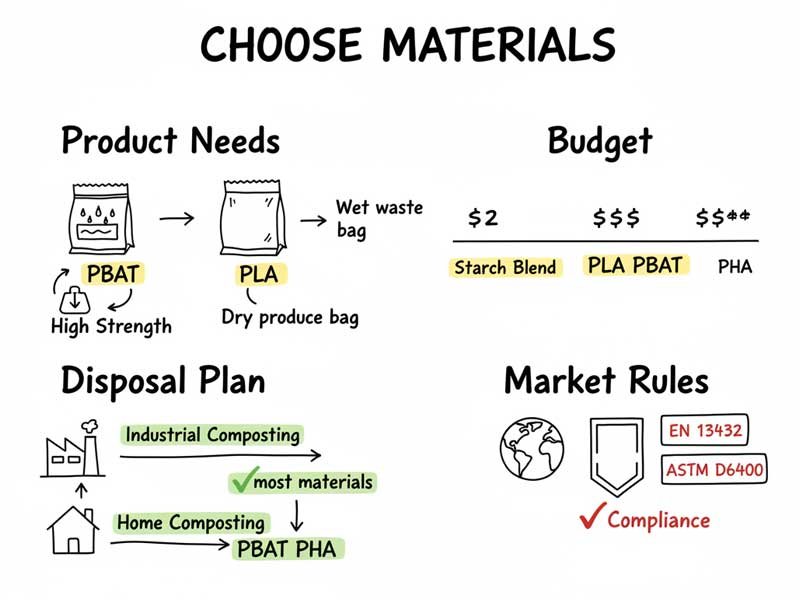
This is important for compostable bags made from materials such as PBAT, PLA blends, starch-based compounds, or other biodegradable plastic polymer blends.
But importers should be careful with the word “truly.”
You should be able to prove why the finished packaging is treated as compostable plastic packaging.
A raw material statement alone is not enough.
What the Exemption Does Not Mean
The Article 7 exemption is narrow.
It does not mean:
- The packaging is exempt from all PPWR duties.
- The supplier can make unsupported compostability claims.
- A raw material certificate covers every finished product.
- The product can be labelled “home compostable” without evidence.
- The importer can ignore technical documentation.
- The packaging is automatically accepted in every EU collection system.
The exemption only answers one question:
Does the Article 7 recycled-content target apply?
For compostable plastic packaging, the answer is no.
Other PPWR requirements may still apply.
Article 7 vs Article 9: Do Not Mix Them Up
Article 7 and Article 9 deal with different topics.
| PPWR Article | Main Topic | What Buyers Should Understand |
|---|---|---|
| Article 7 | Minimum recycled content in plastic packaging | Compostable plastic packaging is exempt from the 2030 and 2040 recycled-content targets |
| Article 9 | Compostable packaging | Certain packaging must be compatible with industrial composting standards by 12 February 2028 |
| Annex VII | Technical documentation | Evidence should show how the packaging meets the relevant rules |
Article 9 requires certain packaging, such as permeable tea, coffee, or other beverage bags and fruit and vegetable sticky labels, to be compatible with industrial composting standards by 12 February 2028.
Member States may also require some other packaging, including very lightweight plastic carrier bags and lightweight plastic carrier bags, to be compostable where suitable bio-waste collection and treatment systems are available.
For the compostability side of the rule, read our PPWR Article 9 compostable packaging guide.
For a wider view of EU packaging duties, see our PPWR packaging guide.
Recycled Content vs Bio-Based Content vs Compostable Content
These terms are often mixed together.
They should not be.
| Term | Meaning | Buyer Risk |
|---|---|---|
| Recycled content | Material recovered from waste and used again in packaging | PPWR Article 7 focuses on post-consumer plastic waste |
| Bio-based content | Material made partly or fully from biological sources | Bio-based does not automatically mean compostable |
| Compostable packaging | Packaging designed to break down under defined composting conditions | Needs certification and finished packaging evidence |
| Biodegradable | A broad degradation claim | Often too vague without time, condition, and standard |
A compostable bag may be bio-based, partly bio-based, or fossil-based biodegradable plastic.
That is separate from recycled content.
Article 8 of PPWR also says the Commission will review the state of technological development and environmental performance of bio-based plastic packaging.
So buyers should not assume that bio-based content can automatically replace recycled content unless the law later allows that path.
What Importers Should Ask Suppliers to Prove
If a supplier says compostable plastic packaging is exempt from recycled-content targets, ask for the evidence behind that position.
For compostable bags, request:
- Finished bag specification
- Material composition summary
- Compostability certificate scope
- Test report or certification linked to the finished product
- Thickness and size covered by the evidence
- Printing ink and additive review
- Batch traceability method
- Technical documentation inputs under Annex VII
- Claim and label review for the EU market
Buyers should also review our compostable certifications overview before relying on a claim.
For EU compostability claims, the EN 13432 standard is often part of the evidence file.
Decision Table for EU Buyers
| Situation | Does Article 7 Recycled Content Apply? | Buyer Action |
|---|---|---|
| Finished product is verified compostable plastic packaging | No, Article 7(4)(e) exempts it | Keep compostability evidence and technical documentation |
| Supplier only provides raw material certificate | Do not decide yet | Ask for finished packaging evidence |
| Bag is conventional plastic with recycled content | Yes, if no exemption applies | Check Article 7 targets and calculation method |
| Bag is food-contact compostable packaging | Compostable exemption may apply, but food-contact rules also matter | Check PPWR and food-contact documentation separately |
| Packaging has a small plastic part below 5% of total unit weight | May be exempt under Article 7(5)(b) | Document plastic part weight and material |
| Supplier wants to print recycled-content claim | Claim creates extra evidence burden | Ask for verified PCR evidence before printing |
Buyer Checklist
Before approving a compostable packaging order, ask:
- Is this product compostable plastic packaging?
- Is the evidence for raw material or finished packaging?
- Does the certificate cover the final thickness, size, ink, and format?
- Which PPWR Article 9 category applies, if any?
- Does the product need industrial composting wording?
- Is home compostability claimed?
- Is the product intended for food contact?
- Does the technical documentation explain the Article 7 exemption basis?
- Are any recycled-content claims printed on the bag or carton?
- Can the supplier provide batch traceability?
This is a procurement question, not only a legal question.
The supplier should be able to explain the product clearly.
Supplier Red Flags
Be careful if a supplier says:
- “Compostable means no PPWR documents are needed.”
- “Our raw material certificate covers every finished bag.”
- “Recycled content and bio-based content are the same.”
- “You can print recycled content without proof.”
- “Article 7 exemption means Article 9 does not matter.”
- “Home compostable and industrial compostable mean the same thing.”
- “PPWR compliant” without technical documentation support.
These answers do not always mean the supplier is dishonest.
But they show that the supplier may not understand EU documentation needs.
B2B Procurement Case
A Dutch importer wants to buy compostable produce bags from China.
The buyer asks whether the bags need recycled content under PPWR.
The supplier replies:
“No, compostable bags are exempt.”
That answer may be correct, but it is not complete.
The importer then asks for:
- Finished bag specification
- Material composition summary
- EN 13432 evidence
- Certificate scope confirmation
- Ink and thickness review
- Article 9 disposal wording check
- Technical documentation inputs
- Batch traceability method
The supplier can show that the finished bags are compostable plastic packaging and that the recycled-content exemption is documented in the technical file.
This is the right way to handle the question.
The buyer does not need to force recycled content into a compostable product when Article 7 does not require it.
But the buyer still needs proof that the product is really within the compostable packaging route.
How Orizon Supports Compostable Packaging Buyers
Orizon manufactures compostable bags for importers, distributors, wholesalers, retailers, and private-label brands.
We support OEM and ODM projects for:
- Compostable garbage bags
- Compostable shopping bags
- Compostable produce bags
- Compostable mailer bags
- Compostable garment bags
- Compostable dog waste bags
- Custom printed compostable packaging
For EU-focused projects, we help buyers check product specifications, material selection, compostability certificate scope, printing details, and batch traceability before production.
You can review our compostable bag factory to understand production and traceability support.
Our factory has 16 years of manufacturing experience, about 20,000 square meters of production space, 16 fully automatic production lines, and monthly capacity of about 500 tons.
We do not recommend making broad “PPWR compliant” claims without evidence.
Instead, we help buyers build a practical document package for each finished packaging type.
That is safer for EU procurement.
FAQ
Does PPWR require recycled content in compostable plastic packaging?
No. Article 7(4)(e) exempts compostable plastic packaging from the minimum recycled-content targets in Article 7(1) and Article 7(2).
Does the Article 7 exemption mean compostable packaging is outside PPWR?
No. Compostable plastic packaging may be exempt from recycled-content targets, but it still needs to meet other relevant PPWR rules, including compostability, labelling, technical documentation, and conformity requirements.
What is the difference between Article 7 and Article 9?
Article 7 covers recycled-content targets for plastic packaging. Article 9 covers compostable packaging requirements and when certain packaging must be compatible with composting standards.
Is bio-based content the same as recycled content?
No. Bio-based content comes from biological sources. Recycled content comes from recovered waste material. Under Article 7, recycled content means post-consumer plastic waste.
Is a raw material compostability certificate enough?
No. A raw material certificate may not cover the finished bag thickness, ink, additive, sealing, or product format. Buyers should ask for finished packaging evidence.
Can suppliers print recycled-content claims on compostable bags?
Only if the claim is supported by reliable evidence. If the product is compostable plastic packaging and exempt from Article 7 recycled-content targets, buyers should avoid adding recycled-content claims unless verified PCR data supports them.
Conclusion
PPWR does not generally require minimum recycled content in compostable plastic packaging because Article 7(4)(e) exempts it from the 2030 and 2040 recycled-content targets.
But this exemption is not a free pass.
EU buyers still need compostability evidence, finished packaging documentation, label review, and traceability.
The safest approach is simple: do not force recycled content into compostable packaging unless there is a clear reason and verified evidence. Instead, prove that the finished packaging is truly compostable and that the technical file supports the claim.