I’Public Dog Waste Stations: Planning and Maintenance Guide
Public dog waste stations are an important part of sanitation planning in parks, trails, dog exercise areas, streetscapes and other shared public spaces.
However, installing a station does not automatically solve a dog waste problem.
The performance of a public station depends on several connected factors:
- whether it is installed where dog owners naturally walk;
- whether the dispenser is easy to see and use;
- whether suitable refill bags are consistently available;
- whether the waste receptacle is emptied before it overflows;
- whether maintenance responsibility is clearly assigned;
- and whether the program is reviewed and adjusted over time.
For councils, parks departments and public facility operators, public dog waste stations should therefore be treated as part of a wider sanitation and maintenance system—not as a one-time hardware purchase.
This guide explains how to plan, locate, operate and maintain public dog waste stations. It also covers refill-bag compatibility, consumption forecasting, inspection procedures and procurement considerations.
Organizations developing a broader municipal strategy can also review our guide to public dog waste management programs.
What Is a Public Dog Waste Station?
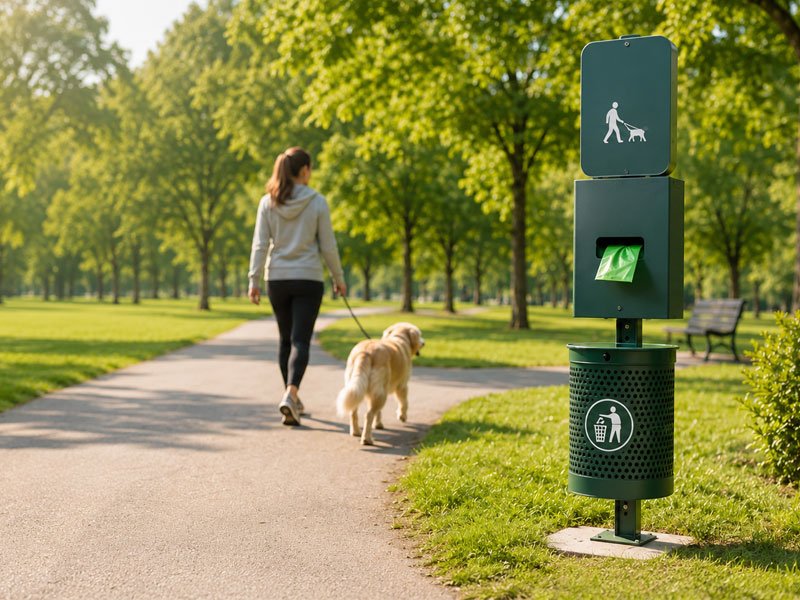
A public dog waste station is an outdoor sanitation point that gives dog owners access to waste bags and disposal instructions in a shared public area.
Depending on the station design, it may include:
- a bag dispenser;
- a post or wall-mounted support;
- instructional signage;
- a dedicated waste receptacle;
- a receptacle liner;
- locks, hinges or access panels;
- and refill bags compatible with the dispensing system.
Some installations include both a dispenser and a waste bin. Others provide only bags and rely on nearby public litter bins.
The correct configuration depends on the site, visitor traffic, maintenance route and existing waste infrastructure.
Public dog waste stations are commonly installed in:
- municipal parks;
- dog parks;
- walking and cycling trails;
- public recreation areas;
- streetscapes and pedestrian corridors;
- waterfront paths;
- rest areas;
- visitor attractions;
- public housing environments;
- and other dog-friendly shared spaces.
The purpose of the station is not simply to provide a bag. It should make responsible disposal convenient while supporting routine cleaning, predictable restocking and better management of public areas.
Why Public Dog Waste Stations Require Proper Planning
A station installed in the wrong location may receive little use, even when dog waste complaints occur elsewhere on the property.
A station that is frequently empty can also reduce public confidence in the program. Similarly, an overflowing bin may create odor, litter and maintenance problems instead of improving the site.
Effective public dog waste station planning therefore needs to consider:
- where dogs and their owners actually travel;
- where waste is most frequently left behind;
- how many entrances and activity areas the site has;
- where public litter bins already exist;
- how often maintenance staff visit the site;
- how many bags the dispenser can hold;
- seasonal and event-related demand;
- accessibility and pedestrian safety;
- and long-term refill availability.
The objective is not to install the highest possible number of stations. It is to create a practical network that covers high-use locations and can be maintained consistently.
Step 1: Conduct a Site Audit
Before selecting station quantities or locations, conduct a physical audit of the site.
The audit should examine how visitors enter, move through and leave the public area.
Record important site features
Mark the following locations on a simple site map:
- main entrances and exits;
- parking areas;
- trailheads;
- route intersections;
- dog park gates;
- open lawns;
- picnic and recreation areas;
- waterfront access points;
- public toilets;
- playgrounds;
- existing litter bins;
- maintenance access routes;
- lighting and surveillance areas;
- drainage points;
- and locations where complaints have been reported.
The audit should also note whether existing bins are already overloaded, difficult to access or too far from the routes most commonly used by dog walkers.
Observe real user behavior
A site map alone may not reveal actual movement patterns.
Where practical, observe the area during:
- weekday mornings;
- weekday evenings;
- weekends;
- peak dog-walking periods;
- community events;
- and different seasons.
Look for natural stopping points, frequently used shortcuts and areas where dog owners already pause.
A station placed along a real walking route will usually be more useful than one placed only according to equal spacing on a map.
Step 2: Identify Dog Waste Hotspots
A hotspot is an area where dog activity, complaints or uncollected waste occurs more frequently than elsewhere.
Common hotspot locations include:
- park entrances;
- the first section of a walking trail;
- grassy areas near parking;
- route intersections;
- dog park gates;
- open exercise fields;
- areas around benches;
- and paths connecting residential streets to public parks.
Hotspot identification can be based on:
- maintenance reports;
- resident complaints;
- staff observations;
- inspection records;
- photographic records;
- dog-traffic counts;
- and previous cleanup data.
A complaint map can be especially useful. Rather than treating all complaints as one general issue, record their exact locations and dates.
Repeated complaints in one location may indicate:
- insufficient bag access;
- poor station visibility;
- inconvenient bin placement;
- an overflowing receptacle;
- or a need for clearer public communication.
Step 3: Review Existing Waste Infrastructure
A complete dog waste station with a dedicated bin is not always required at every location.
Before adding new receptacles, review:
- the position of current public bins;
- available bin capacity;
- collection frequency;
- contamination issues;
- odor complaints;
- and whether staff already service the location.
A dispenser-only station may be practical when a suitable public waste bin is already nearby and clearly visible.
A complete station may be more appropriate when:
- existing bins are too far away;
- the area has concentrated dog activity;
- dog waste frequently appears beside general litter bins;
- maintenance teams require a defined collection point;
- or the site needs clearer separation between disposal functions.
The station configuration should fit the maintenance system that already exists whenever possible.
Step 4: Estimate How Many Stations Are Needed
There is no universal number of public dog waste stations that works for every park or municipal area.
The requirement depends on:
- total site area;
- length of walking routes;
- number of entrances;
- expected dog traffic;
- number of dog-focused activity zones;
- existing public bins;
- visitor behavior;
- maintenance capacity;
- dispenser capacity;
- and seasonal demand.
Instead of relying only on a fixed distance rule, calculate the initial requirement using three types of coverage.
Entrance coverage
Consider a station near major entrances where dog owners begin or finish their visit.
This gives users access to a bag before entering the park and provides a disposal opportunity before leaving.
Not every minor access point needs its own station. Prioritize entrances with the highest pedestrian and dog traffic.
Route coverage
Review the length and layout of walking paths.
Long routes may need additional stations at:
- major intersections;
- route loops;
- rest areas;
- parking connections;
- and points where users naturally change direction.
The station should be visible before the user needs it—not only after passing the main dog activity area.
Hotspot coverage
Add stations where inspections or complaints show a repeated problem.
A hotspot station may be more valuable than another station installed simply to maintain equal spacing.
Start with a pilot program
For larger parks or multiple municipal locations, begin with a pilot deployment.
A practical pilot may run for four to eight weeks. During this period, record:
- bags used at each station;
- refill frequency;
- bin fill rate;
- stockout incidents;
- overflow incidents;
- complaints by location;
- non-pet-waste contamination;
- station damage;
- and time required for each service visit.
Use the results to relocate, add or remove stations before expanding the program.
Best Locations for Public Dog Waste Stations
The most effective locations are usually places where dog owners can see and access a station without leaving their normal route.
Park entrances and exits
Entrances are often strong locations because they allow visitors to take a bag before entering and dispose of collected waste before leaving.
Where a park has several entrances, prioritize:
- the main parking entrance;
- the entrance connected to residential streets;
- the entrance closest to public transport;
- and the entrance most frequently used by dog walkers.
Trailheads and route intersections
Trailheads provide an opportunity to collect a bag before starting a walk.
Intersections can also serve multiple route directions from one station, reducing the number of units required.
Dog park gates
Dog parks generally create concentrated demand.
Depending on the size and layout, stations may be needed:
- outside the entrance;
- immediately inside the gate;
- near high-use seating areas;
- or at more than one point inside a large enclosure.
Placing the only bag dispenser far inside the dog park may be inconvenient for users who arrive without a bag.
Parking-to-park access routes
Dog owners often unload pets in parking areas and walk toward the main park.
A station positioned along this route may receive more use than one located deep inside a landscaped area.
Open lawns and recreation corridors
Large grassy spaces may need coverage when they are regularly used for dog walking or informal exercise.
Locate the station beside a defined pathway where it remains visible and accessible without obstructing recreation.
Waterfronts and sensitive environmental areas
Stations may help encourage collection near waterways and natural areas.
However, they should be located away from:
- drains;
- flood-prone points;
- unstable ground;
- sensitive vegetation;
- and areas where waste could enter water during heavy rain.
Locations to avoid
Avoid installing stations:
- where vegetation blocks visibility;
- directly beside children’s play equipment;
- in poorly lit or isolated corners;
- where they reduce accessible path width;
- in the middle of cycle routes;
- close to drainage inlets;
- where maintenance staff cannot safely reach them;
- or where vehicles may damage the station.
The best location balances public convenience, safety, visibility and maintenance access.
Choosing the Right Station Configuration
Public dog waste stations are available in several configurations.
The right choice depends on visitor volume, site layout, budget and maintenance capacity.
Complete station with dispenser and bin
A complete station creates one clear location for obtaining a bag and disposing of waste.
It may be suitable for:
- dog parks;
- busy municipal parks;
- high-use walking routes;
- areas without nearby litter bins;
- and locations with repeated disposal problems.
The main operational consideration is that the bin must be emptied frequently enough to avoid overflow and odor.
Dispenser-only station
A dispenser-only unit may be appropriate when:
- a public litter bin is already nearby;
- the area has moderate usage;
- the municipality wants to avoid adding another collection point;
- or the existing maintenance route already includes suitable bins.
Clear signage should direct users to the nearest disposal point.
Pole-mounted system
Pole-mounted stations are commonly used in open outdoor environments.
When selecting a pole-mounted system, review:
- installation method;
- wind exposure;
- corrosion resistance;
- post stability;
- dispenser height;
- maintenance access;
- and resistance to tampering.
Wall-mounted system
Wall-mounted dispensers may be used near:
- facility entrances;
- public buildings;
- fenced dog parks;
- parking structures;
- and other fixed surfaces.
The wall and mounting hardware must be suitable for repeated outdoor use.
Capacity and durability
For high-traffic sites, station capacity affects maintenance frequency.
A larger dispenser can reduce restocking visits, but only when the refill bags fit correctly and dispense reliably.
Hardware specifications should also consider:
- outdoor corrosion;
- UV exposure;
- rain;
- freezing temperatures;
- impact damage;
- vandalism;
- lock design;
- and replacement-part availability.
Choosing Compatible Dog Waste Station Bags
Public dog waste stations may use several different refill systems.
The refill bag should be selected only after the dispenser format, internal dimensions and dispensing mechanism have been confirmed.
Commercial station bags are different from ordinary retail rolls because public programs often require:
- controlled dispensing;
- predictable refill quantities;
- consistent perforation;
- repeat-order consistency;
- compatibility with fixed dispensers;
- and efficient bulk packaging.
Organizations comparing refill formats can review our range of dog waste station bags.
Roll dog waste station bags
Roll systems hold perforated bags wound around a core or supplied as a coreless roll.
They are often selected where:
- higher capacity is required;
- longer refill intervals are preferred;
- the dispenser is designed for cylindrical rolls;
- and the maintenance team can monitor roll consumption.
Before ordering, confirm:
- bag width and length;
- bags per roll;
- roll width;
- maximum roll diameter;
- core or coreless design;
- core internal diameter;
- film thickness;
- perforation position;
- seal type;
- and dispenser opening.
More information is available on our roll dog waste station bags page.
Header-style dog waste station bags
Header-style bags are generally supplied as flat bags attached to a reinforced header.
They are used in compatible dispensers where bags are removed individually.
This format can support:
- controlled dispensing;
- fixed refill quantities;
- organized installation;
- and standardized municipal or property-management programs.
Procurement teams should confirm:
- header width;
- hanging-hole configuration;
- hole spacing;
- bag dimensions;
- bags per header;
- fold arrangement;
- and dispenser depth.
See our header-style dog waste station bags for additional format information.
Tissue-style dog waste station bags
Tissue-style bags are flat-packed and designed to dispense one at a time from compatible packet dispensers.
They may be suitable where:
- consumption control is important;
- loose bags around the station are a concern;
- the program requires orderly dispensing;
- and the station has a compatible packet compartment.
The most important specifications include:
- packet width and height;
- bag folding method;
- opening orientation;
- bags per packet;
- packet thickness;
- and dispenser opening dimensions.
Learn more about tissue-style dog waste station bags.
Are station refill bags universal?
Dog waste station refill bags should not automatically be treated as universal.
Even when two dispensers appear similar, they may differ in:
- internal width;
- roll-diameter capacity;
- mounting points;
- hanging-hole position;
- dispensing-slot width;
- or required folding method.
Before bulk purchasing, provide the supplier with:
- dispenser brand and model;
- internal dispenser dimensions;
- photographs of the compartment;
- current bag specifications;
- and a physical sample where available.
This reduces the risk of poor dispensing, roll jamming, excess bag removal or refill packets that do not fit the station.
Public Dog Waste Station Maintenance Schedule
Maintenance frequency should be based on actual use rather than one fixed timetable.
A useful starting schedule is shown below.
| Public location | Suggested initial inspection frequency | Main priorities |
|---|---|---|
| Small community park | Once or twice per week | Bag stock, bin level, signage |
| Busy municipal park | Three or more times per week | Stockouts, overflow, litter |
| Public dog park | Daily or according to peak demand | High bag use, odor, bin capacity |
| Walking trail | Weekly, adjusted for season | Entrance stations, weather damage |
| Waterfront or visitor area | Multiple times per week in peak season | Traffic fluctuations and litter |
| Public event area | Before, during and after the event | Temporary demand and rapid removal |
These are starting points only.
Service frequency should increase when:
- stations repeatedly run out of bags;
- bins reach capacity before the next visit;
- odors become noticeable;
- visitor traffic rises;
- seasonal usage increases;
- or special events are scheduled.
Frequency may be reduced at low-use locations after sufficient usage data has been collected.
Public Dog Waste Station Maintenance Checklist
Each service visit should follow a consistent inspection process.
1. Check bag inventory
Record the approximate number or percentage of bags remaining.
Restock before the dispenser becomes empty.
Where possible, establish a refill trigger—for example, restocking when inventory falls below the amount expected to be used before the next service visit.
2. Test the dispensing mechanism
Pull one bag through the dispenser to confirm:
- bags release correctly;
- perforations separate cleanly;
- packets are aligned;
- the opening is not blocked;
- and users are unlikely to remove multiple bags accidentally.
3. Empty the waste receptacle
Do not wait for waste to extend above the bin opening.
An overfilled bin may:
- create odor;
- attract insects;
- cause loose waste;
- discourage use;
- and generate additional complaints.
4. Replace the receptacle liner
Install a liner that fits the bin properly.
An oversized or poorly secured liner may collapse into the bin, while an undersized liner may tear or restrict capacity.
5. Clean the station and surrounding ground
Remove:
- loose bags;
- spilled waste;
- non-pet litter;
- mud;
- and debris around the base.
Clean high-contact surfaces according to the maintenance provider’s sanitation procedure.
6. Check for odor or leakage
Persistent odor can indicate:
- insufficient collection frequency;
- damaged waste bags;
- leakage inside the bin;
- poor cleaning;
- or inappropriate non-pet waste.
Identify the cause rather than relying only on deodorizing products.
7. Inspect locks, hinges and access doors
Confirm that:
- the access door closes;
- the lock functions;
- hinges are secure;
- no sharp edges are exposed;
- and the compartment has not been forced open.
8. Check the post and mounting hardware
Look for:
- loose bolts;
- movement at the base;
- corrosion;
- leaning;
- impact damage;
- or cracks around concrete foundations.
9. Inspect signage
Instructions should remain:
- visible;
- readable;
- correctly positioned;
- and relevant to the local disposal procedure.
Replace signs that are faded, damaged or covered by vegetation.
10. Record the service visit
A simple log should include:
- date and time;
- station identification number;
- remaining bag quantity;
- bags added;
- bin status;
- damage;
- cleaning completed;
- action required;
- and staff member or contractor name.
Consistent records help identify stations that consume more supplies or require more maintenance than others.
How to Estimate Refill Bag Consumption
Reliable consumption forecasting helps prevent stockouts and unnecessary emergency orders.
Step 1: Measure daily bag usage
During the pilot period, record how many bags are used at each station between service visits.
For example:
- bags loaded at the start;
- estimated bags remaining at inspection;
- days since the previous inspection;
- and unusual events or weather conditions.
Average use should be calculated separately for high-, medium- and low-traffic locations.
Step 2: Calculate monthly requirements
A basic planning calculation is:
Average daily bag use × number of operating days = estimated monthly use
Where multiple stations are involved:
Estimated monthly use per station × number of comparable stations = program requirement
Do not assume every station uses the same quantity.
A dog park entrance may use significantly more bags than a station on a low-traffic section of trail.
Step 3: Include a buffer
Additional stock may be needed for:
- seasonal peaks;
- public events;
- delivery lead time;
- customs and transportation delays;
- unexpected overuse;
- damage;
- and expansion of the station network.
The buffer should be based on procurement lead time and the operational risk of running out—not on a universal percentage.
Step 4: Establish a reorder point
A reorder point can be based on:
- average weekly consumption;
- supplier lead time;
- current stock;
- confirmed incoming orders;
- and required safety inventory.
For example, if the complete procurement and delivery process requires several weeks, the reorder should be placed before the remaining stock falls below expected consumption during that period.
Step 5: Review carton and storage requirements
Bulk procurement planning should also confirm:
- bags per roll or packet;
- rolls or packets per carton;
- carton dimensions;
- carton weight;
- annual carton quantity;
- storage conditions;
- pallet configuration;
- and delivery frequency.
Compostable bags should be stored according to the manufacturer’s guidance, away from excessive heat, moisture and direct sunlight.
Common Public Dog Waste Station Problems
The station frequently runs out of bags
Possible causes include:
- the dispenser is too small;
- usage was underestimated;
- service visits are too infrequent;
- users remove multiple bags;
- or refill records are inaccurate.
Possible actions:
- increase inspection frequency;
- use a higher-capacity dispenser;
- change to a more controlled dispensing system;
- establish a refill trigger;
- and compare actual use by station.
The waste bin frequently overflows
Possible causes include:
- insufficient collection frequency;
- a bin that is too small;
- high non-pet-waste contamination;
- seasonal traffic;
- or poor alignment between bag refilling and waste collection.
Possible actions:
- increase collection frequency;
- use a larger receptacle;
- improve signage;
- separate servicing schedules;
- and review peak-period demand.
Several bags are removed at once
Possible causes include:
- weak or inconsistent perforation;
- incorrect roll tension;
- a dispenser opening that is too large;
- or a refill format that does not match the unit.
Possible actions:
- confirm dispenser compatibility;
- test bag samples;
- review perforation strength;
- or use a header-style or tissue-style controlled-dispensing system.
The station receives little use
Possible causes include:
- poor visibility;
- installation away from natural walking routes;
- unclear signage;
- lack of a nearby disposal point;
- or incorrect assumptions about the hotspot.
Possible actions:
- move the station;
- improve signage;
- inspect during peak periods;
- or compare use with nearby stations.
Odor remains a problem
Possible causes include:
- delayed bin collection;
- leakage;
- high temperatures;
- poor cleaning;
- or loose waste around the station.
Possible actions:
- shorten the collection interval;
- clean the receptacle;
- review liner fit;
- inspect for damage;
- and relocate the bin if environmental conditions are unsuitable.
Dog waste remains on the ground despite the station
A station can improve convenience, but it cannot replace public communication and consistent site management.
Additional measures may include:
- clearer instructions;
- directional signage;
- community education;
- enforcement of local rules;
- complaint reporting;
- and relocation of stations to actual hotspots.
Public stations work best as one component of a broader municipal dog waste management program.
Using QR Codes and Station Identification Numbers
Public operators may improve reporting by assigning each station a unique identification number.
The number can be displayed on:
- the dispenser;
- the station sign;
- the maintenance log;
- and the site map.
A QR code can also direct visitors or staff to a reporting form for:
- empty dispensers;
- overflowing bins;
- damaged hardware;
- missing signage;
- or waste around the station.
This can help maintenance teams locate the correct unit quickly, especially when a municipality operates many stations.
The reporting system should be simple and should not require visitors to provide unnecessary personal information.
How to Measure Program Performance
A public dog waste station program should be reviewed using operational data.
Useful performance indicators include:
- bags used per station;
- refill visits per month;
- stockout incidents;
- overflow incidents;
- complaints by location;
- loose waste found during inspections;
- time required per service visit;
- non-pet-waste contamination;
- hardware damage;
- repair cost;
- and annual refill cost.
Compare locations
High usage does not necessarily mean poor performance.
A heavily used station may be working exactly as intended.
The more important questions are:
- Does it run out before the next service?
- Does the bin overflow?
- Has dog waste in the surrounding area decreased?
- Is the station located where users need it?
- Is the maintenance cost reasonable for the site?
- Are supplies predictable?
Review low-use stations
A low-use station may indicate:
- low dog traffic;
- poor visibility;
- incorrect placement;
- or an unnecessary installation.
Before removing it, compare use across different seasons and observation periods.
Review high-maintenance stations
A station that requires repeated emergency visits may need:
- a larger dispenser;
- a larger bin;
- more frequent collection;
- a controlled-dispensing refill format;
- or relocation.
Performance data allows the operator to make these decisions based on evidence rather than assumptions.
Compostable Bags in Public Dog Waste Programs
Certified compostable dog waste bags may support selected municipal sustainability or plastic-reduction objectives.
However, material selection should be evaluated together with the local disposal system.
Before specifying compostable bags, confirm:
- applicable local regulations;
- required certification standards;
- labeling requirements;
- whether pet waste is accepted by the intended facility;
- the actual disposal route;
- procurement documentation;
- storage conditions;
- and performance requirements.
A bag being certified compostable does not mean it should be littered or left in the environment.
It also does not automatically mean that collected dog waste is accepted by every composting facility.
The correct choice depends on alignment between:
- the bag material;
- certification and labeling;
- the collection system;
- the local waste facility;
- and the final disposal policy.
For buyers comparing broader material options, ORIZON supplies compostable pet waste bags for public, commercial and private-label programs.
What to Include in a Municipal RFQ
A clear request for quotation helps suppliers evaluate compatibility, production requirements and total project volume.
Project information
Include:
- purchasing organization;
- country and destination;
- intended application;
- number of station locations;
- current or planned station models;
- estimated annual requirement;
- initial order quantity;
- delivery schedule;
- and required contract period.
Bag dimensions
Specify:
- bag width;
- bag length;
- gusset dimensions where applicable;
- film thickness;
- bag color;
- opacity;
- seal type;
- and printing requirements.
Refill configuration
Specify:
- roll, header or tissue-style format;
- bags per roll or packet;
- roll width;
- maximum roll diameter;
- paper core dimensions;
- coreless requirement;
- header dimensions;
- hanging-hole configuration;
- packet dimensions;
- and fold orientation.
Performance requirements
Specify:
- perforation consistency;
- dispensing performance;
- leak-resistance requirements;
- tensile or load expectations where applicable;
- outdoor storage conditions;
- and sample-approval procedures.
Certification and documentation
Specify:
- required compostability standard;
- certificate or license documentation;
- technical data sheet;
- material declaration;
- test reports where required;
- country-of-origin requirements;
- carton labels;
- and procurement documentation.
Packaging and logistics
Specify:
- rolls or packets per carton;
- maximum carton weight;
- pallet requirements;
- barcode or label requirements;
- delivery terms;
- preferred port;
- and whether the quotation should be EXW, FOB, CIF or DDP.
For dispenser compatibility, buyers can submit photographs, measurements or an existing refill sample when requesting a quotation for commercial dog waste station bgs.
Public Dog Waste Station Planning Checklist
Before approving a station deployment, confirm the following.
Site planning
- Main dog-walking routes have been mapped.
- Complaint and waste hotspots have been identified.
- Existing bins and maintenance routes have been reviewed.
- Seasonal and event traffic has been considered.
- Station locations are visible and accessible.
- Stations do not obstruct pedestrian or cycle routes.
- Drainage, flooding and environmental risks have been reviewed.
- Installation permission and underground-service checks are complete.
Station selection
- Complete station or dispenser-only configuration has been selected.
- Dispenser capacity matches expected demand.
- Hardware is suitable for outdoor conditions.
- Locks, hinges and replacement parts are available.
- Maintenance staff can access the unit safely.
- Signage requirements have been confirmed.
Refill-bag procurement
- Dispenser model and internal dimensions are available.
- Refill format has been confirmed.
- Bag dimensions and thickness are specified.
- Roll, core, header or packet dimensions are confirmed.
- Bag samples have been tested in the dispenser.
- Certification documentation has been reviewed.
- Carton packing and annual volume are known.
- Safety stock and reorder points have been established.
Maintenance
- Inspection responsibility has been assigned.
- Refill frequency has been defined.
- Bin-emptying frequency has been defined.
- Cleaning and damage-reporting procedures are available.
- Each station has an identification number.
- Service records will be maintained.
- Performance will be reviewed after the pilot period.
FAQ
What is a public dog waste station?
A public dog waste station is an outdoor sanitation point that provides bags and disposal instructions for dog owners. Depending on the configuration, it may also include a dedicated waste receptacle.
How many public dog waste stations does a park need?
The number depends on park size, route length, entrance count, dog traffic, waste hotspots, existing bins and maintenance capacity. A site audit and pilot deployment are more reliable than applying one fixed spacing rule to every park.
Where should public dog waste stations be placed?
Suitable locations often include main park entrances, trailheads, dog park gates, route intersections and frequently used walking corridors. Stations should be visible, convenient and accessible to maintenance teams.
How far apart should dog waste stations be?
There is no universally correct spacing. Route layout, dog activity, entrances, existing bins and hotspot locations should determine placement. Equal spacing alone may place stations where they are not needed.
How often should a public dog waste station be serviced?
Service frequency depends on visitor traffic, bag consumption, bin capacity, season and event schedules. High-traffic dog parks may require daily checks, while lower-use trails may begin with weekly inspections.
What bags fit public dog waste stations?
The correct bag depends on the dispenser. Common formats include roll, header-style and tissue-style bags. Buyers should confirm dispenser dimensions, maximum roll size, core requirements, hanging holes or packet dimensions before ordering.
Are dog waste station refill bags universal?
No. Dispensers vary in internal dimensions, roll capacity, hanging systems and dispensing openings. Compatibility should be verified before bulk procurement.
Can compostable bags be used in municipal dog waste stations?
Certified compostable bags may be considered where material standards, local regulations and disposal pathways align. The municipality should also confirm whether dog waste is accepted in the intended waste or composting system.
How can councils estimate annual refill requirements?
Councils can measure average daily use during a pilot, calculate monthly consumption by station type, add appropriate safety inventory and establish a reorder point based on supplier lead time.
What information should be sent to a dog waste bag supplier?
Provide the dispenser model, internal measurements, photographs, refill format, bag dimensions, thickness, certification requirements, annual volume, carton requirements and delivery destination.
Build a More Reliable Public Dog Waste Station Program
A successful public dog waste station network combines:
- practical site planning;
- convenient placement;
- compatible refill bags;
- clear maintenance responsibility;
- sufficient stock;
- routine inspection;
- and ongoing performance review.
Hardware alone is rarely enough.
When stations are supported by reliable servicing and an appropriate refill supply system, they can make responsible disposal easier and help councils maintain cleaner, more welcoming public spaces.
ORIZON supports councils, distributors, parks departments and public sanitation suppliers with bulk, OEM and certified dog waste station refill bags.
Available formats include:
- roll dog waste station bags;
- header-style dog waste station bags;
- tissue-style dog waste station bags.
Contact our team with your dispenser model, required bag specifications, estimated annual quantity and destination market to discuss compatibility, samples and long-term supply.