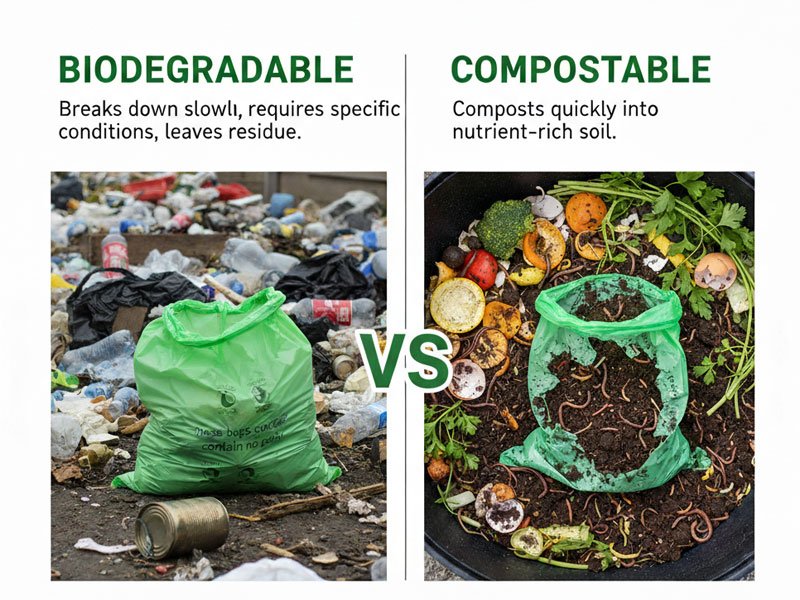
Many buyers compare PLA PBAT vs PHA film when evaluating compostable film materials. As more manufacturers shift toward compostable materials, many start comparing PLA PBAT film with other biodegradable film options.
But in real production, the key question is not what the material is — it is why PLA PBAT film is designed this way for extrusion and performance stability.
Understanding this design logic is critical for anyone working with compostable film materials in packaging or agricultural applications.
Why PLA Alone Does Not Work in Film
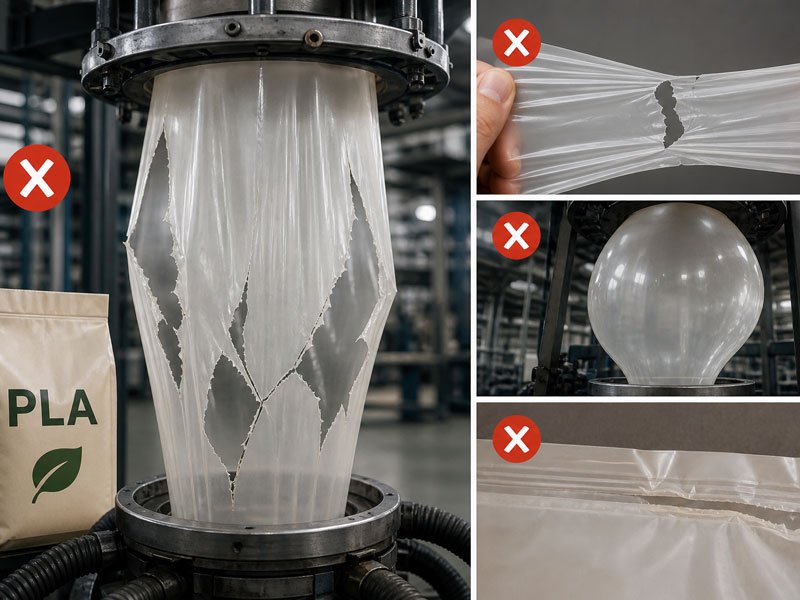
PLA is often considered a promising bio-based material, but in film extrusion, it has a major limitation: brittleness
From a processing perspective:
- PLA has low elongation
- It cracks easily under stress
- Film tends to break during stretching
In real production, this leads to:
- unstable film bubbles
- frequent breakage during extrusion
- poor sealing performance
This is why PLA alone is not suitable for film applications such as compostable bags or flexible packaging.
Why PBAT Is Added to PLA
To solve these issues, PBAT is introduced into the system.
PBAT brings key properties that PLA lacks:
- flexibility
- elongation
- impact resistance
From a film processing perspective:
- PBAT allows the material to stretch without breaking
- It improves sealing behavior
- It stabilizes the film during extrusion
This is the core reason why PLA PBAT blends are used instead of pure PLA in most compostable film materials. PLA PBAT blends are widely used in compostable film materials for packaging applications.
How PLA PBAT Blends Behave in Film Extrusion
In real extrusion processes, performance is not defined by a single material property — but by how the blend behaves as a system.
Melt Flow Behavior
PLA and PBAT together create a more balanced melt flow:
- PLA contributes structure
- PBAT improves flow flexibility
This results in:
- smoother extrusion
- reduced bubble instability
- better processing control
Thickness Control
One of the biggest challenges in compostable films is thickness variation.
PLA alone tends to create:
- uneven film distribution
- weak points
Adding PBAT improves:
- thickness consistency
- film uniformity
Processing Stability
From a production standpoint: stability = efficiency
PLA PBAT film systems provide:
- fewer breakages
- more stable runs
- lower waste rates
This is a key reason why manufacturers prefer PLA PBAT over other compostable film materials.
How Material Ratio Affects Performance
The performance of PLA PBAT film depends heavily on the blend ratio. Understanding compostable packaging standards and certifications is essential when selecting compostable film materials.
Higher PLA Content
- more rigid
- better shape retention
- but more brittle
Higher PBAT Content
- more flexible
- better elongation
- but higher cost
This creates a trade-off:
strength vs flexibility vs cost
In practice, formulations are adjusted based on application needs.
Why This Blend Became Industry Standard
PLA PBAT film has become the dominant solution not because it is perfect — but because it offers the best balance.
Balance of Properties
- strength + flexibility
- structure + processability
Scalability
Unlike newer materials such as PHA:
- easier to process
- more stable in production
- widely available
Cost Efficiency
Compared to alternative biodegradable film materials:
- more competitive
- suitable for large-scale production
This is why PLA PBAT film is widely used in compostable bags and film products for packaging and waste collection.
Application Still Defines the Final Choice
Even with a well-designed material system, application remains critical.
Different use cases require different performance:
- packaging : sealing + strength
- agriculture : degradation control
This is why selecting the right compostable film material always depends on the final application.
Our Experience in Film Production
In our production, we focus on optimizing PLA PBAT film formulations for real-world applications.
This allows us to achieve:
- stable extrusion
- consistent thickness
- reliable sealing
We also understand that:
- material performance is not only about composition
- but about how it behaves in actual production
That is why we optimize formulations based on different application requirements.
Conclusion
PLA PBAT film is not just a material choice — it is a design solution to real production challenges.
By combining PLA and PBAT:
- brittleness is reduced
- flexibility is improved
- processing becomes stable
And that is why it remains the most practical compostable film material today.
CTA
If you are evaluating different materials for your application, understanding both processing and compliance is critical.
Looking for a reliable supplier of compostable film materials?
👉 Explore our compostable bag solutions
👉 Or contact us for OEM support: https://orizonbags.com/contact/