A dog waste complaint may look like a small service request.
For the person making the complaint, it often represents something larger.
They may have found dog waste beside a playground. They may have walked past an overflowing bin for several days. They may have reported an empty bag dispenser more than once and seen no change.
When these issues repeat, residents may start to believe that the problem is being ignored.
A well-run municipal pet waste program can help reduce these complaints. But the program must do more than install signs or provide a few bags.
It needs to connect several basic tasks:
- understand where complaints occur;
- provide bags and disposal points in useful locations;
- keep stations stocked and clean;
- explain what pet owners should do;
- respond to repeat problem areas;
- and measure whether conditions improve.
This guide explains how councils, parks departments and public works teams can build that system.
What Is a Municipal Pet Waste Program?
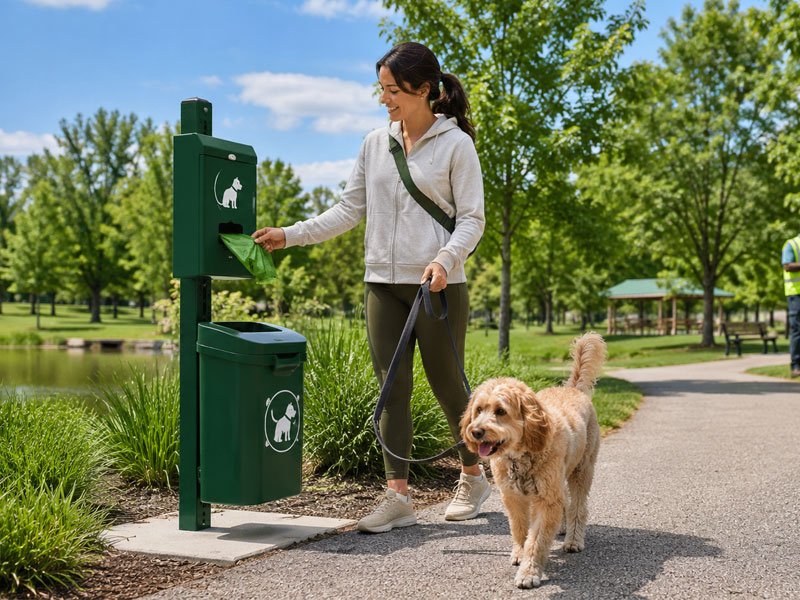
A municipal pet waste program is a public system for managing dog waste in parks, trails, streets, dog exercise areas and other shared spaces.
It may include:
- dog waste bag dispensers;
- waste bins;
- public signs;
- cleaning and collection schedules;
- refill-bag supply;
- resident education;
- local rules;
- complaint reporting;
- inspections;
- and targeted enforcement.
Not every city needs the same program.
A small council with several parks may use a simple station and inspection schedule. A larger city may need hundreds of stations, several departments, service contractors and a central complaint system.
The important point is coordination.
A bag dispenser is a piece of equipment. A municipal pet waste program is the system that keeps the dispenser useful.
Why Pet Waste Creates So Many Community Complaints
Dog waste is easy to notice.
It affects paths, grass, public seating areas and the edges of playgrounds. It can also be carried by rain into storm drains and waterways.
The U.S. Environmental Protection Agency explains that stormwater can move pet waste into streams, lakes and rivers. The EPA recommends that municipalities first study local knowledge, disposal habits and barriers before choosing education, infrastructure or enforcement measures.
Community complaints usually come from more than one problem.
Uncollected waste on the ground
This is the most visible complaint.
It may happen because an owner did not bring a bag, could not find a dispenser, did not see a nearby bin or chose not to clean up.
Each cause needs a different response.
Filled bags left beside paths
Some owners pick up the waste but leave the filled bag on the ground.
This often means the first part of the disposal system worked, but the second part failed. A bag was available, but a convenient bin was not.
Empty bag dispensers
An empty dispenser can create two complaints at once.
Residents complain about the station, and more uncollected waste may appear around it.
Overflowing or dirty bins
A station can become part of the problem when its bin is full, leaking or producing a strong odor.
People may stop using it even when bags remain available.
Damaged equipment
Broken doors, blocked openings, loose posts and missing signs can make a station difficult or unsafe to use.
Slow municipal response
The original issue may be small. Frustration grows when residents report it several times and receive no clear response.
This is why complaint handling should be part of the program—not a separate office task.
Pet Waste Complaints Are Not All the Same
A useful complaint system should separate different types of problems.
Without clear categories, a council may record every report as “dog waste” and miss the real cause.
| Complaint type | What it may indicate | Likely first action |
|---|---|---|
| Waste left on the ground | Low compliance, missing bags or poor station coverage | Inspect the site and record the exact location |
| Filled bags left beside a path | No convenient bin or unclear disposal instructions | Review bin location and signage |
| Empty dispenser | Service schedule or stock problem | Refill and review recent usage |
| Overflowing bin | Collection frequency or bin-capacity problem | Empty the bin and adjust servicing |
| Strong odor or leakage | Delayed collection, damaged liners or poor cleaning | Clean, inspect and shorten the collection cycle |
| Damaged station | Wear, vandalism or weak mounting | Make the area safe and arrange repair |
| Poor station location | Station is not on the natural walking route | Observe users and consider relocation |
| Repeat offender report | Intentional non-compliance | Verify the pattern and review local enforcement options |
| Waste near a drain or waterway | Environmental and stormwater risk | Prioritize removal and inspect nearby routes |
| No response after reporting | Weak complaint workflow | Assign ownership and update the service record |
This classification helps the council move from “we received another complaint” to “we understand what failed.”
Step 1: Establish a Complaint Baseline
A baseline is the starting record used to measure change.
Before changing the program, review at least six months of available information. Twelve months is better when seasonal conditions affect park use.
Collect:
- complaint date;
- exact location;
- complaint category;
- time of day, where known;
- repeat reports from the same area;
- weather or seasonal conditions;
- nearby station locations;
- station condition at inspection;
- action taken;
- response time;
- and whether the issue returned.
Do not rely only on the total number of complaints.
Ten reports from one street are different from ten reports spread across ten parks.
The EPA recommends using complaint-call analysis, surveys and focus groups to identify community knowledge gaps and practical barriers. It also recommends comparing the number and nature of complaints before and after a program change.
Check the quality of the data
Complaint records are not always complete.
One person may report the same location several times. Another problem may go unreported because residents no longer expect a response.
For that reason, compare complaint records with field inspections.
A lower complaint count is useful, but cleaner ground conditions are stronger evidence.
Step 2: Map Complaints and Dog-Walking Routes
Put each complaint on a site map.
This may reveal patterns that are hard to see in a spreadsheet.
Look for clusters near:
- park entrances;
- dog park gates;
- trailheads;
- parking areas;
- walking-route intersections;
- open grass;
- benches;
- playground boundaries;
- waterfront paths;
- and streets connecting homes to parks.
Then add the locations of:
- bag dispensers;
- public bins;
- maintenance routes;
- lighting;
- storm drains;
- and public toilets.
The map may show that a problem area has no station. It may also show that a station exists but sits away from the route people actually use.
For a detailed method covering site audits, placement, inspection and service frequency, see our public dog waste station planning and maintenance guide .
Do not place stations by distance alone
Equal spacing may look tidy on a map.
It does not always match real behavior.
A station near a busy entrance may use more bags than three stations on a quiet outer path. Complaint data can help the council place resources where they are more likely to be used.
Step 3: Remove Practical Barriers to Proper Disposal
Some complaints come from poor behavior.
Others come from a system that makes good behavior harder than it needs to be.
Ask four simple questions:
- Can the owner find a bag?
- Can the owner remove one bag without difficulty?
- Can the owner find a bin after using it?
- Will that bin be usable when they reach it?
A gap in any one of these steps can create waste on the ground.
Provide bags where the walk begins
Major entrances and trailheads are often useful locations because owners can take a bag before they need it.
A dispenser located only at the far end of a route may be too late.
Provide a clear disposal route
A bag dispenser without a nearby bin may still work if signs point to an existing public bin.
But the route must be reasonable.
People are less likely to carry a filled bag for a long distance when no clear disposal point is available.
Make stations easy to see
A station hidden behind shrubs may be technically present but functionally absent.
Keep sightlines open and ensure signs remain readable.
Use the right station capacity
Low-capacity dispensers may be suitable for quiet locations.
High-traffic dog parks and busy urban paths may need larger refills or more frequent service. The correct choice depends on actual consumption, not only purchase price.
Step 4: Match Maintenance to Real Demand
A municipal dog waste station does not fail only when it breaks.
It also fails when it is empty, blocked, dirty or full.
A practical service visit should include:
- checking the number of bags remaining;
- testing whether one bag dispenses correctly;
- refilling before the station becomes empty;
- emptying the waste bin;
- replacing the bin liner;
- removing loose waste nearby;
- cleaning contact areas;
- checking for odor and leakage;
- inspecting locks, doors and hinges;
- checking the post and mounting points;
- and recording the visit.
Use refill triggers
A refill trigger is the stock level at which staff add more bags.
For example, a station may be refilled when the remaining quantity is lower than the amount normally used before the next planned visit.
This is more reliable than waiting until the dispenser is empty.
Adjust for seasons and events
Usage can change during:
- warm weather;
- school holidays;
- weekends;
- tourist seasons;
- festivals;
- sporting events;
- and periods when nearby parks are closed.
A monthly schedule may work in winter and fail during summer.
Verify contractor work
When a contractor services the stations, require a simple record.
It may include:
- station number;
- date;
- bags added;
- bin emptied;
- damage found;
- photograph where required;
- and follow-up action.
The record does not need to be complicated.
It needs to be consistent.
Step 5: Use Communication to Solve a Specific Problem
A general “Pick up after your dog” sign may help as a reminder.
It will not solve every barrier.
Good communication begins with the reason people are not complying.
When people do not understand the environmental issue
Explain that dog waste can be carried into stormwater systems and waterways.
Keep the message short and local. A sign near a creek should refer to the creek, not to a distant environmental problem.
When people forget bags
Place reminders near park entrances and provide a visible dispenser.
When people do not know where to put a filled bag
Add clear directions to the nearest suitable bin.
The disposal rule should be easy to understand.
Our guide on how to dispose of dog poop bags explains why disposal instructions should follow local waste rules rather than assuming one bin or treatment route works everywhere.
When people believe dog waste will disappear naturally
Explain that “natural” does not mean harmless in a busy public area.
The EPA notes that some pet owners wrongly view dog waste as a natural fertilizer that will take care of itself. This is one reason municipalities are encouraged to identify local knowledge gaps before creating messages.
When the behavior is intentional
Education may not be enough.
That is where rules and targeted enforcement may be needed.
Step 6: Use Enforcement After Basic Barriers Are Addressed
Local rules define what dog owners must do.
Some municipalities also require people walking a dog to carry a bag or another cleanup tool.
The EPA includes ordinances, fines, education campaigns and permanent infrastructure among the measures municipalities may combine in a pet waste program.
Enforcement is most credible when:
- bags are available where the council says they are available;
- bins are serviced;
- signs are clear;
- rules are easy to find;
- and complaints are checked before action is taken.
A fine cannot refill an empty dispenser.
In the same way, free bags will not stop every repeat offender.
Municipal pet waste programs work better when convenience, communication and enforcement support each other.
Focus on repeat hotspots
Enforcement teams cannot watch every park and street.
Complaint maps can identify:
- repeated times;
- repeated routes;
- repeat locations;
- and patterns that may justify targeted observation.
Any enforcement activity must follow local law, evidence requirements and privacy rules.
Step 7: Create a Clear Complaint Response Workflow
Residents should not need to understand the council’s internal structure before reporting a problem.
Use one clear intake route where possible.
A practical workflow may follow these steps:
1. Receive the complaint
Collect the location, type of problem, date and optional photograph.
2. Classify it
Separate an empty dispenser from an overflowing bin or an uncollected-waste complaint.
3. Check urgency
Give higher priority to:
- leakage;
- waste near waterways;
- sharp or damaged equipment;
- major overflow;
- and problems close to children’s areas.
4. Assign the correct team
Send refill issues to the service team, equipment damage to maintenance and repeat behavior reports to the department responsible for local enforcement.
5. Inspect the location
Confirm what is present.
A complaint may identify a wider issue, such as a missing bin or poorly placed station.
6. Take action
Clean, refill, repair, relocate, communicate or investigate as needed.
7. Record the result
Include what was done and whether more work is required.
8. Watch for recurrence
A closed ticket does not always mean a solved problem.
If the same location returns, conduct a root-cause review.
Assign One Owner to Each Task
Municipal pet waste programs often involve several teams.
The exact structure varies, but each task should have one accountable owner.
| Program task | Possible lead | Possible supporting teams |
|---|---|---|
| Program policy | Parks, sanitation or environmental services | Public works, animal services |
| Station planning | Parks or public works | Maintenance, accessibility team |
| Bag procurement | Procurement or program owner | Parks, warehouse, finance |
| Station refilling | Parks, public works or contractor | Warehouse |
| Bin collection | Sanitation or contractor | Parks |
| Equipment repair | Public works or facility maintenance | Supplier |
| Complaint intake | Customer service or 311 team | Program owner |
| Public communication | Communications team | Parks, environmental services |
| Enforcement | Animal control or authorized officers | Customer service |
| Program reporting | Named program owner | All service teams |
The title of the department matters less than clear ownership.
Someone must be able to answer: Who checks this? Who fixes it? Who confirms completion?
What Successful Municipal Pet Waste Programs Measure
Complaint totals matter.
They should not be the only measure.
A useful dashboard may include:
| Metric | What it shows |
|---|---|
| Total complaints | Overall public reporting trend |
| Unique complaint locations | Whether the problem is spread out or concentrated |
| Repeat hotspot rate | Whether earlier action solved the issue |
| Average response time | How quickly the council checks reports |
| Station stockout incidents | Reliability of refill supply |
| Bin overflow incidents | Whether collection matches use |
| Bags used per station | Relative demand by location |
| Ground-waste inspection count | Actual site condition |
| Service visits per station | Maintenance workload |
| Damage and repair incidents | Equipment condition |
| Annual bag use | Procurement and storage needs |
| Cost per serviced station | Operating cost |
| Resident satisfaction | Public view of the program |
Do not treat high bag use as a failure
High use may mean a station is well placed and helping owners clean up.
The concern is whether the station stays stocked and whether the surrounding ground becomes cleaner.
Do not treat fewer complaints as proof on their own
Complaints may fall because:
- the site improved;
- fewer people used the site;
- the reporting system changed;
- or residents stopped reporting.
Compare complaint data with inspections, station use and resident feedback.
The EPA recommends combining complaint analysis with before-and-after surveys, focus groups and, where relevant, environmental monitoring.
What Municipal Examples Can Teach Us
Public examples do not provide one universal model.
They do show why municipalities often use several measures at the same time.
New York City: rules alone did not end complaints
New York City has long required owners to clean up dog waste.
Yet the City Council reported that 311 received 821 dog waste complaints during the first two months of 2026, a 35.8% increase from the same period one year earlier.
The proposed SCOOP Act combined wider access to dog waste bags, public education, selected enforcement measures and a composting pilot.
The lesson is practical.
Rules set the expectation. Infrastructure and daily service help people follow it.
The proposal does not yet prove that complaints will fall. It does show that city leaders viewed the issue as more than an enforcement problem.
Waterloo: measure the physical result
The City of Waterloo reported that its Dog Waste Landfill Diversion Program added seven collection containers and captured 28,400 kilograms of dog waste.
That is a clear operating measure. It records what the system collected, not only how many stations were installed.
The final treatment route used by one city may not be suitable in another area.
Still, the measurement approach is useful. Municipalities can track collected volume, participation and station performance alongside complaints.
EPA example: understand the barrier before choosing the message
The EPA describes how municipalities can study complaint calls, surveys and local behavior before selecting an approach.
Its guidance includes education, ordinances, social marketing and permanent structures. It also cites Jefferson County, Colorado, where officials used an educational campaign after receiving many complaint calls despite an existing ordinance.
The point is not that every city needs a humorous video.
The point is that the response should match the local barrier.
How Refill-Bag Supply Affects Complaint Reduction
Refill bags may look like a small procurement item.
They can affect the daily reliability of the whole program.
A station may fail when:
- the roll is too large for the dispenser;
- the packet does not fit the mounting system;
- bags do not separate at the perforation;
- several bags pull out at once;
- film tears during use;
- delivery is late;
- or reserve stock is too low.
These problems can lead to empty dispensers, waste around the station and extra service calls.
Municipal buyers should confirm:
- dispenser type;
- internal dimensions;
- bag width and length;
- film thickness;
- bags per roll or packet;
- roll diameter;
- core dimensions;
- perforation;
- header-hole layout;
- packet size;
- carton quantity;
- annual forecast;
- delivery lead time;
- and required certification documents.
Our municipal dog waste station refill bags page explains the main commercial formats and compatibility points.
Roll station bags
Roll formats can provide higher capacity and longer refill cycles in busy locations.
Buyers should confirm roll width, maximum diameter, core size and perforation before ordering. See the technical options for roll dog waste station bags.
Tissue-style station bags
Tissue-style packets are designed to dispense one bag at a time.
They may be useful where overuse, loose bags or an untidy dispenser creates extra work. See tissue-style dog waste station bags.
Header-style station bags
Header-style bags hang from a reinforced header inside a compatible dispenser.
They can support controlled dispensing, but the hanging holes, header width and station design must match. See header-style dog waste station bags.
No bag format is best for every program.
The best format is the one that fits the station, user volume and service schedule.
Planning Annual Supply
Municipal pet waste programs should plan bag supply before the dispenser becomes empty.
Start with actual use.
For each station, record:
- the number of bags loaded;
- the number left at the next inspection;
- days between visits;
- seasonal conditions;
- and unusual events.
Use this data to group stations into high-, medium- and low-use locations.
Then estimate:
Average daily use × operating days = estimated annual use
Add reserve stock based on:
- delivery lead time;
- seasonal peaks;
- public events;
- shipping risks;
- storage capacity;
- and the effect of running out.
A small price saving has little value if the program repeatedly needs emergency shipments.
Stable supply is part of complaint prevention.
Compostable Bags Need a Clear End-of-Life Plan
Some municipal programs consider certified compostable dog waste bags as part of a wider material policy.
Certification and disposal are separate questions.
Before specifying compostable bags, confirm:
- the relevant local standard;
- labeling rules;
- whether the intended facility accepts pet waste;
- whether the collection route is separate or mixed;
- how filled bags will be handled;
- and what instructions the public will receive.
A compostable claim does not mean the bag should be left in the environment.
It also does not mean every composting facility will accept dog waste.
The material, local rules and actual disposal route should agree.
Municipal Pet Waste Program Checklist
Use this checklist when reviewing a new or existing program.
Complaint management
- Complaints have clear categories.
- Exact locations are recorded.
- Repeat hotspots can be identified.
- Each complaint has an assigned owner.
- Inspection and action are recorded.
- Residents have a clear reporting channel.
- Closed complaints are checked for recurrence.
Infrastructure
- Main dog-walking routes are mapped.
- Stations are visible and accessible.
- Bins are available within a reasonable route.
- Station capacity matches local demand.
- Equipment does not block accessible paths.
- Storm drains and sensitive areas have been considered.
Maintenance
- Refill triggers are defined.
- Bin-emptying schedules match actual use.
- Seasonal demand is included.
- Damage checks are documented.
- Contractors provide service records.
- High-priority issues have a response procedure.
Communication and enforcement
- Messages address known local barriers.
- Disposal instructions are clear.
- Local rules are easy to find.
- Education and enforcement roles are defined.
- Repeat hotspots receive targeted action.
Procurement
- Dispenser specifications are confirmed.
- Bag samples have been tested.
- Annual use has been estimated.
- Reserve stock is included.
- Carton and storage requirements are known.
- Certification documents have been checked.
- Lead time and reorder points are recorded.
Measurement
- Complaint volume is tracked.
- Repeat complaint locations are tracked.
- Ground conditions are inspected.
- Stockouts and overflows are recorded.
- Bag use is compared by station.
- Response times are reviewed.
- The program is adjusted when results do not improve.
FAQ
What is a municipal pet waste program?
A municipal pet waste program is a public system used to manage dog waste in parks, trails, streets and other shared areas. It may include bag dispensers, bins, maintenance, public education, complaint handling and local enforcement.
How do municipal pet waste programs reduce complaints?
They reduce practical barriers to cleanup, keep stations usable, provide clear disposal instructions and give councils a process for responding to repeat problem areas. Results depend on maintenance and follow-up, not only installation.
Do dog waste stations reduce public complaints?
Dog waste stations may help when they are placed on real walking routes, kept stocked and supported by suitable bins. A poorly placed or empty station is unlikely to improve conditions.
Why do complaints continue after stations are installed?
Common causes include poor placement, empty dispensers, overflowing bins, unclear disposal instructions, weak maintenance and intentional non-compliance.
How should councils track dog waste complaints?
Councils should record the type of complaint, exact location, date, repeat reports, station condition, response time and action taken. Complaint records should be compared with field inspections.
Which department should manage a municipal pet waste program?
The lead department varies by municipality. It may be parks, sanitation, public works or environmental services. The key requirement is one named program owner with authority to coordinate other teams.
How often should municipal dog waste stations be serviced?
Service frequency should follow real use. Busy dog parks may need daily checks, while quiet trails may need weekly service. Schedules should change with seasons, events and recorded consumption.
What should municipalities measure?
Useful measures include complaints, repeat hotspots, response time, stockouts, overflows, bag use, ground-waste counts, service visits, repair costs and resident feedback.
Can compostable bags be used in municipal programs?
Certified compostable bags may be considered when local rules, labeling, collection and disposal systems support their use. Buyers should confirm whether local facilities accept pet waste.
How should a municipality estimate annual bag requirements?
Measure bag use during a pilot or normal service period, calculate average use by station type and add reserve stock based on seasonal demand and supplier lead time.
A Practical Program Focuses on the Whole Service
Municipal pet waste complaints rarely come from one cause.
Some relate to behavior. Others reveal an empty dispenser, a poor location, an overflowing bin or a slow response.
The complaint is useful information.
When councils classify reports, inspect the location and connect the finding to maintenance, communication or enforcement, they can make better decisions.
Start with the route from beginning to end:
A dog owner needs a bag.
The bag must work.
A bin must be available.
The station must be serviced.
A reported problem must reach the right team.
When those steps are reliable, community complaints are more likely to fall—and public spaces are more likely to become cleaner.
Councils and public suppliers reviewing the wider system can visit our public dog waste management programs page.
For refill-format specifications or dispenser compatibility review, visit our dog waste station bags page or contact ORIZON with the station model, bag specification, estimated annual quantity and destination market.