A dog waste station can be well made, fully stocked and easy to use.
It can still fail if it is placed in the wrong location.
A station hidden behind shrubs may not be seen. A dispenser installed after the main dog-walking area may be too late. A bin placed far from the dispenser may lead to filled bags being left beside the path.
Good dog waste station placement follows how people actually move through a park.
It should consider:
- where dog owners enter;
- which paths they follow;
- where dogs usually stop;
- where complaints occur;
- where bins already exist;
- how maintenance staff reach the station;
- whether the station blocks an accessible route;
- and how seasonal use changes demand.
Dog waste stations should usually be placed near high-use park entrances, trailheads, dog park gates, major walking-route intersections and documented pet waste hotspots. The final location should also provide clear disposal access, safe public use and reliable servicing.
The U.S. Environmental Protection Agency notes that lack of bags or waste receptacles can be a barrier to proper pet waste disposal in public parks. It also recommends placing permanent structures and information along common walking routes and in parks to encourage use.
This guide explains how councils and parks teams can turn that idea into a practical placement plan.
For the wider municipal program, including public education, servicing and measurement, visit our Public Dog Waste Management Programs page.
What Dog Waste Station Placement Really Includes
Dog waste station placement is more than choosing a point on a map.
The placement decision includes:
- park zone;
- side of the path;
- distance from the main user route;
- visibility;
- ground condition;
- accessibility;
- nearby bin access;
- servicing access;
- drainage;
- lighting;
- sign direction;
- dispenser height;
- and space around the station.
A station must be easy for dog owners to notice and use.
It must also be practical for staff to refill, empty and inspect.
These needs should be reviewed together.
A location that looks convenient for the public may fail if the service team cannot reach it safely.
A location that is easy for staff may still fail if users never see it.
There Is No Universal Spacing Rule
Councils often ask:
How far apart should dog waste stations be?
There is no single distance that works for every public park.
A fixed spacing rule can produce poor results because parks differ in:
- size;
- path layout;
- number of entrances;
- dog-owner traffic;
- existing bins;
- off-leash areas;
- terrain;
- seasonal use;
- complaint history;
- and servicing capacity.
Do not start with a rule such as “one station every 100 metres” or “one station at every entrance.”
Start with the route.
Where do dog owners enter?
Where do they walk?
Where do they need a bag?
Where can they put the filled bag?
Where can staff service the station?
Use spacing as a final check, not the first decision.
Two stations placed on the main dog-walking loop may work better than four stations spread evenly across areas that few dog owners use.
Step 1: Map the Park Before Choosing Locations
Create a simple site map.
It does not need to be complex at the beginning.
Mark:
- main entrances;
- secondary entrances;
- car parks;
- trailheads;
- path intersections;
- dog park gates;
- open lawns;
- sports fields;
- picnic areas;
- playgrounds;
- public toilets;
- benches;
- existing litter bins;
- waterways;
- storm drains;
- and maintenance access points.
Then add:
- pet waste complaint locations;
- uncollected waste hotspots;
- filled bags left beside trails;
- existing dog waste station locations;
- and areas with poor visibility.
The EPA recommends that municipalities assess community knowledge gaps, current disposal behavior and barriers through tools such as surveys, focus groups and complaint-call analysis before choosing a program approach.
A map helps move the discussion from opinion to evidence.
Instead of saying, “This park probably needs more stations,” the team can say:
“This entrance has repeated complaints, no visible dispenser and no bin on the main walking route.”
That is a better starting point.
Step 2: Observe Real Dog-Walking Routes
A park map shows paths.
It does not always show behavior.
Visit the park at different times:
- early morning;
- after work;
- evening;
- weekends;
- warm-weather days;
- sports-event days;
- and holiday periods.
Observe:
- which entrances dog owners use;
- which routes they follow;
- whether they walk a loop or a one-way route;
- where dogs stop;
- where owners pause;
- which bins they use;
- where filled bags are left;
- and whether existing stations are noticed.
You may find an informal route that is not marked as a main path.
That route may deserve a station more than a quiet paved path elsewhere.
Record route patterns, not individual people.
The goal is to understand site use, not to monitor residents.
Step 3: Prioritize High-Value Placement Zones
Some areas usually deserve earlier review.
They should still be checked against local evidence.
Park entrances
A station near a busy entrance allows owners to take a bag before the walk starts.
This is often more useful than placing the first dispenser deep inside the park.
Prioritize entrances linked to:
- residential streets;
- car parks;
- public transport;
- shared walking paths;
- and main dog-walking loops.
Do not assume every entrance needs a station.
A small side entrance used by few dog owners may be lower priority than one high-use main entrance.
Trailheads
Trailheads are natural decision points.
People stop, read signs, prepare for the route and begin a longer walk.
A station at a trailhead can provide:
- bags before departure;
- disposal after return;
- cleanup instructions;
- a station identification number;
- and council contact details.
Where several trails begin in one area, one visible station may serve more users than several poorly placed units farther along each trail.
Major path intersections
Path intersections can serve users approaching from several directions.
They may be useful when:
- several dog-walking routes meet;
- a public bin already exists;
- the location is visible;
- there is enough space beside the path;
- and staff can service it without blocking users.
Avoid placing the station in the centre of the intersection.
People need room to pass, turn, stop and read signs.
Dog park gates and off-leash areas
Dog park entrances and exits are high-priority locations.
Owners can collect a bag before entering and dispose of waste before leaving.
Possible layouts include:
- a dispenser outside the entry gate;
- a complete station near the double-gate area;
- a bin near the exit route;
- and additional bins inside large off-leash spaces.
Do not place the only station at the far end of the enclosure.
The entry and exit route usually offers better visibility and easier servicing.
Car park pedestrian routes
Car parks often act as the starting point for longer visits.
A station near the pedestrian route from the car park can serve owners before they enter the park.
Avoid placing stations in:
- vehicle reversing areas;
- loading zones;
- accessible parking transfer areas;
- narrow crossings;
- and drainage channels.
The station should be reached from a pedestrian route without requiring users to stand in vehicle traffic.
Open lawns and sports-field edges
Dogs are often walked around the edge of open lawns and sports fields, even where the area is not a formal dog park.
A station may be useful near:
- the main field entrance;
- the start of a perimeter path;
- a nearby general waste bin;
- or the route between parking and the field.
Avoid placing the bin directly beside spectator seating, team benches or food areas.
A good location is close to the dog-walking route without creating odor or conflict for other users.
Waterfront paths and stormwater-sensitive areas
Pet waste near drains, creeks, lakes and beaches may be carried into waterways during rain.
The EPA states that stormwater can move pet waste into streams, lakes and rivers, where it can contribute bacteria and nutrients and harm water quality.
Priority locations may include:
- entrances to waterfront paths;
- bridge and creek crossings;
- lake paths;
- stormwater education points;
- and dog-access beach entrances.
A station should not be placed where leakage or runoff can enter a drain.
Place it on stable ground and include clear disposal information.
Place the Dispenser Before the Likely Waste Point
Timing matters.
A dispenser should usually appear before or at the start of the dog-walking route.
A common placement mistake is installing the dispenser only beside the destination bin.
By then, the owner may already have needed a bag.
Think of the route in this order:
- Owner enters the park.
- Owner sees the dispenser.
- Owner takes a bag.
- Dog waste is collected.
- Owner reaches a suitable bin.
The exact route will vary by park.
The principle stays the same.
A dispenser placed after the main dog-walking area may be too late.
Connect the Dispenser to a Clear Disposal Route
A bag dispenser without a disposal route solves only half the problem.
Before installing a dispenser, ask:
- Is there a bin at the station?
- Is there an existing public bin nearby?
- Can the user see the bin?
- Is the walking distance reasonable?
- Does the sign explain where the filled bag goes?
- Is that bin included in the collection schedule?
Complete station
A complete station includes:
- bag dispenser;
- sign;
- and dedicated waste bin.
This gives users one clear service point.
It also gives staff one asset to refill, empty and inspect.
The weakness is that the bin must be collected regularly. If not, the station may create odor, overflow and complaints.
Dispenser beside an existing public bin
This can reduce duplicate infrastructure.
It may work when:
- the existing bin accepts dog waste;
- the bin has enough capacity;
- the dispenser does not block access;
- the bin is already on a service route;
- and signs make the disposal rule clear.
Dispenser with directions to another bin
This may work where a bin cannot be installed at the dispenser.
The direction must be clear.
Do not expect users to search for an unmarked bin after carrying a filled bag.
Use simple wording such as:
“Place filled bags in the bin 30 metres ahead.”
Placement Decision Tree: Dispenser and Bin
Use this simple decision tree before confirming a location.
Is there a suitable public bin nearby?
│
├── Yes
│   ├── Does it have enough capacity?
│   │   ├── Yes → Place the dispenser beside the existing bin.
│   │   └── No → Increase bin capacity or install a complete station.
│
└── No
    ├── Can a bin be serviced at this location?
    │   ├── Yes → Install a complete station.
    │   └── No → Move the dispenser or provide clear directions to another bin.
This decision should be made before the dispenser is installed.
It is much easier to design the route correctly than to explain later why filled bags are being left beside the path.
Keep Stations Visible Without Blocking the Path
A station is more likely to be used when people can see it before reaching it.
Improve visibility by:
- facing the sign toward approaching users;
- keeping signs above low landscaping;
- using consistent station colors;
- trimming vegetation;
- placing the station near a route decision point;
- and adding the station to park maps where suitable.
Avoid placing stations:
- behind trees;
- inside dense landscaping;
- behind buildings;
- where parked vehicles hide them;
- too far from the path edge;
- in deep shadow;
- or facing away from the main walking direction.
Visibility should not require placing the station inside the walking path.
The station should be near the route, not in the route.
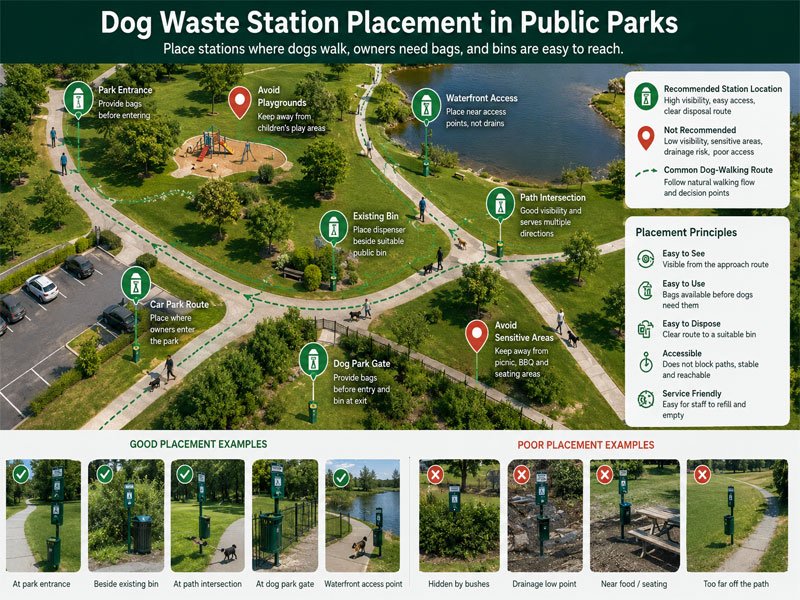
Good vs Poor Placement Examples
Use these examples when reviewing a site.
| Better placement | Poor placement |
|---|---|
| Beside a main park entrance | Behind shrubs |
| At a trailhead | After the main dog-use area |
| Near a dog park gate | At the far end of the dog park only |
| Beside a suitable existing bin | With no clear disposal route |
| On firm ground beside a path | In mud or a drainage low point |
| Visible from the approach route | Hidden behind parked cars |
| Accessible for users and staff | Blocking the accessible route |
| Away from seating and food areas | Beside picnic tables or food vendors |
A poor location can make a good product look ineffective.
Protect the Accessible Route
A dog waste station should not narrow or block a path.
Councils must follow the accessibility rules that apply in their own location.
As a useful U.S. outdoor-design reference, the U.S. Access Board states that trash and recycling receptacles in outdoor developed areas need clear ground space positioned for forward or parallel approach. It lists 36 by 48 inches for a forward approach and 30 by 60 inches for a parallel approach. It also notes that clear ground surfaces should be firm and stable.
This does not automatically define the legal rule for every country or every council park.
It does show the kind of access questions planners should ask.
Check:
- Can a wheelchair user reach the dispenser?
- Is the approach firm and stable?
- Is there enough clear space to stop and use the station?
- Does the post narrow the walking route?
- Is the dispenser or bin opening at a usable height?
- Does the sign become a protruding hazard?
- Can maintenance staff service the station without blocking the route?
The U.S. Access Board also limits protruding objects in circulation paths and states that protruding objects must not reduce the required clear width of accessible routes.
Place the station beside the route, not inside its required clear width.
Accessibility placement checklist
- Accessible approach provided
- Ground is firm and stable
- Clear space available
- Station does not block the route
- Sign does not create a protruding hazard
- Dispenser can be reached
- Bin opening can be used
- Local accessibility rules checked
Choose Stable Ground and Avoid Drainage Problems
The station base should remain stable during normal use and servicing.
Suitable ground may include:
- concrete pad;
- paved shoulder;
- stable compacted surface;
- or an approved post-mounted base.
Avoid:
- soft mud;
- loose sand;
- flood-prone ground;
- drainage channels;
- eroding slopes;
- root-damaged areas;
- and mowing-damage zones.
Check how the location behaves after rain.
A site that looks suitable in dry weather may become muddy, slippery or difficult to service in winter.
Also review:
- surface slope;
- irrigation;
- nearby drains;
- stormwater flow;
- sun and shade;
- and odor risk.
A bin placed in a low point may collect water.
A station in a poorly ventilated corner may create odor complaints.
Keep Stations Away From Sensitive Uses
Dog waste stations should be convenient.
They should not create unnecessary conflict with other park users.
Use care near:
- playgrounds;
- picnic tables;
- barbecue areas;
- food vendors;
- drinking fountains;
- sports-team benches;
- public-event areas;
- and building entrances.
This does not mean the station should be so far away that nobody uses it.
Look for a point on the approach route.
For example, a station may be placed on the path leading into a playground zone rather than directly beside the playground gate.
Plan for Maintenance Before Installation
A public location can be convenient for users but difficult for staff.
Before approving the site, ask the servicing team to review it.
Check:
- Can staff reach the station safely?
- Can a service cart stop nearby?
- Can the bin be emptied without blocking the path?
- Is the station inside a locked area after hours?
- Will events or parked vehicles block access?
- Can staff carry refill cartons to the site?
- Is the station included in an existing route?
A location is not suitable if it is convenient for the public but regularly missed by the servicing route.
The EPA describes pet waste stations as permanent structures that can include bag dispensers, signs and trash bins. It also recommends that municipalities evaluate whether program results improve and adjust the design if they do not.
Placement and maintenance should be planned together.
For servicing schedules, refill forecasting and inspection procedures, see our broader public dog waste station planning and maintenance guide .
Match Station Capacity and Bag Format to the Location
Placement affects which station format is practical.
A high-use dog park may need:
- a larger-capacity dispenser;
- a larger bin;
- more frequent servicing;
- or more than one station.
A quiet neighborhood park may need:
- a smaller dispenser;
- a shared public bin;
- a lower refill capacity;
- and less frequent servicing.
| Site type | Likely system need |
|---|---|
| High-use dog park | High-capacity roll or header system |
| Main park entrance | Complete station |
| Existing public-bin location | Dispenser-only option |
| Low-use trailhead | Smaller controlled dispenser |
| Vandalism hotspot | One-at-a-time controlled dispensing |
| Seasonal event area | Temporary or adjustable capacity |
The final bag format should be confirmed against the dispenser model, refill capacity, service schedule and actual use.
Before purchasing bags, confirm:
- dispenser model;
- internal dimensions;
- maximum roll diameter;
- roll height;
- core size;
- header-hole pattern;
- packet dimensions;
- bags per refill;
- and required film thickness.
Our dog waste station bgs page explains the main commercial refill formats and compatibility information.
Use a Weighted Placement Priority Matrix
When the budget does not allow a station at every candidate location, score each site.
The table below is a planning tool. It is not an international standard.
| Factor | Suggested weight |
|---|---|
| Dog-owner traffic | 20 |
| Complaint history | 15 |
| Ground waste found | 15 |
| Bin access | 10 |
| Visibility | 10 |
| Maintenance access | 10 |
| Accessibility | 10 |
| Waterway or drain risk | 5 |
| Seasonal demand | 5 |
Give each factor a score from 1 to 5.
- 1 = low need or poor fit
- 3 = moderate need or acceptable fit
- 5 = high need or strong fit
Then multiply:
Score × weight = weighted score
Use the score to compare candidate locations.
Do not let the score replace judgement.
For example, a location may score high for dog traffic but still be rejected if it blocks an accessible path or cannot be serviced safely.
Estimate the Number of Stations by Park Type
The number of stations should follow the park layout and demand.
Small neighborhood park
Typical features:
- one or two entrances;
- short walking loop;
- one existing public bin;
- low to medium dog traffic.
Possible starting point:
- one complete station at the main entrance;
- or one dispenser beside a suitable existing bin.
Monitor use before adding more stations.
Linear trail
Typical features:
- multiple access points;
- long route;
- users may not return to the starting point;
- limited bins.
Possible starting point:
- stations at main access points;
- disposal options near both entry and exit routes;
- midpoint station only if pilot data supports it.
A linear trail needs special care because users may carry a filled bag for a long distance if no disposal point is available.
Fenced dog park
Typical features:
- high dog concentration;
- double-gate entry;
- longer visits;
- high bag use.
Possible starting point:
- dispenser before entry;
- bin near exit;
- extra bin or station inside large areas if inspections support it.
The entry and exit path is usually the first place to review.
Waterfront park
Typical features:
- lakeside or beach paths;
- stormwater risk;
- tourist use;
- seasonal peaks.
Possible starting point:
- stations at waterfront access points;
- clear water-quality message;
- placement away from drainage low points;
- extra review after rain and peak periods.
Do not place the bin where leakage can enter a drain or waterbody.
Run a Placement Pilot Before Full Rollout
A pilot helps the council test whether the chosen location works.
Suggested review points may include:
- baseline inspection before installation;
- 30-day check;
- 60-day or 90-day review;
- seasonal review where needed.
Record:
- bags used;
- bin fill level;
- waste found nearby;
- complaints;
- stockouts;
- service visits;
- user comments;
- damage;
- visibility issues;
- and access problems.
Pilot review questions
- Did users notice the station?
- Did bag use increase?
- Did ground waste decline?
- Were filled bags placed in the bin?
- Was the bin too full?
- Was the site easy to service?
- Did the station block the path?
- Did vegetation hide the sign?
- Should the station move?
- Is a second station needed?
A pilot is useful only when the results can lead to a change.
Do not treat the first location as permanent before the data supports it.
Give Every Station an Identification Number
A station number improves reporting and maintenance.
Use a simple code such as:
- PARK-01
- TRAIL-A3
- DOGPARK-NORTH-02
The code can be used for:
- refill records;
- damage reports;
- complaint tickets;
- public QR forms;
- contractor inspections;
- usage tracking;
- and asset maps.
A resident can report:
“Station PARK-01 is empty.”
That is more useful than:
“The green station somewhere near the lake is empty.”
Add Clear and Useful Signage
The sign should help the user act.
Useful information may include:
- Pick up after your dog.
- Free bags available.
- Place filled bags in the bin.
- Station identification number.
- Council contact method.
- QR reporting code.
- Local rule or fine, where appropriate.
The EPA recommends placing signs and maps near permanent structures to explain their purpose, encourage use and provide municipal contact information.
Keep the main instruction short.
Do not turn a station sign into a full policy document.
Adjust Placement for Seasonal and Event Use
Park demand can change.
A quiet path may become busy during:
- summer;
- school holidays;
- festivals;
- markets;
- sports seasons;
- community events;
- temporary dog events;
- and nearby construction closures.
The council may need:
- temporary dispensers;
- extra bins;
- more frequent servicing;
- event-specific signs;
- or mobile refill points.
Temporary demand does not always justify permanent infrastructure.
Review the result after the event or season ends.
Measure Whether the Placement Works
A station being installed is not the final result.
Track:
- bag use;
- stockouts;
- bin overflow;
- waste found nearby;
- complaints;
- repeat complaints;
- service visits;
- damage;
- user feedback;
- and cost per station.
The EPA recommends evaluating pet waste programs through methods such as before-and-after surveys, focus groups, complaint analysis and monitoring, then changing the program when results do not improve.
Interpret the data carefully
High bag use may mean:
- the station is well placed;
- demand is higher than expected;
- several bags are dispensing at once;
- or people are taking bags for later use.
Low bag use may mean:
- the location has low demand;
- the station is hidden;
- the dispenser is difficult to use;
- or owners already carry their own bags.
Combine usage data with site inspections.
Numbers without field observation can mislead the team.
Poor Placement Signs to Watch For
A station may need to be moved or changed when:
- it remains full of unused bags;
- nearby ground waste continues;
- users walk past without seeing it;
- filled bags are left before reaching the bin;
- the station blocks the path;
- vegetation repeatedly hides the sign;
- the ground becomes muddy;
- service teams cannot reach it;
- the bin overflows often;
- odor affects seating or food areas;
- or the station is regularly damaged.
Do not keep a station in the wrong location only because it has already been installed.
The cost of relocation may be lower than years of poor performance.
Public Park Dog Waste Station Site Survey
Use this table when comparing possible locations.
| Field | Notes |
|---|---|
| Park name | |
| Candidate location | |
| Entrance type | Main entrance, secondary entrance, trailhead or dog park gate |
| Estimated dog traffic | Low, medium or high |
| Complaint history | None, occasional or repeated |
| Existing bin nearby | Yes or no |
| Distance to bin | |
| Visibility | Poor, acceptable or strong |
| Ground surface | |
| Drainage risk | |
| Accessibility | |
| Sensitive uses nearby | Playground, seating, food area or waterway |
| Maintenance access | |
| Recommended station type | Complete station, dispenser only or temporary unit |
| Pilot result | |
| Final decision |
This survey can be used during site visits, internal reviews or contractor discussions.
It also creates a record of why one location was selected over another.
Public Park Dog Waste Station Placement Checklist
Site demand
- Dog-owner traffic observed
- Complaint locations mapped
- Ground-waste hotspots recorded
- Seasonal use reviewed
- Event use considered
User route
- Main entrances identified
- Trailheads identified
- Walking loops mapped
- Dog park gates reviewed
- Car park routes reviewed
- Disposal route confirmed
Site condition
- Station is visible
- Ground is stable
- Drainage is suitable
- Site is not flood-prone
- Vegetation will not hide the station
- Lighting reviewed where needed
Accessibility
- Accessible approach provided
- Clear ground space reviewed
- Station does not block the path
- Sign does not protrude into the route
- Dispenser height reviewed
- Bin opening is reachable
- Local accessibility rules checked
Sensitive uses
- Distance from playground considered
- Distance from food areas considered
- Distance from seating considered
- Waterways and drains considered
- Odor risk reviewed
Maintenance
- Staff can reach the station
- Refill cartons can be transported
- Bin can be emptied safely
- Station is included in a route
- Station identification number assigned
- Inspection record created
Equipment
- Dispenser type confirmed
- Bag format confirmed
- Refill dimensions confirmed
- Bin capacity confirmed
- Sign content approved
- Mounting method approved
Pilot and review
- Pilot period defined
- Bag use recorded
- Bin fill level recorded
- Waste around station recorded
- Complaints compared
- Relocation criteria defined
FAQ
Where should dog waste stations be placed in a public park?
Dog waste stations should usually be placed near busy park entrances, trailheads, dog park gates, major path intersections and repeated pet waste complaint hotspots. The final location should also be visible, accessible and easy to service.
How far apart should dog waste stations be?
There is no universal spacing distance. Station spacing should follow park entrances, walking routes, complaint history, existing bins, dog-owner traffic and servicing capacity.
Should every park entrance have a dog waste station?
Not always. Councils should prioritize entrances used by the largest number of dog owners and entrances connected to main walking routes, car parks or residential access points.
Should the dispenser and bin be together?
A combined station gives users one clear service point. A dispenser may also be placed beside a suitable existing bin. If the bin is separate, the sign should clearly direct users to the disposal point.
Where should dog waste stations be placed in a dog park?
Place a dispenser near the entry point so owners can take a bag before entering. A bin near the exit can support disposal. Large off-leash areas may need additional bins or stations based on use.
Should dog waste stations be placed near playgrounds?
Stations should be convenient but should not create odor or conflict near children’s play, seating or food areas. A location on the approach route may be better than placing the station directly beside the playground gate.
How does accessibility affect dog waste station placement?
The station should have a stable approach, clear usable space and reachable components. It should not block the accessible route or create a protruding hazard. Councils must check the accessibility rules that apply locally.
How can a council know whether station placement is working?
Track bag use, waste found nearby, complaints, stockouts, bin overflow, servicing records and user feedback. If the station remains unused while waste continues nearby, the location may need to change.
Should dog waste stations be placed near waterways?
Stations can be useful on waterfront dog-walking routes because pet waste can enter waterways through runoff. They should be placed on stable ground and away from points where leakage could enter drains or waterbodies.
What information should be recorded for every station?
Record the station ID, location, dispenser type, bag format, bin capacity, installation date, service route, refill use, overflow, damage and complaint history.
Place Stations Where They Support the Whole Journey
The best dog waste station placement is not always the centre of the park.
It is the point where the station can influence behavior.
Dog owners need to see the dispenser before they need a bag.
They need a clear disposal option after use.
Staff need to reach the station before it becomes empty or full.
Start with the route.
Then check visibility, accessibility, bin access, sensitive uses and maintenance.
Councils planning the wider system can visit our Public Dog Waste Management Programs .
Procurement teams comparing refill formats can review our Dog Waste Station Bags.