Biodegradable packaging sounds simple.
In EU packaging compliance, it is not simple.
Under PPWR and wider EU rules on environmental claims, buyers should be careful with words such as “biodegradable,” “compostable,” “eco-friendly,” “green,” and “sustainable.”
These words can create risk if they are vague, unsupported, or printed on the wrong packaging.
This guide explains what EU buyers should avoid claiming when sourcing biodegradable or compostable packaging.
It is written for importers, distributors, retailers, private-label brands, packaging buyers, and artwork approval teams.
Short Answer
EU buyers should avoid broad biodegradable packaging claims unless the claim is specific, proven, and linked to the correct end-of-life environment.
A safer claim should explain:
- What part of the packaging the claim applies to
- Whether the claim is biodegradable or compostable
- Which conditions are required
- Which standard or certificate supports the claim
- Whether the claim is supported in technical documentation
Under PPWR Article 14, environmental claims about packaging properties covered by PPWR must exceed the applicable minimum requirements and must be supported in technical documentation.
So, do not treat “biodegradable” as a simple marketing word.
Why Biodegradable Packaging Claims Are Risky Under PPWR
PPWR, Regulation (EU) 2025/40, sets rules for packaging placed on the EU market.
For claims, Article 14 is important.
It says environmental claims about packaging properties covered by PPWR may be made only when the claim meets specific conditions.
The claim must relate to packaging properties that exceed the applicable minimum PPWR requirements.
The claim must also specify whether it applies to:
- The packaging unit
- Part of the packaging unit
- All packaging placed on the market by the operator
Compliance with Article 14 must be shown in the technical documentation under Annex VII.
For a wider view of EU packaging duties, see our PPWR packaging guide.
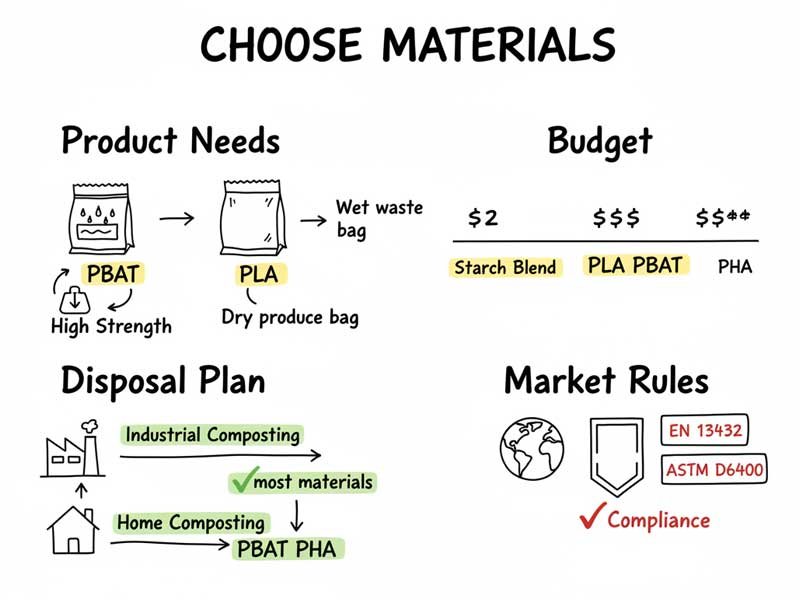
Biodegradable vs Compostable vs Biobased
These words are often mixed together.
They should not be.
| Term | What It Means | Buyer Risk |
|---|---|---|
| Biodegradable | The material can break down under certain conditions | Too vague unless the environment and time are clear |
| Compostable | The packaging can biodegrade under defined composting conditions | Needs industrial or home compostability evidence |
| Biobased | The material is partly or fully made from biological resources | Biobased does not automatically mean biodegradable or compostable |
| Recyclable | The packaging can be collected, sorted, and recycled in practice | Not the same as biodegradable or compostable |
The European Commission explains that the term “bioplastics” is often used for different materials and may be misleading.
A biobased plastic is not automatically compostable.
A biodegradable plastic is not automatically suitable for composting.
A compostable plastic still needs the right collection and treatment route.
What Article 14 Says About Environmental Claims
Article 14 of PPWR applies to environmental claims about packaging properties for which PPWR sets legal requirements.
For B2B buyers, the practical meaning is this:
If you make a packaging claim, you need evidence in the technical file.
This affects wording on:
- Bags
- Cartons
- Retail packs
- Product pages
- Catalogues
- Private-label artwork
- Distributor sales sheets
Claims should not be vague.
They should not suggest a wider benefit than the evidence supports.
They should not apply to the whole product if they only apply to one part.
What EU Buyers Should Avoid Claiming
Some claims are high risk because they are broad or hard to prove.
| Claim | Why It Is Risky | Safer Direction |
|---|---|---|
| Eco-friendly | Generic and broad | Use a specific, proven claim |
| Green packaging | Can suggest overall environmental superiority | State the exact property and evidence |
| 100% sustainable | Very hard to prove for full life cycle | Avoid |
| Planet safe | Broad and emotional | Avoid |
| Biodegradable | Vague without receiving environment and timeframe | Specify condition, standard, and limits |
| Compostable anywhere | Compostability depends on facility or home composting conditions | State industrial or home composting route |
| Plastic-free | Compostable plastic is still plastic if it is a plastic polymer | Use only if technically true |
| Zero waste | Usually overbroad | Use clear disposal or collection wording |
Directive (EU) 2024/825 also strengthens EU consumer protection against misleading environmental claims.
It targets generic environmental claims, including terms such as “eco-friendly,” “green,” “biodegradable,” and “biobased,” when recognised excellent environmental performance cannot be demonstrated.
The European Commission states that Member States had until 27 March 2026 to transpose the Directive, and it applies from 27 September 2026.
Compostable Claims Need a Clear Disposal Route
Compostable is more specific than biodegradable.
But it still needs care.
A compostable claim should tell buyers and users the correct route.
For example:
- Industrially compostable
- Home compostable
- Certified under a named standard or scheme
- Accepted only where suitable collection and treatment systems exist
PPWR Article 12 also matters for certain compostable packaging covered by Article 9.
The label must indicate that the material is compostable, not suitable for home composting, and not to be discarded in nature, where those rules apply.
Artwork teams should also review PPWR packaging labelling requirements before printing claims.
Certificate, Test Report, and Technical Documentation Are Not the Same
Many claim mistakes start with document confusion.
A supplier may send a certificate, but that does not automatically approve every claim.
| Document | What It Does | What Buyers Should Check |
|---|---|---|
| Certificate | Shows certification under a scheme or standard | Product scope, holder, validity, logo use |
| Test report | Shows lab result for a sample | Sample thickness, material, ink, format |
| Supplier declaration | Supplier’s statement | Whether it is backed by test evidence |
| Technical documentation | Evidence file behind conformity and claims | Whether claims are supported under Annex VII |
| Artwork file | Printed claims and disposal wording | Whether wording matches evidence |
Buyers should also compare certification evidence in our compostable certifications guide.
For broader certification terms, see our compostable certifications overview.
Decision Table for Claim Review
| Claim Situation | Risk Level | Buyer Action |
|---|---|---|
| “Biodegradable” with no environment or timeframe | High | Replace with specific wording or remove |
| “Industrially compostable under EN 13432” | Lower if supported | Verify finished packaging evidence |
| “Home compostable” | Medium to high | Check finished product certificate and target market |
| “Eco-friendly bag” | High | Avoid generic wording |
| Certification logo printed on bag | Medium | Check logo licence and certified scope |
| Claim applies only to packaging film | Medium | Do not imply the whole product has the same claim |
| Supplier gives only raw material certificate | High | Ask for finished packaging evidence |
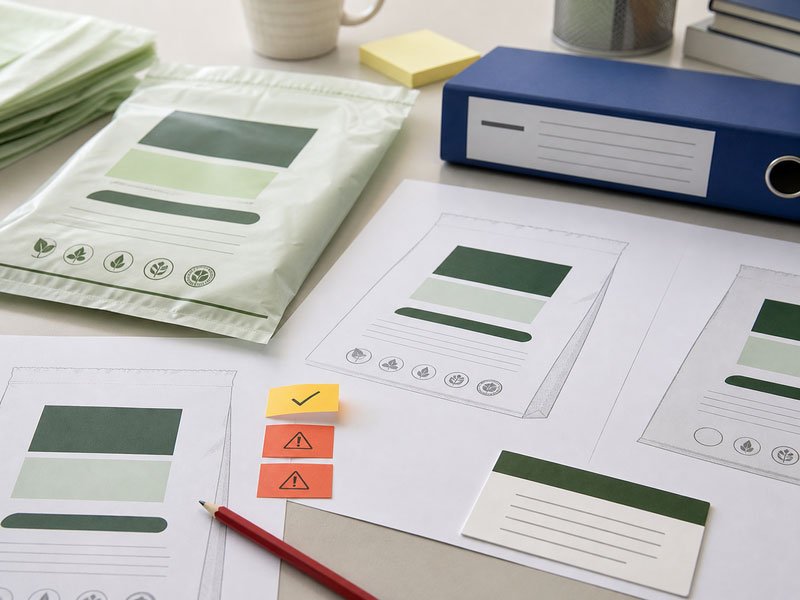
Buyer Checklist Before Approving Artwork
Before printing biodegradable or compostable claims, ask:
- What exact claim will appear on the packaging?
- Does the claim say biodegradable, compostable, biobased, or recyclable?
- Which part of the packaging does the claim cover?
- Is the evidence for raw material or finished packaging?
- Does the certificate cover the final thickness, ink, and format?
- Is the claim supported in technical documentation?
- Does the wording explain the correct disposal route?
- Does the target EU market accept the claim?
- Is a certification logo used?
- Is logo use authorised for this SKU?
- Could the wording encourage littering?
The last question matters.
The European Commission policy framework says biodegradable and compostable labels should not mislead consumers or encourage disposal in a way that causes plastic pollution.
Supplier Red Flags
Be careful if a supplier says:
- “Biodegradable and compostable are the same.”
- “Eco-friendly is fine because the bag is compostable.”
- “You can print any compostable logo.”
- “The raw material certificate covers all finished bags.”
- “Plastic-free is fine for compostable plastic bags.”
- “No need to mention industrial composting.”
- “Biodegradable means it can be discarded in nature.”
- “PPWR compliant” without technical documentation support.
These answers show claim-control risk.
They also increase the chance of artwork revisions, buyer complaints, or customs and market checks.
B2B Procurement Case
A private-label brand in France wants custom printed compostable mailer bags.
The first artwork says:
“100% eco-friendly biodegradable packaging. Safe for nature.”
The supplier provides a raw material certificate only.
This is a risky setup.
The claim is broad. It does not explain the composting route. It may suggest the bag can be discarded in nature. The certificate does not prove the finished printed bag.
A better artwork review would ask for:
- Finished bag specification
- Compostability certificate scope
- Ink and print coverage review
- Industrial or home composting route
- Logo authorisation
- Technical documentation support
- Target market disposal wording
A safer claim may be:
“Industrially compostable where accepted by local facilities. Do not discard in nature.”
Only use this if the finished product evidence supports it.
How Orizon Supports Safer Compostable Packaging Claims
Orizon manufactures compostable bags for importers, distributors, wholesalers, retailers, and private-label brands.
We support OEM and ODM projects for:
- Compostable garbage bags
- Compostable shopping bags
- Compostable produce bags
- Compostable mailer bags
- Compostable garment bags
- Compostable dog waste bags
- Custom printed compostable packaging
For claim-sensitive artwork projects, review our custom printed compostable bags options.
For EU-focused projects, we help buyers review product specifications, certificate scope, printing details, label wording, and batch traceability before production.
Our factory has 16 years of manufacturing experience, about 20,000 square meters of production space, 16 fully automatic production lines, and monthly capacity of about 500 tons.
We do not recommend broad claims such as “eco-friendly” or “safe for nature.”
Instead, we help buyers align claims with finished packaging evidence and practical disposal routes.
That is safer for EU importers and private-label programs.
FAQ
Can packaging be labelled biodegradable under PPWR?
Biodegradable claims should be used carefully. Buyers should specify the receiving environment, timeframe, standard, and evidence. A broad “biodegradable” claim can be misleading if it is not clearly supported.
Is biodegradable the same as compostable?
No. Compostable packaging is a specific type of biodegradable packaging designed for defined composting conditions. Biodegradable is broader and can be vague without conditions and timing.
Can EU buyers use “eco-friendly” on compostable packaging?
EU buyers should avoid generic claims such as “eco-friendly” unless they can prove recognised excellent environmental performance and the claim is clear, specific, and not misleading.
Does a compostable certificate approve every environmental claim?
No. A compostable certificate may support a specific compostability claim, but it does not automatically support broad claims such as sustainable, green, eco-friendly, or plastic-free.
What should buyers check before printing biodegradable claims?
Buyers should check the finished packaging evidence, certificate scope, claim wording, disposal route, target market rules, logo authorisation, and technical documentation.
Can compostable packaging be discarded in nature?
No. Compostability depends on the right composting environment. Claims should not encourage littering or suggest that packaging can be discarded in nature.
Conclusion
PPWR biodegradable packaging claims need careful control.
EU buyers should avoid broad words such as eco-friendly, green, sustainable, and safe for nature unless the claim is specific and strongly supported.
Biodegradable, compostable, and biobased are different terms. Each needs its own evidence.
Before approving artwork, check the finished packaging, certificate scope, disposal route, technical documentation, and target market rules.
A clear, specific claim is less flashy, but it is much easier to defend.
Official Sources
- EUR-Lex: Regulation (EU) 2025/40
- EUR-Lex: Directive (EU) 2024/825
- European Commission: Sustainable Consumption
- European Commission: Biobased, Biodegradable and Compostable Plastics
- European Commission: EU Policy Framework for Biobased, Biodegradable and Compostable Plastics
- European Commission: Green Claims