A buyer sends a supplier this message:
“Please quote compostable produce bags for supermarkets. We need 100,000 bags.”
It sounds clear.
It is not.
Before a factory can prepare an accurate quotation, it still needs to know the bag format, dimensions, thickness, bags per roll, core size, roll diameter, perforation, dispenser requirements, printing, certification, packing and delivery terms.
One missing detail can change the price.
Several missing details can result in two suppliers quoting products that are not actually comparable.
For roll-fed supermarket produce bags, dispenser compatibility should be confirmed together with the bag and roll specification. A roll can have the correct bag size and thickness but still fail in store if the core, roll width, outer diameter, perforation or winding direction does not match the dispenser.
This guide explains what to include in a practical B2B RFQ for compostable produce bags.
The goal is simple:
Give every supplier enough information to quote and manufacture the same product.
For common roll configurations, see our Compostable Produce Bags on a Roll.
Last reviewed: 26 September 2026
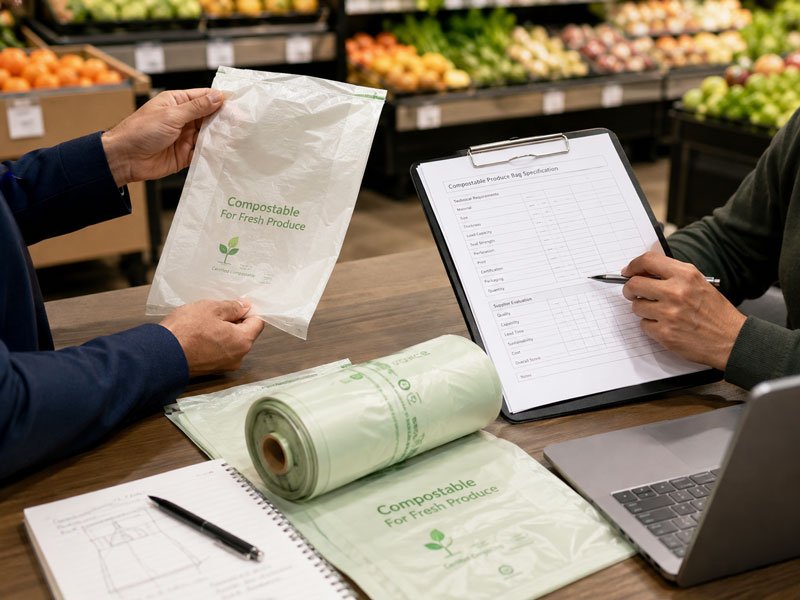
Why “Please Quote Compostable Produce Bags” Is Not Enough
Produce bags look simple.
The specification is not.
Consider two quotations.
Supplier A
250 × 450 mm
12 μm
500 bags/roll
Supplier B
250 × 450 mm
15 μm
250 bags/roll
Both suppliers may describe the product as:
compostable produce bags for supermarkets
But they are not quoting the same product.
The differences affect:
- material consumption
- bag weight
- finished roll diameter
- roll replacement frequency
- carton quantity
- shipping weight
- dispenser fit
- final cost
A useful RFQ should therefore describe the finished operating specification, not only the product name.
The 11 Specifications Every Produce Bag RFQ Should Include
At minimum, confirm:
- Bag format
- Bag dimensions
- Film thickness
- Bags per roll
- Core and roll dimensions
- Dispenser compatibility
- Printing and film appearance
- Required certification
- Packing configuration
- Order volume
- Incoterm and destination
For an existing supermarket program, also send the current roll specification or a physical sample if possible.
A full reference roll is often more useful than a long email description.
1. Define the Produce Bag Format
Start with the bag construction.
Different bag formats can require different film widths, thicknesses, roll structures and dispenser setups.
Flat Open-Top Bags on Roll
This is a common format for supermarket fruit and vegetable sections.
The shopper tears one bag from the roll, opens it and places loose produce inside.
C-Fold Produce Bags
The film is folded before winding.
The fold changes the finished roll width and can affect how the roll feeds through the dispenser.
Vest or T-Shirt Produce Bags
These bags have built-in handles.
They usually require a different size and thickness approach because they may carry heavier produce.
Flat Loose Produce Bags
These bags are supplied loose or in packs rather than on a dispenser roll.
Do not write only:
Produce bag.
Instead write:
Flat open-top compostable produce bag on roll
or:
Vest-style compostable produce bag on roll
For OEM structures, colors, printing and packing options, see our Custom Compostable Produce Bags.
2. Give the Exact Bag Size
Always state the dimensions.
For example:
250 mm W × 450 mm L
If the bag has gussets, show them separately.
For example:
300 + 75 + 75 mm × 500 mm
Do not write:
Medium produce bag.
There is no useful manufacturing definition of “medium.”
Width, Length and Gusset
These dimensions affect:
- film area
- bag weight
- product capacity
- roll width
- finished roll diameter
- carton weight
- material consumption
- cost
A small dimensional change becomes important when the order contains hundreds of thousands of bags.
Use millimeters or centimeters and make the specification clear.
Use Your Existing Produce Bag as a Reference
If you are replacing an existing PE or compostable produce bag that already works well, send:
- one unused bag
- one full roll if possible
- current specification sheet
- roll photos
- dispenser photos
A physical reference can reduce specification errors.
3. Specify Film Thickness
Film thickness is normally expressed in microns, or μm.
Do not select thickness only by copying another supplier.
It should be considered together with:
- bag dimensions
- produce type
- expected load
- puncture risk
- material formulation
- transparency
- bags per roll
- roll diameter
- cost
A practical starting framework for ORIZON projects is:
| Produce Bag Type | Practical Starting Range | Starting Point |
|---|---|---|
| Supermarket roll produce bags | 10–15 μm | 12 or 15 μm |
| Standard loose produce bags | 15–18 μm | About 15 μm |
| Heavier fruit / market use | 18–20 μm | 18 or 20 μm |
| Secondary food-waste use | 20–25 μm | 20 or 25 μm |
| Handle / T-shirt produce bags | 20–30 μm | Based on expected load |
These are starting references, not universal standards.
A lightweight roll program may test 12 μm.
Many standard projects can start by evaluating 15 μm.
Heavier produce or larger bags may require 18–20 μm or another approved specification.
The final thickness should be confirmed through testing.
For a detailed comparison, see our Compostable Produce Bag Thickness Guide.
4. Define the Complete Roll Specification
For supermarket produce bags, the bag specification and roll specification should be confirmed together.
Do not write only:
150 bags per roll.
The factory also needs to know the paper core, finished roll size, perforation and dispenser requirements.
A complete roll specification may include:
| RFQ Field | Example Project Specification |
|---|---|
| Bag Size | (190 + 95 × 2) × 510 mm |
| Unfolded Bag Size | 380 × 510 mm |
| Film Thickness | 13 μm |
| Bags per Roll | 150 pcs |
| Bag Structure | Star seal |
| Film Appearance | Transparent |
| Printing | 1 side / 1 color |
| Print Color | PMS 348C green |
| Paper Core Length | 130 mm |
| Core ID | 30 mm |
| Core Wall Thickness | 3 mm |
| Core OD | 36 mm |
| Tear Opening | 30 mm |
| Finished Roll Width | To be measured on the trial roll |
| Finished Roll OD | To be measured on the final trial roll |
| Winding Direction | To be confirmed |
| Dispenser Shaft Diameter | 22 mm |
| Dispenser Shaft Length | 137 mm |
| Usable Dispenser Width | To be measured |
| Maximum Dispenser Roll OD | To be measured |
The paper core already matches the dispenser shaft in two key dimensions: 30 mm core ID > 22 mm dispenser shaft diameter and: 130 mm paper core length < 137 mm dispenser shaft length
However, this does not confirm the complete dispenser fit.
The finished roll width and finished roll OD still need to be checked against the available space inside the dispenser.
Bags per Roll
The number of bags per roll affects more than the roll count.
More bags normally mean:
- more film on the roll
- a larger finished roll OD
- more roll weight
- fewer roll changes in store
For this example project, the target is:
150 bags per roll
If the thickness or bag dimensions change, the finished roll diameter should be checked again.
Paper Core
The paper core should be specified by actual dimensions.
For this project:
Core length: 130 mm
Core ID: 30 mm
Core wall thickness: 3 mm
Core OD: 36 mm
Do not use only the phrase:
standard core
because supermarket dispenser shafts and holders can vary.
Finished Roll Outer Diameter
Finished roll OD means the total outside diameter after all bags have been wound onto the paper core.
It is different from the core OD.
For this project:
Core OD = 36 mm
The final roll OD should be measured after the trial roll is produced.
If the dispenser has a fixed maximum roll diameter, the finished roll must remain below that limit.
Perforation
The perforation should allow one bag to tear away cleanly without damaging the next bag.
For this project, the tear opening is:
30 mm
The final tear performance should still be tested with the actual roll and dispenser.
A correct roll specification tells the factory what to manufacture.
The next step is to confirm that the finished roll can actually fit and operate in the supermarket dispenser.
5. Confirm Produce Bag Dispenser Compatibility
A produce bag roll can have the correct bag size, thickness and bag count but still fail in store if it does not fit or operate correctly in the dispenser.
For replacement supermarket programs, the existing dispenser should therefore be treated as part of the product specification.
Do not assume that every produce bag roll fits every supermarket dispenser.
What Should You Measure on a Produce Bag Dispenser?
Before requesting a replacement or custom compostable roll, confirm:
| Dispenser / Roll Parameter | What to Confirm | Why It Matters |
|---|---|---|
| Usable roll width | Maximum space available for the roll | The roll must fit between the supports |
| Shaft / spindle diameter | Diameter of the dispenser shaft | The core must fit over the shaft |
| Core inside diameter | ID of the current paper core | Determines mounting compatibility |
| Core wall thickness | Thickness of the core wall | Changes starting roll diameter |
| Maximum roll OD | Maximum roll diameter the dispenser accepts | Oversized rolls may jam or fail to rotate |
| Bags per roll | Current or target bag count | Changes finished roll diameter |
| Film thickness | Required film gauge | Thicker film normally increases roll OD |
| Perforation | Tear spacing and performance | Bags must separate cleanly |
| Winding direction | Direction the roll unwinds | Affects feeding through the dispenser |
| Bag opening orientation | Position after tearing | Affects shopper usability |
These parameters should be reviewed together.
Does Every Produce Bag Roll Fit a Standard Dispenser?
No.
There is no single roll specification that fits every supermarket produce bag dispenser.
Two rolls can use the same bag size but have different:
- core IDs
- core wall thicknesses
- roll widths
- outer diameters
- bags per roll
- perforation positions
- winding directions
This is why:
“Fits standard supermarket dispenser”
is not a complete OEM specification.
For an existing program, send the actual dispenser measurements or a current roll sample.
How Film Thickness Changes Dispenser Fit
Film thickness is directly connected to roll diameter.
If the bag dimensions, core and bags per roll remain unchanged:
same bag size + thicker film + same bag count = larger finished roll
If the dispenser has a fixed maximum roll OD, the buyer may need to:
- reduce bags per roll
- change the core configuration
- use a larger dispenser
- reconsider the film thickness
Thickness should therefore not be approved separately from the roll specification.
New Supermarket Program vs Replacement Program
For a new supermarket program, there may be more flexibility.
A new program can be developed in this order:
bag size → thickness → bags per roll → core → roll OD → dispenser
A replacement program usually works in the opposite direction:
existing dispenser → available roll space → core → maximum roll OD → bags per roll → film thickness
The starting point is different.
Real Produce Roll Specification Example
A real produce bag project shows why the roll and dispenser details should be included in the RFQ.
The bag specification alone does not tell the factory whether the finished roll will fit the dispenser.
| RFQ Item | Project Specification |
|---|---|
| Bag Size | (190 + 95 × 2) × 510 mm |
| Unfolded Bag Size | 380 × 510 mm |
| Film Thickness | 13 μm |
| Bags per Roll | 150 |
| Bag Structure | Star seal |
| Film Color | Transparent |
| Printing | 1 side / 1 color |
| Print Color | PMS 348C green |
| Paper Core Length | 130 mm |
| Core ID | 30 mm |
| Core Wall Thickness | 3 mm |
| Core OD | 36 mm |
| Dispenser Shaft Diameter | 22 mm |
| Dispenser Shaft Length | 137 mm |
| Tear Opening | 30 mm |
| Finished Roll OD | Final trial roll to be measured |
| Usable Dispenser Width | To be measured |
| Maximum Dispenser Roll OD | To be measured |
The confirmed dimensions already show that the 30 mm core ID can fit over the 22 mm dispenser shaft, and the 130 mm paper core is shorter than the 137 mm shaft.
However, this does not complete the compatibility check.
The finished roll width, finished roll OD and available dispenser space should still be measured before bulk production.
Why These Missing Measurements Still Matter
A paper core can fit the dispenser shaft while the finished roll itself is still too large.
Before final approval, check:
- finished roll width
- finished roll outer diameter
- usable dispenser width
- maximum roll OD accepted by the dispenser
- roll rotation
- perforation and tear-off
- winding direction
This is why an RFQ should describe the complete roll and dispenser system, not only the bag dimensions.
For custom roll development and compatibility testing, see our Custom Compostable Produce Bags.
What Should You Send the Supplier?
For a dispenser compatibility review, send:
- dispenser photos
- dispenser make or model, if available
- usable roll width
- shaft or spindle diameter
- current core ID
- current core wall thickness
- maximum available roll OD
- current bags per roll
- current roll photos
- one complete reference roll if possible
A physical reference roll is usually more useful than saying:
“Please make it fit a standard supermarket dispenser.”
ORIZON can review an existing PE or compostable roll when developing a replacement compostable roll configuration.
Video: How We Check Produce Bag Roll Dispenser Compatibility
[VIDEO EMBED POSITION]
A supermarket produce bag roll should be checked as a complete dispensing system.
In this demonstration, we check:
- roll width
- paper core inside diameter
- dispenser shaft diameter
- finished roll OD
- winding direction
- perforation
- bag separation
- roll rotation inside the dispenser
A successful compatibility test should confirm that the roll installs correctly, rotates freely and allows one bag to be removed without damaging the next bag.
6. Define Film Appearance and Printing
Next, define what the bag should look like.
Possible requirements include:
- natural translucent
- clear
- high transparency
- green tint
- custom film color
If produce visibility matters, do not write only:
Transparent.
Send a physical reference or agreed visual standard.
For more detail, see our Compostable Produce Bag Transparency Guide.
Custom Printing
If printing is required, state:
- number of print colors
- one-side or two-side printing
- logo
- instructions
- certification marks
- barcode if required
- Pantone reference
- print repeat
- approximate print coverage
Then send the final artwork.
Instead of:
Green logo
write:
Pantone reference: ___
when color matching matters.
Certification Marks Need Extra Attention
A certification logo is not simply another design element.
Do not assume that because a material has certification, every certification mark can automatically be printed on every custom bag.
The final:
- material formulation
- bag dimensions
- thickness
- printing
- color
- certification scope
- mark-use requirements
should be checked before artwork approval.
7. State the Required Certification and Target Market
Do not write only:
Need compostable certificate.
Tell the supplier where the bags will be sold and what certification or documentation your buyer requires.
Common references may include:
| Market | Common Compostability Reference |
|---|---|
| United States | ASTM D6400 / BPI where applicable |
| Europe | EN 13432 / applicable market requirements |
| Australia | AS 4736 or AS 5810 depending on the intended composting route |
The correct requirement depends on the finished product, target market and intended claim.
Certification should be checked against the actual finished specification rather than assumed from the base material alone.
For a broader overview, see our Compostable Certifications Guide.
Australia
For Australian projects, clearly state:
- target market
- required compostability standard
- certification mark requirement
- intended organics or retail application
For more detail, see our AS4736 Compostable Produce Bags Australia Guide.
United States
If ASTM D6400 or BPI-related certification is required, state that requirement clearly in the RFQ.
Do not write:
ASTM / BPI maybe.
Confirm what your retailer, distributor or compliance team actually requires.
European Union
For EU projects, define:
- destination Member State
- intended use
- product type
- required compostability documentation
- labeling requirements
- environmental claims
Do not assume that one phrase such as:
PPWR compliant
is a complete product specification.
For produce-bag projects in the EU, see our PPWR Compostable Produce Bags Guide.
8. Define Packing Before Asking for Final Pricing
The bag specification is only part of the quotation.
Packing also affects:
- cost
- carton size
- shipping weight
- pallet quantity
- container utilization
Roll Packing
For example:
250 bags/roll
6 rolls/carton
Inner Packaging
Specify whether you require:
- no individual wrapping
- paper band
- compostable outer bag
- other approved wrapping
- custom private-label packaging
Master Carton
Confirm:
- rolls per carton
- carton dimensions
- net weight
- gross weight
- carton printing or labeling
Pallet Requirements
If pallets are required, specify:
- pallet type
- maximum pallet height
- maximum pallet weight
- cartons per pallet
- destination-specific wood packaging requirements where applicable
Do not wait until production is complete to discuss palletization.
9. Give the Order Volume and Annual Forecast
Do not write:
Best price please.
Give a real quantity.
For example:
Trial: 500 kg
or:
2,400 rolls
or:
1 × 20GP
If available, also provide an annual forecast.
For example:
Initial order: 500 kg
Estimated annual requirement: 5–8 tons
This helps the supplier understand whether the project is:
trial procurement
or:
repeat commercial supply.
ORIZON’s standard custom produce-bag MOQ is usually approximately 500 kg per specification.
The final number of bags and rolls depends on:
- bag dimensions
- film thickness
- bags per roll
- core
- roll configuration
10. State the Incoterm and Destination
Do not ask only:
Please give shipping price.
State:
- destination
- requested Incoterm
- named port or place
For example:
Destination: Melbourne, Australia
Requested term: CIF Melbourne
or:
FCA supplier factory
The important point is that the quotation must clearly identify the trade term and named destination.
Do Not Skip Sample Approval
A detailed RFQ improves the quotation.
A sample confirms the product.
Before mass production, approve:
- bag dimensions
- thickness
- film feel
- transparency
- color
- printing
- perforation
- roll width
- core
- roll OD
- winding direction
- dispenser fit
- bag opening
- packing
For an existing supermarket program, test the sample in the actual dispenser.
Use the actual produce where possible.
A specification can look correct on paper and still perform poorly in daily use.
Build a Golden Sample
For repeat supply, keep one approved production reference sample.
The Golden Sample can be used to compare:
- dimensions
- thickness
- film feel
- clarity
- color
- printing
- roll format
- core
- perforation
- winding
- dispenser fit
The physical sample should be supported by an approved written specification.
Do not rely on:
Same as last time.
Complete Supermarket Produce Bag RFQ Template
Copy this table when preparing your next sourcing request.
Compostable Produce Bag RFQ
| RFQ Item | Buyer Requirement |
|---|---|
| Product | Compostable produce bags for supermarkets |
| Bag format | Flat / C-fold / Vest / Other |
| Bag width | ___ mm |
| Bag length | ___ mm |
| Gusset | ___ mm / None |
| Thickness | ___ μm |
| Film appearance | Clear / High clarity / Natural / Color |
| Film color | ___ |
| Typical produce | ___ |
| Expected load | ___ kg |
| Bags per roll | ___ pcs |
| Roll width | ___ mm |
| Core ID | ___ mm |
| Core wall thickness | ___ mm |
| Maximum roll OD | ___ mm |
| Perforation | Standard / Easy tear / Reference sample |
| Winding direction | ___ |
| Dispenser type | Existing / New / Not yet selected |
| Dispenser shaft diameter | ___ mm |
| Usable dispenser width | ___ mm |
| Dispenser photo / drawing | Attached / Not available |
| Reference roll | Available / Not available |
| Printing | None / ___ colors |
| Printing sides | One / Two |
| Pantone reference | ___ |
| Certification required | ___ |
| Certification mark printing | Yes / No |
| Food-contact documentation | Target-market requirement |
| Rolls per carton | ___ |
| Inner packing | ___ |
| Carton requirement | ___ |
| Pallet required | Yes / No |
| Initial order volume | ___ |
| Annual forecast | ___ |
| Destination | ___ |
| Incoterm | ___ + named place / port |
| Sample approval required | Yes |
Example of a Well-Written Produce Bag RFQ
Compare this:
Please quote compostable produce bags.
We need good quality and a good price.
with this:
We are sourcing compostable produce bags for a supermarket roll system.
Bag size: (190 + 95 × 2) × 510 mm
Unfolded size: 380 × 510 mm
Thickness: 13 μm
Film appearance: Transparent
Bag structure: Star seal
Bags per roll: 150 pcs
Printing: 1 side / 1 color
Print color: PMS 348C green
Paper core length: 130 mm
Core ID: 30 mm
Core wall thickness: 3 mm
Core OD: 36 mm
Tear opening: 30 mm
Existing dispenser: Yes
Dispenser shaft diameter: 22 mm
Dispenser shaft length: 137 mm
Finished roll width: To be measured on the trial roll
Finished roll OD: To be confirmed after trial production
Usable dispenser width: To be measured
Maximum dispenser roll OD: To be measured
Winding direction: To be confirmed
Reference roll / dispenser photos: Available if required
The second RFQ gives the supplier enough information to understand both the bag and the roll system.
It also shows which specifications are already confirmed and which still need to be measured before mass production.
This makes quotations easier to compare and reduces the risk of producing a roll that does not fit the existing dispenser.
For replacement supermarket programs, the trial roll should be tested in the actual dispenser before the final specification is approved.
Common Produce Bag RFQ Mistakes
Mistake 1: Giving Only the Bag Size
250 × 450 mm
is not enough.
Add the film thickness and roll configuration.
Mistake 2: Giving Only Bags per Roll
500 bags/roll
does not tell the supplier whether the finished roll will fit the dispenser.
Add:
- core
- roll width
- maximum roll OD
- dispenser dimensions
Mistake 3: Asking for a “Standard Core”
Measure it.
Give:
core ID + core wall thickness
Mistake 4: Asking for a “Standard Dispenser Roll”
There is no reason to assume that one roll configuration fits every supermarket produce bag dispenser.
Check:
- usable roll width
- shaft diameter
- core ID
- maximum roll OD
- winding direction
- perforation
For a replacement program, send the current roll and dispenser information before production.
Mistake 5: Saying Only “Transparent”
Transparency is subjective.
If clarity matters commercially, send a physical reference or visual approval standard.
Mistake 6: Asking for “All Certifications”
More certification logos do not automatically make the product more suitable.
Specify the target market and actual certification requirement.
Mistake 7: Changing Thickness After Roll Approval
Changing:
12 μm → 18 μm
can affect:
- material weight
- finished roll OD
- bags per roll
- carton weight
- cost
- dispenser fit
Recheck the roll specification after changing thickness.
Mistake 8: Comparing Quotations With Different Specifications
A lower price is not meaningful if one supplier quoted 12 μm and another quoted 18 μm.
Prepare one RFQ.
Send the same specification to every shortlisted supplier.
Then compare.
A Good RFQ Reduces More Than Pricing Errors
The purpose of a detailed RFQ is not paperwork.
It reduces ambiguity.
For supermarket produce bags, these variables form one connected system:
bag size + thickness + bags per roll + core + roll OD + dispenser + perforation + printing + certification + packing + quantity
Changing one item can affect several others.
That is the difference between buying:
“a compostable produce bag”
and developing:
a repeatable supermarket produce-bag supply program.
FAQ About Compostable Produce Bag RFQs
What information should I provide when requesting a quote for compostable produce bags?
Provide the bag format, dimensions, thickness, bags per roll, roll width, core dimensions, maximum roll OD, dispenser information, printing, certification, packing, quantity and destination.
If you are replacing an existing product, send a reference bag or full roll when possible.
Do compostable produce bag rolls fit standard supermarket dispensers?
Not automatically.
Compatibility depends on the roll width, core ID, dispenser shaft size, maximum roll OD, film thickness, bags per roll, perforation and winding direction.
For a replacement program, check the existing dispenser before approving production.
What information is needed to check produce bag dispenser compatibility?
Provide:
- usable dispenser width
- shaft or spindle diameter
- current core ID
- current core wall thickness
- maximum roll OD
- bags per roll
- dispenser photos
- reference roll if available
These details allow the roll specification to be reviewed before mass production.
What thickness should supermarket compostable produce bags use?
There is no single thickness for every project.
For ORIZON projects, lightweight roll bags may start around 12 μm, many standard projects may evaluate 15 μm, and heavier produce applications may require 18–20 μm or another approved specification.
The final thickness should be tested with the actual bag size and application.
How many bags should be packed on each produce roll?
Typical ORIZON produce-roll projects may use approximately 200–500 bags per roll.
The correct count depends on bag size, thickness, core, maximum roll OD and dispenser space.
Why do I need to specify core diameter and roll OD?
These dimensions affect whether the finished roll fits and rotates correctly in the supermarket dispenser.
Two rolls with the same number of bags can have different outside diameters because of differences in film thickness, bag dimensions and core size.
Can compostable produce bags be custom printed?
Yes.
Custom OEM projects can include logos, instructions, film color and other printing, subject to the approved film specification and applicable certification requirements.
For custom projects, see Custom Compostable Produce Bags.
Which compostability certification should I request?
That depends on the destination market, intended use and claim.
State the market first, then confirm the appropriate standard, certificate scope and mark-use requirements.
See our Compostable Certifications Guide.
What is the MOQ for custom compostable produce bags?
ORIZON’s standard custom production MOQ is usually approximately 500 kg per specification.
The final bag and roll quantity depends on the dimensions, thickness and roll configuration.
Ready to Prepare a Produce Bag RFQ?
If you already have an existing supermarket produce roll, send us:
- bag dimensions
- thickness
- bags per roll
- core dimensions
- roll OD
- dispenser photos
- reference roll if available
- printing requirements
- required certification
- order quantity
We can review the specification before preparing the quotation.
View our Compostable Produce Bags on a Roll.
Explore Custom Compostable Produce Bags.
B2B and OEM supply only.