How much does one 9 × 13 inch dog poop bag weigh? For a B2B buyer, this is not a small detail.
Bag weight affects:
- material consumption
- price per bag
- roll weight
- carton weight
- how many rolls can be produced from a production batch
- freight and landed cost
A 9 × 13 inch bag at 18 microns does not weigh the same as the same bag at 20 or 25 microns.
This guide shows the calculation.
Quick Answer: 9×13 inch Dog Poop Bag Weight
Using an exact bag size of 9 × 13 inches (In actual production, the factory manufactures the product according to the 23 x 33 cm specifications), a two-layer flat bag and a planning material density of approximately 1.20 g/cm³, the theoretical film weight is:
| Thickness | Approx. Weight per Bag | Film Weight per 15-Bag Roll | Approx. Rolls from 500 kg |
|---|---|---|---|
| 15 μm | 2.72 g | 40.8 g | 12,267 |
| 18 μm | 3.26 g | 48.9 g | 10,222 |
| 20 μm | 3.62 g | 54.3 g | 9,200 |
| 25 μm | 4.53 g | 67.9 g | 7,360 |
| 30 μm | 5.43 g | 81.5 g | 6,133 |
These are theoretical film-weight calculations, not guaranteed production weights.
Printing ink, film formulation, thickness tolerance and actual finished dimensions can change the final result.
Paper cores, labels and retail packaging are not included.
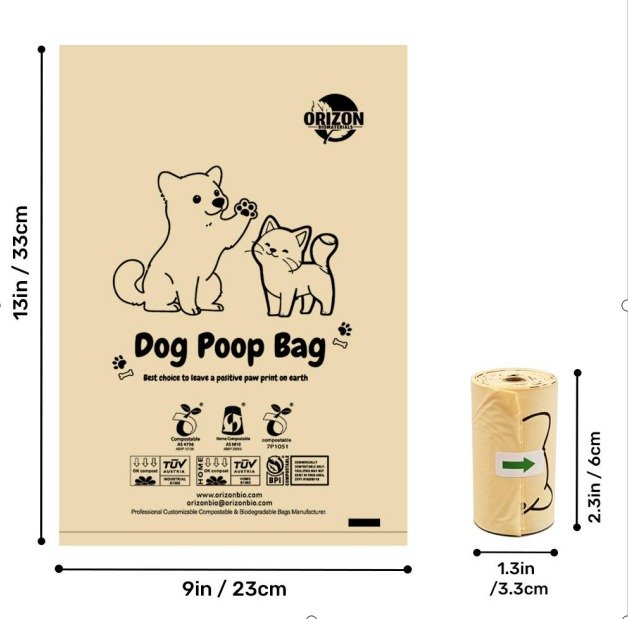
What Size Is a 9×13 Inch Dog Poop Bag?
The exact metric conversion is:
9 inches = 22.86 cm
13 inches = 33.02 cm
So an exact 9 × 13 inch bag is:
22.86 × 33.02 cm
In manufacturing, buyers may also describe a similar product as:
23 × 33 cm
The two specifications are very close, but they are not mathematically identical.
That matters when you calculate millions of bags.
For product development, I recommend using the actual production dimensions rather than treating 9 × 13 inch and 23 × 33 cm as exactly the same size.
For a wider comparison of common dog waste bag dimensions, see our Dog Waste Bag Size Guide.
How Is Dog Poop Bag Weight Calculated?
For a simple flat bag, the calculation starts with four numbers:
width × length × thickness × material density
But there is one detail buyers often miss.
A flat dog poop bag has two film walls.
So the formula must include both layers.
Weight Formula
Bag Weight (g) = Width × Length × Thickness × 2 × Material Density
When dimensions are entered in millimeters and thickness in microns:
Weight (g) = Width (mm) × Length (mm) × Thickness (μm) × 2 × Density ÷ 1,000,000
For the examples on this page, I use:
Width = 228.6 mm
Length = 330.2 mm
Density = 1.20 g/cm³
The density is a planning value for the calculation.
Your final production calculation should use the density and finished weight of the approved material formulation.
Example: 9×13 Inch, 18 Micron
Take a standard flat bag:
228.6 mm × 330.2 mm
Thickness:
18 μm
Planning density:
1.20 g/cm³
The calculation is:
228.6 × 330.2 × 18 × 2 × 1.20 ÷ 1,000,000
The result is approximately:
3.26 g per bag
If there are 15 bags per roll:
3.26 × 15 = approximately 48.9 g of film per roll
That does not include the paper core or label.
Example: 9×13 Inch, 20 Micron
Keep the same size and material assumption.
Only change thickness to:
20 μm
The theoretical bag weight becomes:
approximately 3.62 g per bag
At 15 bags per roll:
approximately 54.3 g of film per roll
Compared with 18 μm:
3.62 g vs 3.26 g
That is roughly 11.1% more film per bag.
The difference looks small when you hold one bag.
Across 100,000 or 1,000,000 bags, it becomes a meaningful material and cost difference.
For a full comparison of these two specifications, see our 18 Micron vs 20 Micron Dog Poop Bags guide.
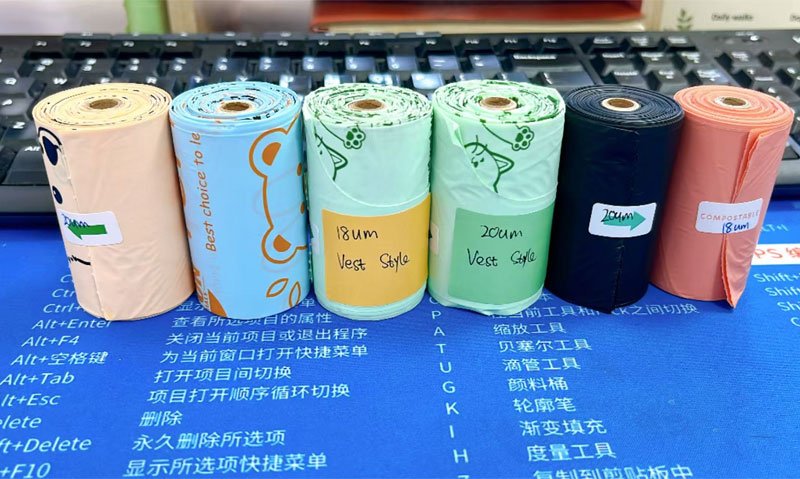
15, 18, 20, 25 or 30 Micron: Weight Comparison
Thickness changes bag weight almost in direct proportion when the size and material density stay the same.
15 Micron
A 9 × 13 inch bag is approximately:
2.72 g
This uses less material and allows more bags to be produced from the same film weight.
18 Micron
Approximate weight:
3.26 g
This is a useful reference point for many standard and premium dog waste bag projects.
20 Micron
Approximate weight:
3.62 g
It uses about 11.1% more film than 18 μm under the same assumptions.
25 Micron
Approximate weight:
4.53 g
At this point, product weight, roll diameter and freight impact become more noticeable.
30 Micron
Approximate weight:
5.43 g
This type of specification may be considered when a project requires a substantially heavier film, but roll size and packaging should be checked before approval.
A higher micron number is not automatically the better choice.
The finished bag still needs to be tested for seal quality, opening, perforation, puncture resistance and dispenser fit.
Why 23×33 cm May Show a Slightly Different Weight
You may have seen a 23 × 33 cm, 18 μm dog poop bag listed at around:
3.28 g
while the exact 9 × 13 inch calculation above gives:
3.26 g
Both can be correct.
The reason is dimension.
Exact 9 × 13 inch:
22.86 × 33.02 cm
Common metric specification:
23 × 33 cm
The metric version has slightly more film area.
Using the same 18 μm thickness and 1.20 g/cm³ planning density:
| Size | 18 μm Approx. Weight | 20 μm Approx. Weight |
|---|---|---|
| 9 × 13 inch | 3.26 g | 3.62 g |
| 23 × 33 cm | 3.28 g | 3.64 g |
The difference is small.
For quotation and mass production, however, always use the approved dimensions.
How Much Does a 15-Bag Roll Weigh?
Buyers often compare prices per roll.
That can be misleading unless the bag weight and bag count are the same.
For a 9 × 13 inch bag with 15 bags per roll:
| Thickness | Film Weight per Bag | Film Weight per 15-Bag Roll |
|---|---|---|
| 15 μm | 2.72 g | 40.8 g |
| 18 μm | 3.26 g | 48.9 g |
| 20 μm | 3.62 g | 54.3 g |
| 25 μm | 4.53 g | 67.9 g |
| 30 μm | 5.43 g | 81.5 g |
These figures are film only.
A finished paper-core roll will weigh more because it also includes:
paper core + label + film
For freight planning, use the actual finished roll and carton gross weight.
How Does Bag Weight Affect 500 kg Output?
Bag weight tells you how many finished units can theoretically be produced from a given film weight.
The basic formula is:
Number of Bags = Total Film Weight ÷ Weight per Bag
Using 500 kg, or 500,000 grams:
18 μm
500,000 ÷ 3.26 ≈ 153,300 bags
At 15 bags per roll:
≈ 10,220 rolls
20 μm
500,000 ÷ 3.62 ≈ 138,000 bags
At 15 bags per roll:
≈ 9,200 rolls
So changing only the thickness from 18 to 20 microns reduces theoretical output by roughly:
1,020 rolls per 500 kg
That is why bag weight matters in B2B purchasing.
For a more detailed bags-to-rolls-to-retail-box calculation, see our Dog Poop Bag MOQ: How Many Rolls in 500 kg? guide.
How Many Retail Boxes Can 500 kg Produce?
Assume a retail pack contains:
10 rolls × 15 bags = 150 bags
The theoretical retail-pack quantity becomes:
| Thickness | Approx. Rolls from 500 kg | Approx. 10-Roll Retail Boxes |
|---|---|---|
| 15 μm | 12,267 | 1,227 |
| 18 μm | 10,222 | 1,022 |
| 20 μm | 9,200 | 920 |
| 25 μm | 7,360 | 736 |
| 30 μm | 6,133 | 613 |
This is useful when a buyer is planning inventory.
A material specification that looks like a small technical change can alter the number of sellable units in the first production run.
Does Printing Change the Bag Weight?
Yes, but the main film-weight calculation should still start with the bag itself.
Printed bags may include additional ink mass.
The actual difference depends on:
- print coverage
- number of print colors
- one-side or two-side printing
- artwork repeat
- ink system
For most order planning, the base film weight gives you the starting point.
For final production and freight calculations, use the actual finished sample or production specification.
Does Film Color Change the Weight?
Custom film colors use color masterbatch or pigment.
This can slightly change the final formulation and finished weight.
That is another reason theoretical calculations should not replace actual QC data.
For an early quotation, calculated weight is useful.
For mass production approval, I prefer using:
approved dimensions + actual thickness + finished bag weight
Those three numbers give the buyer a much better reference.
Does Bag Weight Tell Me Whether the Bag Is Strong?
No.
Weight and thickness are useful specifications, but they do not fully describe performance.
A 3.62 g bag is not automatically better than a 3.26 g bag.
Finished performance also depends on:
- film formulation
- thickness consistency
- bottom seal
- perforation
- tensile behavior
- puncture resistance
This is why physical samples matter.
When I compare two specifications, I would not only put them on a scale.
I would also open them, tear them from the roll, stretch them, check the seal and test them in the intended dispenser.
How Bag Weight Affects Product Cost
For the same size and material formula, increasing thickness increases the amount of film used in each bag.
That raises the material portion of the cost.
But finished product cost includes more than film.
It may also include:
printing + paper core + labels + retail packaging + cartons + inspection + freight
So moving from 18 to 20 μm does not mean the entire retail pack price must increase by exactly 11.1%.
The film portion changes by roughly that amount under equal conditions.
The total finished-product cost needs a full quotation.
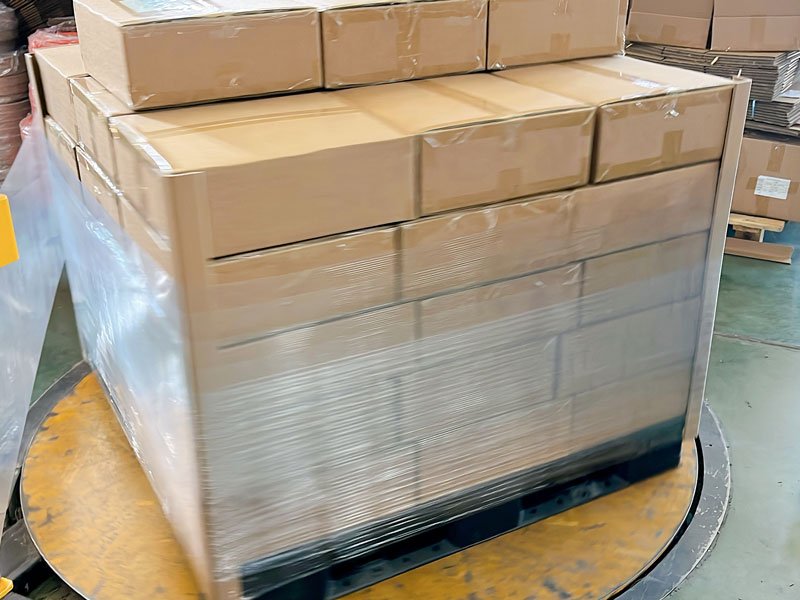
How Bag Weight Affects Shipping Cost
Higher bag weight also increases shipment weight.
For one roll, the difference may look small.
Across thousands of rolls, it adds up.
For example, the theoretical film weight of 10,000 rolls at 15 bags per roll is approximately:
18 μm: 489 kg
20 μm: 543 kg
That is roughly:
54 kg more film
before adding cores, boxes and cartons.
For high-volume orders, this difference should be considered together with carton size and freight method.
For pallet, carton and recurring-order planning, see our Bulk Dog Waste Bags guide.
What Weight Should a B2B Buyer Put on a Specification Sheet?
Do not write only:
9 × 13 inch, 18 micron
A more complete production specification should identify:
| Item | Example |
|---|---|
| Bag size | 228.6 × 330.2 mm |
| Thickness | 18 μm, single layer |
| Target bag weight | Approx. 3.26 g |
| Bags per roll | 15 |
| Roll format | Paper core or coreless |
| Printing | Unprinted or confirmed artwork |
| Film color | Confirmed color / Pantone reference |
| Packaging | Confirmed pack configuration |
The phrase single-layer thickness is important.
If 18 μm is the thickness of each wall, the weight calculation must include both sides of the finished bag.
Without that clarification, buyers and suppliers can calculate different numbers from what looks like the same specification.
Which Thickness Should You Choose for a 9×13 Bag?
There is no universal answer.
I would start with the product position.
If cost and compact roll size are important, a lower thickness may make sense.
If a heavier hand feel, better opacity or premium positioning matters more, a thicker specification may be worth testing.
The best approach is to compare physical samples using the same:
9 × 13 inch size + film formulation + bag color + bags per roll
Then the effect of thickness becomes much easier to judge.
For custom size, color, printing and roll options, see our Custom Dog Poop Bags page.
For a full branded retail project, see our Private Label Dog Poop Bags program.
Simple 9×13 Dog Poop Bag Weight Calculator
If you want to estimate another thickness, use:
Weight (g) = Width (mm) × Length (mm) × Thickness (μm) × 2 × Density ÷ 1,000,000
For an exact 9 × 13 inch flat bag using a planning density of 1.20 g/cm³:
Weight ≈ 0.18116 × Thickness in μm
Examples:
15 μm × 0.18116 ≈ 2.72 g
18 μm × 0.18116 ≈ 3.26 g
20 μm × 0.18116 ≈ 3.62 g
Use this for early B2B planning.
Use actual finished-bag measurements for the final production order.
Buyer Checklist Before Comparing Bag Weight
Before comparing two quotations, make sure both suppliers are using the same specification:
- exact width and length
- single-layer thickness
- material formulation
- bag structure
- finished bag weight
- bags per roll
- paper core or coreless format
- printing
- retail packing
Otherwise, comparing grams per bag or price per roll can give the wrong picture.
9×13 Dog Poop Bag Weight FAQ
How much does a 9×13 inch 18 micron dog poop bag weigh?
Using a two-layer flat-bag calculation and a planning density of 1.20 g/cm³, the theoretical weight is approximately 3.26 g per bag.
How much does a 9×13 inch 20 micron dog poop bag weigh?
Under the same calculation basis, the theoretical weight is approximately 3.62 g per bag.
How much does a 15-bag roll weigh?
Film-only weight is approximately 48.9 g at 18 μm and 54.3 g at 20 μm. Paper cores and labels are additional.
Is 9×13 inch exactly the same as 23×33 cm?
No. 9 × 13 inches converts to approximately 22.86 × 33.02 cm. The difference is small but should be considered when calculating production weight.
Why does my supplier give a different bag weight?
Differences may come from actual dimensions, density, thickness tolerance, formulation, printing or bag structure.
Does a heavier dog poop bag mean better quality?
Not always. Thickness and weight matter, but seal strength, film formulation, perforation and production consistency also affect finished performance.
How many 18 micron 9×13 bags can 500 kg produce?
The theoretical result is about 153,300 bags, or approximately 10,220 rolls at 15 bags per roll, before production adjustments.
Need a Weight Calculation for Your Dog Poop Bag Specification?
Send us your:
bag width × bag length × thickness × bags per roll
and we can estimate:
bag weight → roll weight → production quantity
for early quotation and order planning.
For other customization options, see our Custom Dog Poop Bags page.