Two dog poop bag boxes can look almost the same in a photo. One may cost far more than the other. Why? Because a custom dog poop bag packaging quote is not based only on the printed box you see.
It can change with:
- Rolls per retail pack
- Finished roll diameter
- Box dimensions
- Paperboard type and thickness
- Box structure
- Printing colors and coverage
- Window design
- Surface finish
- Dispenser or insert
- Order quantity
- Tooling and sample cost
- Master-carton efficiency
- Freight
For B2B buyers, the better question is not:
“How much is one custom box?”
It is:
“What specification is this box price based on?”
That is where a useful comparison starts.
Quick Answer
The main factors behind custom dog poop bag packaging cost are:
| Cost Factor | Why It Matters |
|---|---|
| Rolls per box | Changes box size and paper use |
| Roll diameter | Thicker or larger rolls may need a larger box |
| Box structure | Tuck box, mailer box and dispenser box use different materials and processes |
| Paperboard | Grade, GSM and stiffness affect cost |
| Printing | Colors, coverage and inside printing affect setup and production |
| Window | Open die-cut and film-covered windows cost differently |
| Surface finish | Lamination, foil, UV and embossing add processes |
| Accessories | Dispensers and inserts change the internal layout |
| Quantity | Fixed setup costs are spread across more or fewer boxes |
| Freight | Larger boxes can increase master-carton and shipping volume |
Packaging-industry pricing guides use many of the same variables: finished size, flat dieline, paperboard, box structure, print coverage, finish, die tooling, quantity and delivery terms all affect the final quote.
For dog poop bags, one more factor comes before all of them:
the finished roll specification.
There Is No Standard Price for a Dog Poop Bag Box
It is difficult to give one fixed answer such as:
“A custom dog poop bag box costs $0.30.”
That number means very little without the specification.
A box for:
4 rolls × 15 bags
is different from a box for:
16 rolls × 15 bags.
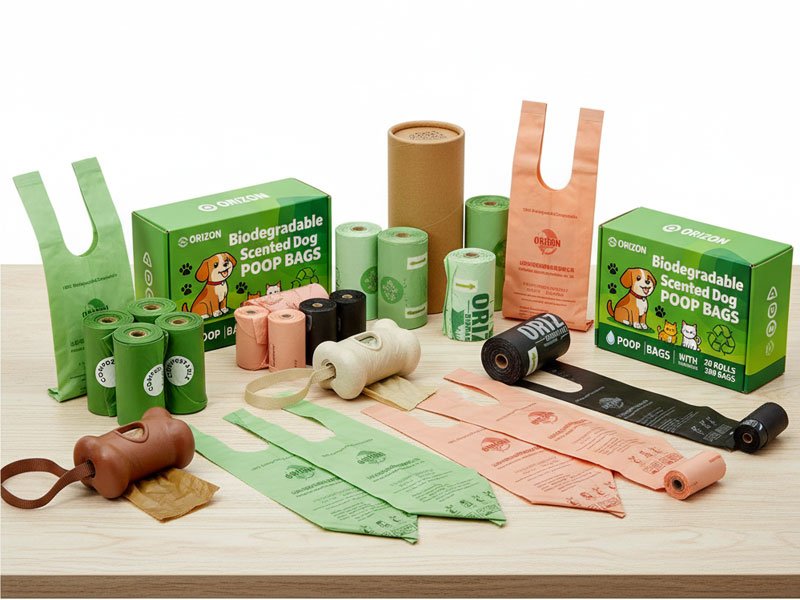
A simple white-card tuck box is different from:
- a mailer-style box
- a window box
- a dispenser box
- a box with an insert
- a laminated premium retail box
Even two boxes with the same outside dimensions can cost differently if they use different paperboard, printing and finishing.
Packaging suppliers also point out that unit price should not be compared until the finished size, flat dieline, board grade, printing, finishing, tooling and included services are matched.
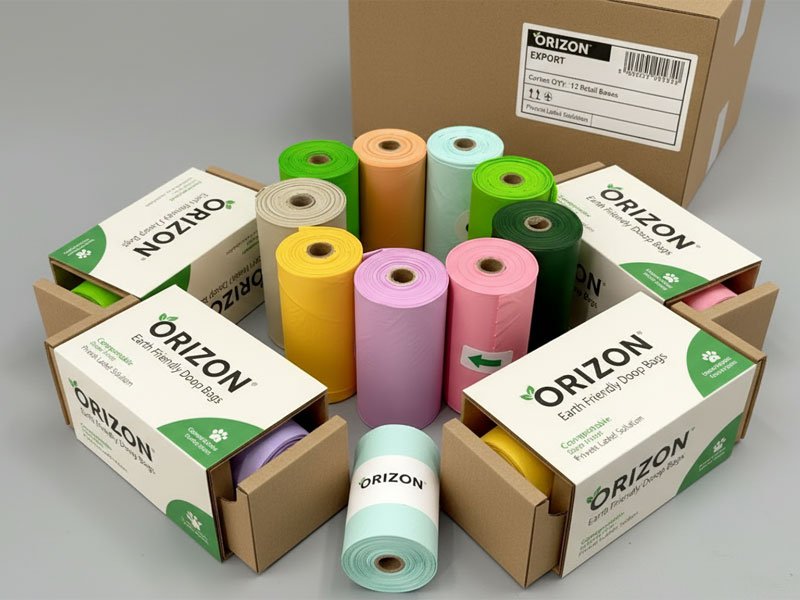
1. Start With the Finished Roll, Not the Box
This is the most important point for dog poop bag packaging.
Do not finalize the retail-box dimensions before the roll specification is confirmed.
First confirm:
- Bag size
- Bag thickness
- Bags per roll
- Paper core or coreless
- Finished roll diameter
- Finished roll height
- Number of rolls per retail pack
- Whether a dispenser is included
Then design the box.
Why?
Because changing the dog poop bag specification can change the roll.
And when the roll changes, the box may need to change too.
A useful production sequence is:
Bag → Roll → Retail Pack → Master Carton
not:
Retail Box → Try to Make the Product Fit
2. Rolls per Retail Box Change Packaging Cost
Consider two private label products.
Product A
4 rolls per retail box
Product B
16 rolls per retail box
Even if the bags are exactly the same, the packaging requirement is not.
A larger pack usually requires:
- more paperboard
- a larger dieline
- stronger board
- different internal arrangement
- a larger outer carton
This is why the number of rolls per box should be confirmed before requesting a packaging quote.
The same principle applies to:
- 4-roll packs
- 8-roll packs
- 10-roll packs
- 16-roll packs
- 24-roll packs
A quote for one configuration should not be used to estimate another without checking the finished dimensions.
3. Roll Diameter Can Change the Box Size
Dog poop bag thickness affects more than the bag itself.
It can also change the finished roll diameter.
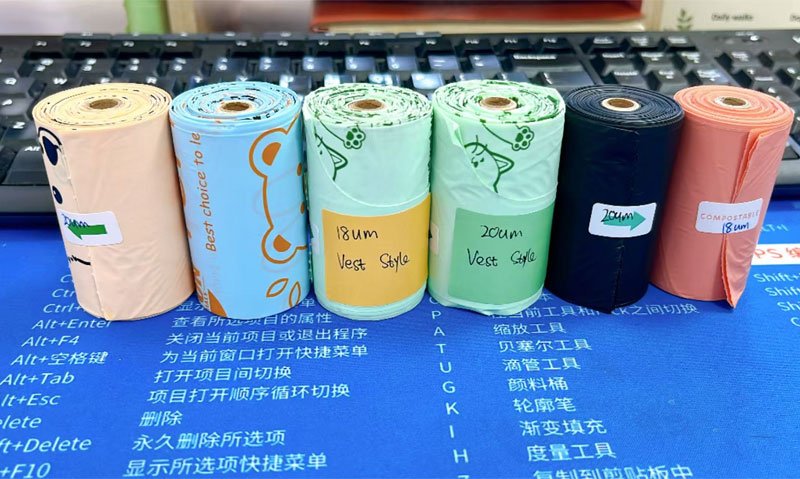
For one ORIZON reference specification:
| Specification | 18 μm | 20 μm |
|---|---|---|
| Bag size | 23 × 33 cm | 23 × 33 cm |
| Bags per roll | 15 | 15 |
| Roll height | Approx. 60 mm | Approx. 60 mm |
| Roll diameter | Approx. 32 mm | Approx. 34 mm |
That 2 mm difference sounds small.
But if a retail box holds 16 rolls in a tight arrangement, several millimeters across multiple rolls can affect the final box dimensions.
That can then change:
box size → dieline area → paper use → master carton → freight
This is why I would not approve the final packaging dieline before the bag and roll specification is stable.
If you are deciding between the two common thicknesses, see our 18 Micron vs 20 Micron Dog Poop Bags comparison.
4. Box Size Affects More Than Paper Use
Finished length, width and height matter.
But packaging factories also look at the dieline.
A dieline is the flat cutting and folding layout used to make the box.
A box that measures:
150 × 100 × 60 mm
when assembled takes up a larger flat area before folding.
That flat area determines:
- paperboard use
- sheet layout
- production waste
- die size
- printing area
Two finished boxes may look similar but use different amounts of board because their flat layouts are different.
Packaging-industry cost guides specifically note that a larger unfolded dieline, inefficient sheet use, heavier board or more complex flap structure can increase folding-carton cost.
So when comparing quotes, compare more than outside dimensions.
5. Box Structure Changes the Price
Not every dog poop bag box is built the same way.
Common structures include:
Tuck-End Folding Carton
A common retail structure.
It is usually efficient for standard multi-roll packs.
Mailer-Style Box
This can give more protection and a stronger presentation.
But it normally uses more board than a simple tuck box.
Sleeve
A sleeve may work when the product already has another inner pack or tray.
It can be simpler than a full retail carton.
Dispenser Box
The box itself may also work as the dispensing system.
This needs a different opening and structural design.
Window Box
A die-cut window lets the customer see the product.
It adds another design and die-cutting requirement.
Box structure is one of the largest packaging cost variables because different structures require different dielines, folding paths, glue areas and tooling. Packaging pricing data also shows large cost differences between simple folding cartons, corrugated mailers and rigid structures.
For dog poop bag retail projects, do not choose the most complex structure unless it solves a real sales or packing problem.
6. Paperboard Type and GSM Affect Cost
GSM means grams per square meter.
It is a common way to describe paper weight.
For example:
- lighter paperboard may cost less
- heavier paperboard may feel stronger
- kraft and white card have different appearance and printing behavior
- coated board may give a smoother printed surface
The correct board depends on:
- total product weight
- box dimensions
- stacking
- shipping method
- retail presentation
A 4-roll retail pack may not need the same board strength as a 16-roll pack.
Do not choose paper only by appearance.
The board still needs to hold the product.
7. Printing Can Change the Quote
“Custom printed box” is not one specification.
A packaging supplier needs to know what is actually printed.
For example:
One-Color Printing
This may be suitable for a simple brand design.
Spot Colors
A specific Pantone color may be used when brand-color control is important.
CMYK Printing
CMYK uses cyan, magenta, yellow and black to reproduce full-color artwork.
Inside and Outside Printing
Printing only the outside is different from printing both surfaces.
Large Solid Areas
A box with a large dark background may need more ink and tighter color control than a mostly white box with a small logo.
So instead of asking:
“How much for a printed box?”
send the actual artwork or at least describe:
colors + coverage + print sides
That will produce a more useful quote.
8. An Open Window and a Film Window Are Different
This is a small detail that can change the packaging quotation.
Open Die-Cut Window
The box has a cut opening.
There is no clear film covering it.
Window With Transparent Film
A clear PET or other window film is added behind the opening.
That means extra:
- material
- window application
- processing
Packaging cost guides also list window film and window application as additional cost variables.
If your design only needs customers to see the rolls, an open window may be enough.
If the product needs more protection, a film-covered window may make sense.
Define this before quotation.
9. Surface Finishes Add Processes
A box can be printed and finished without lamination.
Or it can include:
- matte lamination
- gloss lamination
- soft-touch finish
- foil stamping
- embossing
- debossing
- spot UV
Each extra finish means another production step.
This normally increases cost.
It can also affect:
- lead time
- MOQ
- sample cost
- recyclability considerations
- artwork setup
Current B2B packaging pricing guides consistently show that finishes such as foil, embossing and spot UV increase packaging cost compared with simple printed folding cartons.
A premium finish can make sense.
But it should support the product position.
Do not add five finishes just because they are available.
10. A Dispenser or Insert Changes the Whole Pack
Many dog poop bag retail products include a dispenser.
That sounds simple.
But adding one dispenser may change:
- internal arrangement
- box dimensions
- insert requirement
- assembly work
- box strength
- total pack weight
For example:
10 rolls only
and:
10 rolls + 1 dispenser
should not automatically use the same packaging design.
An insert can also increase cost if it is needed to hold the dispenser and rolls in position.
Before designing the packaging, confirm whether the dispenser will be:
- loose inside the box
- fixed in an insert
- packed separately
- displayed through a window
11. Packaging Quantity Has a Large Effect on Unit Price
This is one reason buyers receive very different quotes.
Custom packaging includes fixed preparation costs.
These can include:
- printing setup
- cutting die
- proofing
- samples
- machine setup
The factory needs to prepare these whether you order 500 boxes or 5,000 boxes.
With a small order, those costs are spread across fewer units.
With a larger order, they are spread across more boxes.
Packaging pricing guides therefore show a clear decline in unit cost as order quantity increases, especially between low-volume and commercial runs.
Small-brand discussions show the same problem from the buyer side: brands often want 100–200 boxes to test a product, while custom packaging suppliers may require several hundred or more because of setup economics.
This is why you should request price tiers.
For example:
500 / 1,000 / 3,000 / 5,000 boxes
Then you can see where the unit cost starts to become more efficient.
12. Packaging MOQ and Dog Poop Bag MOQ Are Not the Same
This causes confusion in private label projects.
The dog poop bag may have a production MOQ based on:
- film weight
- color
- thickness
- printing
The retail box has its own MOQ based on:
- paperboard
- printing
- die cutting
- finishing
So you may have:
Bag MOQ: based on 500 kg
while:
Packaging MOQ: based on box quantity
These two numbers need to be matched.
For example, if 500 kg of bags creates approximately 1,000 sellable retail boxes, ordering 5,000 boxes would leave a large amount of unused packaging.
That is not efficient.
If you need to convert film MOQ into finished bags, rolls and retail units, see our 500 kg Dog Poop Bag MOQ Conversion Guide.
13. Multiple SKUs Can Increase Packaging Cost
Imagine a brand has four colors:
- Green
- Purple
- Peach
- Black
If every color uses different printed retail packaging, you do not have one packaging SKU.
You have four.
That can affect:
- MOQ per design
- printing setup
- inventory
- storage
- obsolete packaging risk
One way to control cost is to keep the main box design shared where possible and separate variants using:
- labels
- small printed areas
- color codes
- sleeves
This depends on the brand and retail channel.
But the main principle is simple:
more packaging SKUs create more production and inventory complexity.
14. Tooling, Dieline and Sample Costs
A new packaging project may include one-time or development costs.
These can include:
Dieline
The flat structural drawing for the box.
Cutting Die
The tool used to cut and crease the paperboard into the correct shape.
Printing Setup
Preparation required before mass printing.
White Sample
An unprinted structural sample used to check size and fit.
Printed Prototype
A sample used to review artwork, color and presentation.
Professional packaging RFQ guides recommend making tooling, proofing, samples and included services clear before comparing unit prices.
When you compare two quotes, ask:
Is the tooling included?
and:
Will the existing die be reused for repeat orders?
Without this information, two unit prices may not be directly comparable.
15. Why Can Two Suppliers Quote Very Different Box Prices?
Suppose Supplier A quotes:
$0.28 per box
and Supplier B quotes:
$0.52 per box
That does not immediately mean Supplier A is cheaper.
Check whether both quotes use the same:
| Item | Supplier A | Supplier B |
|---|---|---|
| Finished size | Same? | Same? |
| Paperboard | Same? | Same? |
| GSM | Same? | Same? |
| Structure | Same? | Same? |
| Printing | Same? | Same? |
| Inside printing | Included? | Included? |
| Lamination | Included? | Included? |
| Window | Included? | Included? |
| Die cost | Included? | Included? |
| Sample | Included? | Included? |
| Packing | Same? | Same? |
| Freight | Included? | Included? |
Packaging RFQ guidance recommends exactly this approach: fix the technical specification first, then compare suppliers using the same scope and delivery basis.
The cheapest number in the spreadsheet is not useful if it describes a different box.
16. Dog Poop Bag Packaging Cost Example
Here is a simple example.
Assume the product is:
23 × 33 cm dog poop bags
20 μm
15 bags per roll
10 rolls per retail box
The buyer initially requests:
- white card box
- outside color printing
- open die-cut window
- no lamination
Later, the buyer changes to:
- 16 rolls per box
- thicker paperboard
- inside + outside printing
- transparent window film
- matte lamination
- one dispenser
The second box should not be expected to cost the same.
Almost every important cost input has changed:
product volume + box size + board + printing + window + finish + accessory
This is why accurate packaging quotations normally come after the main product configuration is confirmed.
17. A Small Product Change Can Create a Packaging Change
This happens often in real dog poop bag projects.
Suppose a project moves from:
18 μm
to:
20 μm
The new roll may become slightly larger.
Now imagine 16 rolls packed tightly into one box.
The original box may still work.
Or it may not.
If it does not, the packaging factory may need:
- a revised dieline
- a larger box
- more paper
- a new sample
- possibly a new cutting die
So before changing thickness late in a project, check the packaging impact too.
That is one reason bag specification, roll specification and retail packaging should be developed as one product system.
18. How to Reduce Packaging Cost Without Making the Pack Look Cheap
Cost reduction does not always mean removing the brand.
Start with unnecessary complexity.
Keep the Structure Simple
A standard folding carton may be enough.
Avoid an Oversized Box
Extra empty space increases paper use and can hurt freight efficiency.
Use One-Side Printing if Inside Printing Adds Little Value
Customers may never see the inside.
Choose One Useful Finish
A good printed board without multiple special finishes can still look professional.
Consider an Open Window
If a transparent film patch is not needed, remove it.
Share Packaging Across SKUs Where Practical
This can reduce separate packaging inventory.
Increase Quantity Only When Sales Support It
A lower unit box price is not a saving if thousands of unused boxes remain in storage.
Small-business packaging discussions often make this same trade-off: for early market testing, simple stock packaging with labels or sleeves can sometimes reduce inventory risk compared with a large fully custom run.
19. Packaging Cost per Box Is Not the Same as Landed Packaging Cost
A retail box also affects logistics.
Consider two boxes.
Box A
Compact and tightly packed.
Box B
20% larger but only $0.03 cheaper.
The second box may increase:
- master-carton size
- CBM
- pallet volume
- container space
- freight per retail unit
CBM means cubic meter. It is commonly used to measure shipment volume.
A slightly cheaper box can create a more expensive shipment.
Packaging suppliers also note that shipped-flat packing, packed volume, dimensional weight and delivery terms can materially change total packaging cost.
For B2B sourcing, compare:
box unit cost + packing efficiency + freight impact
not just:
box unit cost
For larger recurring orders, see our Bulk Dog Waste Bags guide for carton, pallet and logistics planning.
20. What Information Is Needed for an Accurate Packaging Quote?
If you want two suppliers to give comparable prices, send the same information to both.
At minimum, provide:
Product
- Bag size
- Thickness
- Bags per roll
- Finished roll diameter
- Paper core or coreless
- Number of rolls per box
- Dispenser or accessory
Retail Box
- Box structure
- Finished size if known
- Paperboard preference
- Printing colors
- Print sides
- Window requirement
- Lamination or other finish
Commercial Information
- Required quantity
- Number of packaging SKUs
- Delivery country
- Sample requirement
If some details are not known, say:
Supplier recommendation required
Do not let two suppliers silently quote different assumptions.
That makes comparison difficult.
21. What Should You Confirm Before Approving the Box?
Before mass production, check the physical pack.
Do not approve the packaging from a flat PDF alone.
Confirm:
- Rolls fit comfortably
- Box closes properly
- Board is stiff enough
- Window position is correct
- Dispenser fits
- Artwork direction is correct
- Barcode is readable
- Finished box dimensions are correct
- Master-carton arrangement works
A dieline shows structure.
A physical sample shows whether the product actually fits.
For a broader production approval process, see our Dog Poop Bag OEM Project Checklist.
22. Custom Dog Poop Bag Packaging Cost Checklist
Before comparing packaging quotations, make sure both suppliers are quoting the same:
- Rolls per retail box
- Finished roll dimensions
- Box structure
- Box dimensions
- Paperboard grade
- GSM
- Printing colors
- Printing sides
- Print coverage
- Window type
- Lamination
- Special finishes
- Insert
- Dispenser
- Quantity
- Number of SKUs
- Dieline cost
- Cutting-die cost
- Sample cost
- Master-carton packing
- Shipping terms
If these details are different, the prices are not directly comparable.
Custom Dog Poop Bag Packaging Cost FAQ
How much does custom dog poop bag packaging cost?
There is no fixed price. Cost depends on box size, structure, paperboard, printing, finish, window, quantity, accessories and tooling.
Why does packaging quantity change the unit price?
Custom box production includes setup, tooling and machine-preparation costs. Larger runs spread those costs across more boxes, so the unit price usually falls.
Does thicker dog poop bag film change packaging cost?
It can. Thicker bags may create a larger finished roll, which can require a larger retail box or different internal arrangement.
Is kraft packaging always cheaper than white card?
No. Price depends on the exact board grade, GSM, printing, structure and quantity. Do not compare paper color alone.
Does a die-cut window increase box cost?
Usually yes because it adds die-cutting requirements. A window with transparent film normally requires additional material and processing compared with an open window.
Is packaging MOQ the same as dog poop bag MOQ?
No. Bag production may use a weight-based MOQ, while the packaging factory may use a box-count MOQ.
Can several dog poop bag SKUs use the same retail box?
Sometimes. It depends on roll dimensions, pack count, artwork and product positioning. Sharing one structure can reduce packaging complexity when the products fit the same box.
What should I send for an accurate packaging quotation?
Send the bag and roll specification, rolls per box, box structure, material, printing, finish, accessories, quantity and destination.
Need a Packaging Cost Review for Your Dog Poop Bag Project?
If you already know your:
bag size + thickness + bags per roll + rolls per box
send those details first.
From there, the retail packaging can be sized around the actual product rather than estimated too early.
For complete bag customization, see our Custom Dog Poop Bags page.
For a complete branded retail product, see our Private Label Dog Poop Bags program.