Tying a trash bag looks simple until the bag is too full, the drawstring snaps, or the whole liner slips back into the trash can.
The best way to tie a trash bag depends on the type of closure it has.
A drawstring bag has a cord built into the top edge. A handle-tie bag has handles or flaps that you tie together. A flat-top bag has no built-in closure, so you close it using the loose film at the top. Some bags also come with a separate twist tie, which is a short wire or plastic-coated strip used to close the bag.
If you leave enough empty space at the top, all of these bags are easy to close.
The basic rule is simple:
Do not fill the bag all the way to the rim. Leave enough material above the waste to gather, pull, or tie without putting too much stress on the film.
Below are five practical ways to tie and secure a trash bag.
1. How to Tie a Trash Bag Without Drawstrings
If your trash bag has no handles, strings, or ties, you can still close it securely.
This is common with flat-top trash bags and many commercial can liners.
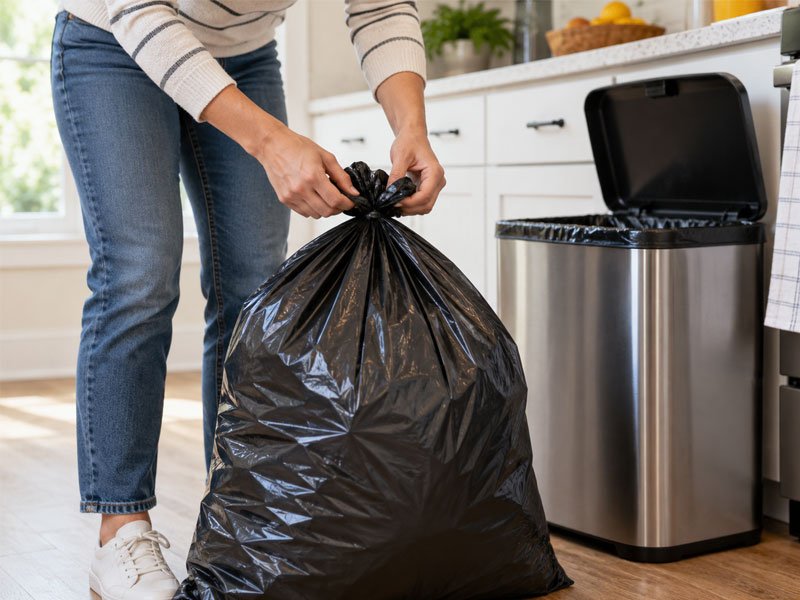
Method 1: Gather, Twist, and Knot
This is the easiest method for most flat-top bags.
- Stop filling the bag before the waste reaches the top.
- Gather the loose film above the waste.
- Hold the gathered section with one hand.
- Twist it several times to form a narrow neck.
- Bend the twisted section into a loop.
- Push the end through the loop.
- Pull gently until the knot is secure.
Do not pull as hard as possible.
A tight knot is useful, but pulling one thin section of film too hard can stretch or tear the bag.
If the bag is difficult to knot, the real problem may be that it is too full or too short for the trash can.
Method 2: The Two-Corner Knot
This method works well when the bag has plenty of material above the trash.
Pull the left and right sides of the bag upward so they form two loose “ears.”
Cross one side over the other and tie them together.
This method spreads the force across a larger area than pulling on one narrow piece of film.
It also works well when you need to reopen the bag later.
2. How to Tie a Drawstring Trash Bag
A drawstring trash bag has a cord built into the top of the bag.
When you pull the cord, the opening closes around the waste.
Drawstrings are common on tall kitchen trash bags because they make closing, lifting, and carrying the bag easier.
How to close a drawstring trash bag
- Leave several inches of space at the top.
- Remove the bag from the trash can carefully.
- Pull the drawstring evenly from both sides.
- Let the opening gather toward the center.
- Cross the two sections of drawstring.
- Tie a simple knot.
- Add a second knot if you need a more secure closure.
Do not jerk the drawstring.
Pull it steadily instead.
If one side of the string carries all the load, it can put more stress on the drawstring channel or the film around it.
Real users often complain about two problems with drawstring trash bags: the string breaking and the bag feeling too small around the rim. Those problems are often connected to bag fit and loading, not just the knot itself. Reddit discussions about 13-gallon drawstring bags include both complaints about snapping strings and bags that would not stay properly fitted around the can.
Should you carry a heavy trash bag by the drawstring?
For light household waste, the drawstring is convenient for carrying.
For a heavy bag, I would not rely on the drawstring alone.
Support the bottom of the bag with your other hand, especially when the bag contains wet food waste, bottles, cans, or other heavy items.
The drawstring closes the bag.
It should not always be treated as the main load-bearing part of the bag.
If you are comparing closure designs for kitchen liners, see our compostable drawstring trash bags page.
3. How to Tie a Garbage Bag With Handles
Some garbage bags use built-in handles instead of a drawstring.
These may be called:
- handle-tie trash bags;
- tie-handle bags;
- flap-tie bags;
- four-flap bags.
The exact design varies, but the idea is the same.
You use part of the bag itself as the tie.
For a two-handle bag
Pull both handles upward.
Bring them together above the waste.
Cross one handle over the other, then tie a basic overhand knot.
If there is enough handle length, tie a second knot.
For a four-flap bag
Bring two opposite flaps together first.
Tie them.
Then tie the remaining two flaps across the first knot.
This can create a more even closure because the waste is held from more than one direction.
Handle-tie bags are useful when users want an easy closure but do not want a separate drawstring component.
4. How to Close a Trash Bag With a Twist Tie
A twist tie is a small flexible strip used to close the neck of a bag.
It is common with simple trash bags, food bags, and some economy liners.
How to use a twist tie
- Gather the film at the top of the trash bag.
- Twist the loose film into a short neck.
- Place the twist tie around the neck.
- Cross the two ends of the tie.
- Twist the ends around each other several times.
- Check that the bag is closed before lifting it.
The goal is to hold the film together.
You do not need to twist until the tie cuts into the bag.
Twist Tie vs Drawstring Trash Bags
| Feature | Twist Tie | Drawstring |
|---|---|---|
| Closure built into bag | No | Yes |
| Easy to close | Yes | Very easy |
| Separate part needed | Yes | No |
| Easy to carry | Limited | Usually better |
| Product construction | Simpler | More complex |
| Common use | Basic or light-duty bags | Kitchen and retail bags |
A drawstring usually gives the user a faster one-piece closure.
A twist tie can be a simpler option when low cost and basic function are more important.
5. How to Tie a Trash Bag That Is Too Full
This is where many people run into trouble.
If there is almost no empty film above the waste, there may not be enough material to make a safe knot.
Do not keep pulling harder.
Remove some of the waste and put it into another bag.
Or use a larger liner next time.
A trash bag needs extra length for more than reaching the bottom of the can. It also needs enough material above the rim for closing and tying.
That extra material is often called overhang.
Overhang means the part of the bag that extends above and folds over the top edge of the trash can.
Commercial liner sizing guides also allow extra material above the container rather than sizing the bag only to the exact height of the bin. Pitt Plastics, for example, matches liner dimensions to specific receptacle shapes and sizes instead of relying on gallon capacity alone.
If your bag is always difficult to close, check the bag size before blaming the knot.
See our trash bag size guide for gallon, liter, inch, and centimeter comparisons.
Trash Bag Closure Types Compared
Different closure styles solve the same basic problem in different ways.
| Closure Type | How It Closes | Ease of Closing | Common Use |
|---|---|---|---|
| Drawstring | Pull built-in cord | Very easy | Kitchen, household, retail |
| Handle tie | Tie built-in handles | Easy | Kitchen and household |
| Flap tie | Tie film flaps | Easy | Household and general waste |
| Flat top | Gather and knot film | Moderate | Commercial and household liners |
| Twist tie | Separate tie wraps bag neck | Easy | Basic and light-duty bags |
| Open top | Fold, knot, clip, or leave open | Varies | Commercial and industrial use |
There is no single “best” closure for every application.
A household kitchen user may value speed and easy carrying.
A commercial buyer may care more about liner cost, case count, dimensions, and how quickly staff can replace bags.
A food-waste program may also need to consider whether the liner material is accepted by the composting system.
How to Secure a Trash Bag Inside a Trash Can
Sometimes the problem starts before you try to tie the bag.
The liner keeps sliding down into the trash can.
This is usually a fit or installation problem.
Start with the correct bag size
A bag that is too narrow has to stretch hard around the rim.
A bag that is far too large may sit loosely and fall inward as waste is added.
Commercial liner suppliers use actual liner dimensions because two trash cans with similar gallon capacities can still have different shapes. AAA Polymer and Pitt Plastics both publish liner sizing information based on container size and liner dimensions.
Before buying a large quantity, measure the trash can.
Leave enough film over the rim
Do not stop the liner exactly at the top edge.
Fold part of the bag over the outside of the rim.
This helps create friction and gives the bag more material to hold onto the can.
Keep the drawstring above the rim
For a drawstring kitchen bag, place the bag in the can with the drawstring area near or just outside the top rim.
Do not push the entire closure deep inside the bin.
You want to reach it easily when the bag is full.
Use a retaining ring or clip when needed
Some commercial bins use liner-retaining rings, clips, or other holders.
These can help when the container has a smooth rim or when the waste load pulls heavily downward.
Simple household fixes such as elastic bands or clips are also commonly suggested for bags that keep falling into the can.
But first check the size.
A clip should not be used to hide a badly matched liner.
Why Does My Trash Bag Keep Slipping Into the Can?
There are several common reasons.
The bag is too small
If the liner is stretched tightly around the rim, it may slowly pull itself inward.
It may also tear at a corner.
The bag is too large
A very loose liner can slide downward because there is not enough tension around the opening.
There is not enough overhang
If only a small amount of film sits over the rim, the weight of the waste can pull the liner into the can.
The trash can is tapered
Some bins are wider at the top and narrow at the bottom.
Others have thick lips, handles, or unusual lid systems.
These shapes can change how the liner fits.
The load is heavy
Wet kitchen waste can pull downward much harder than paper or tissues.
This is why a bag that works well in an office may not behave the same way in a kitchen.
If your liner often slips, tears, or will not close, the bag dimensions may be wrong for the container.
For a standard kitchen can, our guide to 13 gallon trash bag dimensions explains why bags with the same gallon label can still have different widths and lengths.
Does Trash Bag Size Affect How Easy It Is to Tie?
Yes.
Size affects tying more than many people expect.
A bag can technically fit inside a trash can but still be too short to close comfortably.
That is because the liner needs material for three jobs:
- covering the inside of the can;
- reaching and folding over the rim;
- closing after the bag is full.
The gallon number is only a starting point.
A 13-gallon can can be tall and narrow or short and wide.
The bags used with those two cans may not need the same flat dimensions.
This is why professional can-liner guides focus on width and length as well as nominal gallon capacity.
If you are buying liners for your own home, measure the can once.
If you are buying bags for a business, retail brand, or private-label project, record the target width, length, thickness, seal type, and closure style before production.
How to Put a Trash Bag in a Trash Can Properly
Correct installation makes the bag easier to fill and easier to tie later.
- Open the bag fully.
- Place the closed bottom of the bag into the bottom of the trash can.
- Push the bag down gently so trapped air can escape.
- Pull the open end over the rim.
- Leave enough film outside the can to keep the bag in place.
- Keep handles or drawstrings where you can reach them.
Do not stretch the opening harder than needed.
If you have to fight the bag every time you install it, try a wider size.
Does a Compostable Trash Bag Tie Differently?
Usually, the basic tying method is the same.
You can close a compostable flat-top bag with a knot, use handles on a handle-tie bag, or pull the drawstring on a compostable drawstring trash bag.
The main point is not to assume that every compostable film behaves exactly like every polyethylene film.
Performance depends on the material formulation, thickness, bag size, seal construction, and load.
For a compostable bag, I would use the same practical rules:
- do not overfill it;
- avoid pulling one small area sharply;
- choose the right dimensions for the can;
- select enough thickness for the waste being collected;
- support very heavy bags from underneath.
Compostable bags can also be produced in several closure styles. B2B manufacturers currently offer flat, star-seal, drawstring, and tie-handle compostable trash bags, showing that compostability and closure type are separate product choices.
If you are comparing compostable materials, thickness, certification, and kitchen-bin applications, read our 13 gallon compostable trash bags buying guide.
For bulk product specifications, see our compostable 13 gallon trash bags page.
Drawstring vs Handle-Tie vs Flat-Top Trash Bags
If you are choosing a bag rather than simply tying one, closure style matters.
Choose drawstring when:
- quick closing is important;
- users need to carry the bag easily;
- the product is aimed at household or kitchen use;
- convenience matters more than the simplest bag construction.
Choose handle-tie when:
- users want built-in handles;
- the handles will also be used for closing;
- the product needs a simple, visible closure method.
Choose flat-top when:
- the bag will be placed inside a commercial bin;
- users can knot, twist, or clip the liner;
- simple construction is preferred;
- the liner is regularly replaced by cleaning staff.
Choose twist tie when:
- the bag needs a basic separate closure;
- carrying by the closure is not important;
- a simpler bag design is acceptable.
The closure should match the way the bag will actually be used.
That sounds obvious, but it is easy to focus only on thickness or gallon capacity and forget how the person at the end will remove and close the bag.
Common Trash Bag Tying Mistakes
A good closure does not need much force.
Most problems come from fit, filling, or handling.
Filling the bag to the top
Leave room to close it.
Pulling only one side
Spread the force when possible.
Using the wrong size
A bag that barely reaches the rim will be hard to tie.
Carrying a very heavy load by a thin tie
Support the base.
Ignoring sharp waste
Sharp corners can puncture the film before the knot becomes the problem.
Pulling a drawstring suddenly
Use a steady pull instead.
Frequently Asked Questions
What is the easiest way to tie a trash bag?
For a flat-top trash bag, gather the loose material at the top, twist it into a neck, form a loop, and pull the end through the loop.
If the bag has a drawstring, pull the string evenly until the opening closes and tie the two sections together.
How do you tie a trash bag without strings?
Gather the top of the bag, twist the film, and tie the twisted section into a knot.
You can also pull two opposite sides upward and tie them together.
How do you tie a garbage bag with handles?
Bring the two handles together and tie a simple overhand knot.
For four-flap bags, tie opposite flaps together in pairs.
How do you use a twist tie on a garbage bag?
Gather and twist the neck of the bag, wrap the twist tie around it, cross the two ends, and twist them together several times.
Why does my trash bag keep falling into the can?
The bag may be too small, too large, too short, or not folded far enough over the rim.
Heavy waste can also pull the liner downward.
Check the bag dimensions before using clips or other fixes.
How do I keep a trash bag from slipping?
Use a liner that fits the actual width and height of the can, leave enough overhang around the rim, and keep the closure area outside the bin.
A retaining ring, clip, or elastic band can help when needed.
How much empty space should I leave before tying a trash bag?
There is no single number for every bag, but you should leave enough unused film to gather the opening without stretching it tightly over the waste.
If you cannot make a knot without pulling hard, the bag is too full.
Can you tie compostable trash bags?
Yes.
Flat-top compostable bags can be knotted, while compostable drawstring or handle-tie bags use their built-in closure.
The correct method depends on the bag design.
How do you open a trash bag that is stuck together?
Rub the top edges gently between your fingers to separate the film layers.
Do not pull hard from one small point because that can stretch or tear thin film.
Should I carry a heavy trash bag by the drawstring?
For light waste, this is usually convenient.
For a heavy load, support the bottom of the bag as well.
This reduces stress on the drawstring area.
The Bottom Line
The best way to tie a trash bag depends on the closure.
Use the built-in drawstring when there is one. Tie the handles when the bag has handles. Use a twist tie when it is supplied. For a flat-top bag, gather and knot the loose film.
But if a trash bag is always hard to close, slips into the can, or feels too tight around the rim, do not just tie it harder.
Check the fit.
The right bag should have enough width to fit the opening, enough length to reach the bottom, and enough extra material at the top to close securely.
That makes tying easier.
It also makes the bag work the way it was meant to.