Most trash bags are made from polyethylene, also called PE.
Common garbage bag materials include HDPE, LDPE, and LLDPE. These plastics are widely used because they can be made into thin, flexible, and water-resistant films.
Plant-based trash bags use a different material approach.
Some plant-based bags contain renewable materials such as corn starch or sugarcane. Certified compostable bags are often made from blends of PLA, PBAT, and thermoplastic starch.
However, plant-based, biodegradable, and compostable do not mean the same thing.
This difference matters.
A bag may contain plant material but still behave much like regular plastic. Another bag may be certified to break down under controlled composting conditions.
In this guide, I will explain what trash bags are made of, how plant-based garbage bags are produced, and how you can compare different materials before buying or sourcing them.
What Are Trash Bags Made Of?
Most traditional trash bags are made from polyethylene.
Polyethylene is a family of plastics made by joining many small ethylene molecules into long polymer chains. A polymer is simply a large molecule made from repeating smaller units.
The three most common types used for trash bags are:
- HDPE: high-density polyethylene
- LDPE: low-density polyethylene
- LLDPE: linear low-density polyethylene
Plastic manufacturers supply both HDPE and LLDPE grades for garbage bags, refuse bags, and commercial bin liners. HDPE offers high tensile strength, while LDPE and LLDPE provide the toughness needed for heavier or irregular waste.
So, if someone asks, “What are garbage bags made of?” the most direct answer is:
Most garbage bags are made from HDPE, LDPE, LLDPE, or a blend of these polyethylene materials.
The same answer applies to the question “What are bin bags made of?” Bin bag is simply the common British term for a trash bag or garbage bag.

Why Is Polyethylene Used for Trash Bags?
A trash bag has a simple job, but the film must handle several stresses.
It must hold weight, resist tearing, contain moisture, and fit around the edge of a bin. It should also be thin enough to control material costs.
Polyethylene works well for these needs.
Different PE grades are chosen based on the type of waste and the required bag performance.
HDPE Trash Bags
HDPE trash bags tend to feel thinner and stiffer.
They often make a light, crisp sound when handled. Because HDPE has good tensile strength, manufacturers can use it to make relatively thin bags for light or moderate waste.
Common applications include:
- Office bins
- Bathroom bins
- Paper waste
- Hotel room bins
- Light commercial waste
HDPE resins are used in extrusion film applications such as grocery bags, garbage bags, and freezer bags.
HDPE is not always the best choice for sharp or heavy waste. A thin HDPE bag may split when it is stretched around an irregular object.
LDPE Trash Bags
LDPE is softer and more flexible than HDPE.
It is often used when a bag needs better stretch and puncture resistance. The film may also feel smoother and less noisy.
LDPE may be used for:
- Kitchen waste
- Garden waste
- Commercial cleaning
- Construction debris
- Heavy or irregular waste
It can be produced at a greater thickness when more load strength is needed.
LLDPE Trash Bags
LLDPE is widely used for consumer trash bags and industrial can liners.
It offers a useful balance of strength, stretch, and tear resistance. Resin producers list LLDPE grades for trash bags, refuse bags, industrial liners, and heavy-duty bags.
Many modern garbage bags use blends instead of one resin alone.
For example, a manufacturer may combine HDPE with LLDPE to balance stiffness, strength, sealing performance, and cost.
There is no single formula for every trash bag.
What Are Black Garbage Bags Made Of?
Black garbage bags are usually made from the same polyethylene materials as other conventional trash bags.
The black color normally comes from a color masterbatch added during film production. A masterbatch is a concentrated mixture of pigment and carrier resin.
In practical terms, a black bag may contain:
- Virgin polyethylene
- Recycled polyethylene
- Black color masterbatch
- Processing additives
- A blend of HDPE, LDPE, or LLDPE
The color does not tell you whether the bag is recycled, biodegradable, or compostable.
A green, brown, or black bag can still be ordinary polyethylene.
Always check the material statement and certification instead of judging the product by color.
What Are Plant-Based Trash Bags?
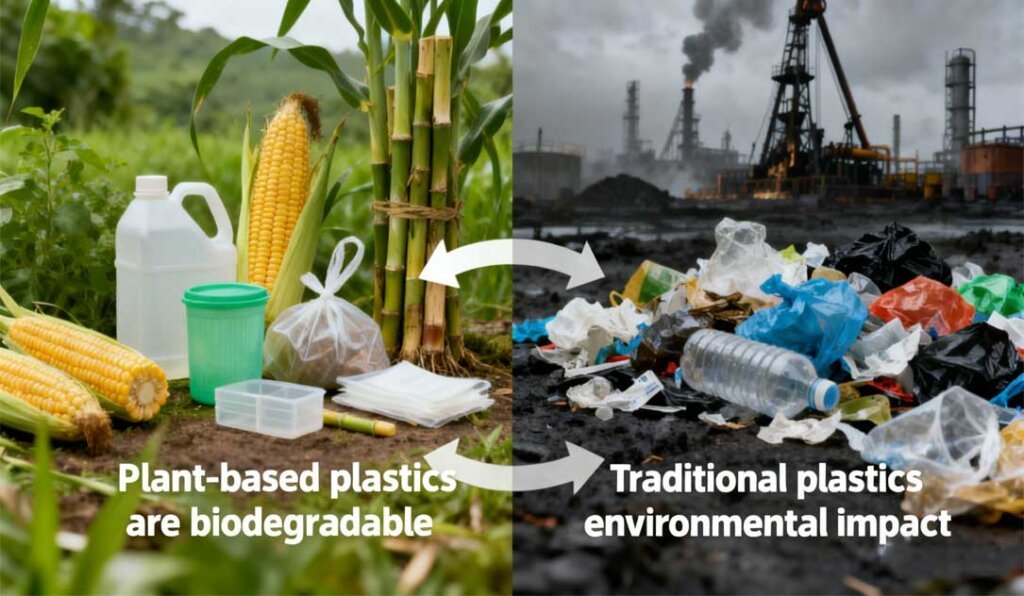
Plant-based trash bags are bags made partly or fully from raw materials linked to renewable biological resources.
These resources may include:
- Corn
- Sugarcane
- Cassava
- Potato starch
- Other plant sugars or starches
However, “plant-based” only tells us something about the source of the raw material.
It does not automatically tell us how the finished bag will break down.
The European Commission explains that bio-based plastics are fully or partly made from biological resources, but they are not necessarily biodegradable or compostable.
This is one of the most important points on this page.
A plant-based plastic bag may fall into one of several groups:
- Bio-based but not compostable
- Partly bio-based and certified compostable
- Starch-filled but not fully compostable
- Certified for industrial composting
- Certified for both industrial and home composting
So, a bag that starts with plants does not always end as compost.
What Are Plant-Based Trash Bags Made Of?
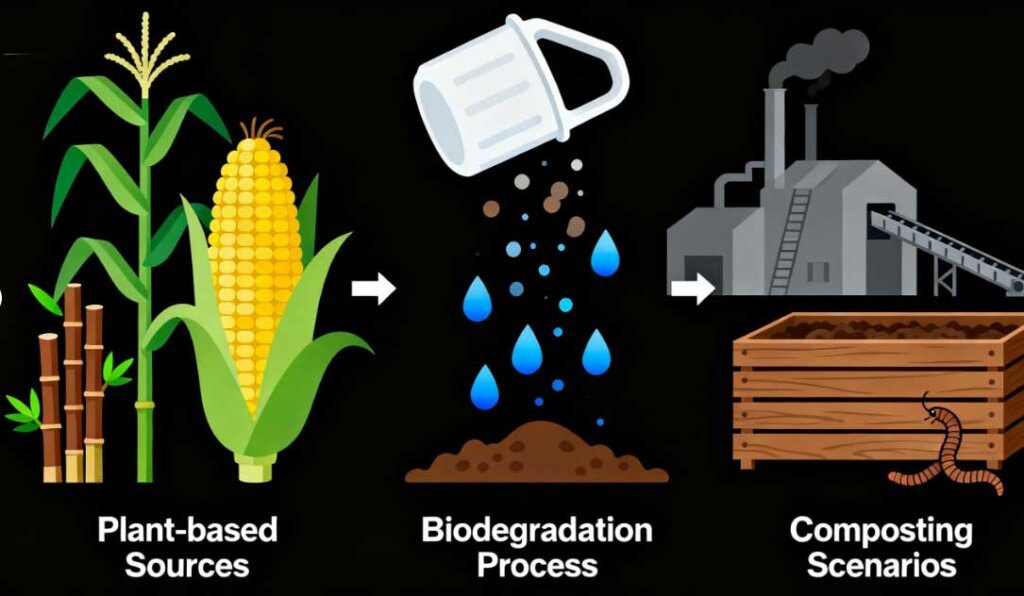
Certified plant-based compostable bags are commonly made from a blend of materials rather than one material alone.
The blend may include PLA, PBAT, and thermoplastic starch.
Each part has a different job.
PLA: Polylactic Acid
PLA stands for polylactic acid.
It is commonly made from plant sugars taken from crops such as corn or sugarcane. The sugars are fermented to produce lactic acid, which is then processed into a polymer.
PLA can add:
- Structure
- Stiffness
- Shape
- Bio-based content
Pure PLA is often too stiff or brittle for a flexible trash bag.
That is why it is normally blended with softer materials.
PBAT: Polybutylene Adipate Terephthalate
PBAT is a flexible biodegradable polyester.
It helps give compostable film the stretch, toughness, and tear resistance needed for daily use. BASF describes PBAT as a fossil-based, certified compostable polymer that provides flexibility and toughness to compostable blends.
This point is often misunderstood.
PBAT can be biodegradable under the correct conditions, but standard PBAT is not normally described as a plant-derived polymer.
PLA may provide renewable content, while PBAT helps the bag perform more like flexible polyethylene.
The final environmental claim should be based on the complete certified product, not one ingredient.
Thermoplastic Starch
Thermoplastic starch is often made from corn, potato, or cassava starch.
Natural starch cannot simply be blown into a strong trash bag. It must be processed and combined with other materials so it can behave like a thermoplastic.
Thermoplastic means that a material can soften when heated and be formed into a new shape.
Starch can help:
- Increase renewable content
- Adjust film stiffness
- Support biodegradation in a certified formulation
- Reduce the amount of some other polymers
This is why terms such as cornstarch garbage bags, starch-based bags, and biomass garbage bags appear in the market.
Still, the word “cornstarch” is not proof that the entire bag is compostable.
Certification remains important.
Bio-Based Polyethylene
Some plant-based trash bags are made from bio-based polyethylene.
Bio-based PE may use ethanol made from sugarcane or another renewable source. Its chemical structure can be similar to conventional polyethylene.
This means it may be plant-based without being compostable.
It may work in some PE recycling systems, subject to local collection rules, but it should not be placed in an organic waste stream unless it has the required compostability certification.
This shows why material source and end-of-life performance must be checked separately.
How Are Plant-Based Trash Bags Made?
The production process depends on the material formula, but most flexible plant-based bags follow several basic steps.
1. Raw Material Preparation
PLA, PBAT, starch compounds, color masterbatch, and other approved materials are prepared according to a specific formula.
The formula must match the required:
- Strength
- Thickness
- Color
- Composting standard
- Printing method
- Intended use
A small kitchen caddy liner does not need the same formula as a 240-liter commercial garbage bag.
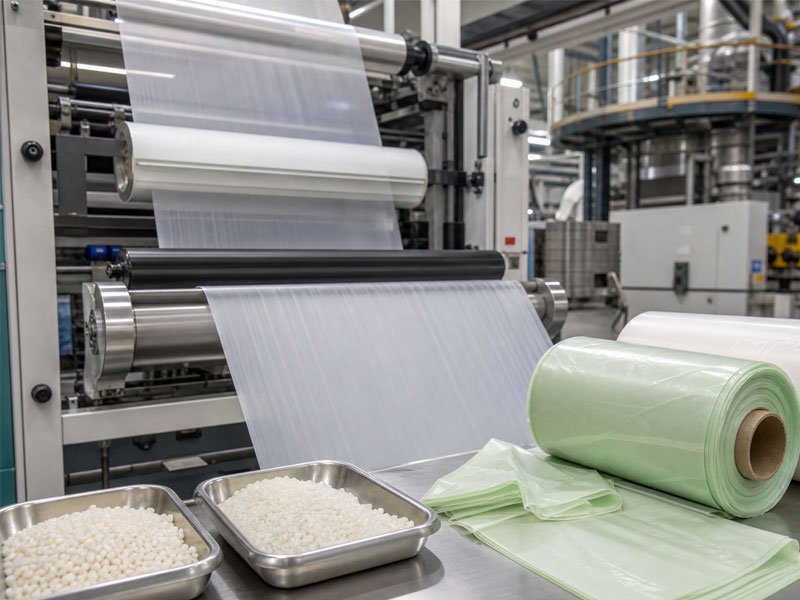
2. Film Extrusion
The material pellets are heated inside an extrusion machine.
The melted material is pushed through a circular die and inflated into a thin film tube. This process is called blown film extrusion.
Operators control the film width, thickness, cooling, and tension.
Even a small change in thickness can affect the bag’s weight, cost, strength, and composting certification scope.
3. Printing
The film may be printed with:
- A brand logo
- Disposal instructions
- Compostability marks
- Warning text
- Bag size
- Certification information
Certification logos should only be used when the finished product and the company using the mark are properly authorized.
4. Bag Conversion
The film is cut, sealed, perforated, folded, or wound into rolls.
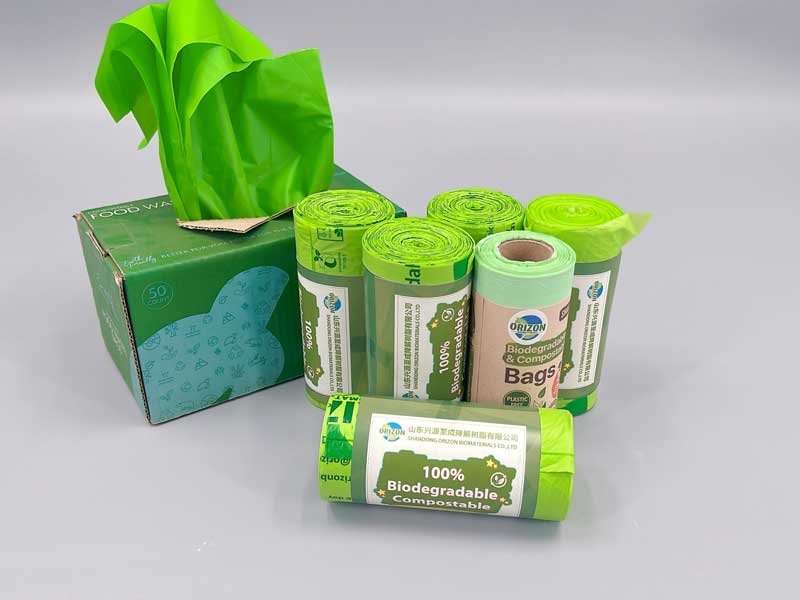
Common bag formats include:
- Flat-top bags
- Star-seal bags
- Drawstring bags
- Tie-handle bags
- T-shirt bags
- Coreless rolls
- Paper-core rolls
- Flat-packed liners
5. Quality Control
The finished bag should be checked for:
- Width and length
- Film thickness
- Bag weight
- Seal strength
- Perforation quality
- Roll count
- Printing position
- Carton quantity
- Load performance
In my experience, material claims alone are not enough. A compostable bag still needs to work as a bag.
Plant-Based, Biodegradable, and Compostable: What Is the Difference?
These three terms are often used as if they mean the same thing.
They do not.
| Term | What It Describes | Does It Guarantee Compostability? | What You Should Check |
|---|---|---|---|
| Plant-based | Where some or all raw materials come from | No | Bio-based content and full material composition |
| Biodegradable | Ability to break down through biological activity under certain conditions | No | Environment, timeframe, test method, and residues |
| Compostable | Ability to biodegrade and disintegrate under defined composting conditions | Only when properly certified | Certification, composting type, and local acceptance |
| Recycled plastic | Plastic made partly or fully from recovered material | No | Recycled content, resin type, and recycling route |
The US Environmental Protection Agency explains that compostable plastic is biodegradable, but not every biodegradable plastic is compostable. Commercially compostable plastic must break down under the conditions of a commercial or industrial composting facility.
For a more detailed comparison, read our guide to biodegradable vs compostable bags.
Are All Plant-Based Trash Bags Compostable?
No.
Some plant-based bags are compostable. Some are not.
A plant-based claim can refer to raw material origin, while a compostable claim refers to tested end-of-life performance.
For example:
- Bio-based PE may come from sugarcane but is not normally compostable.
- A PLA and PBAT blend may be compostable if the finished bag meets a recognized standard.
- A starch-filled PE bag may contain plant material but still leave conventional plastic behind.
- A certified home-compostable bag has different requirements from an industrially compostable bag.
The safest way to check is to review the certification of the finished product.
Do not rely only on words such as:
- Green
- Natural
- Bio
- Eco
- Plant
- Degradable
- Earth friendly
These words may sound positive, but they do not define a tested disposal route.
What Are Compostable Bags Made Of?
Compostable bags may be made from several biodegradable polymers and bio-based materials.
Common ingredients include:
- PLA
- PBAT
- Thermoplastic starch
- PHA in some products
- Certified biodegradable additives
- Compostable color and printing systems
The exact formula varies by manufacturer, bag thickness, intended market, and certification scope.
What matters is the final construction.
A bag should not be described as certified merely because one raw material has a compostable data sheet. The finished film, thickness, inks, additives, and product construction may all affect compliance.
For commercial waste collection, you can review our range of certified compostable trash bags.
Which Compostability Certifications Should You Check?
The correct certification depends on the market and disposal system.
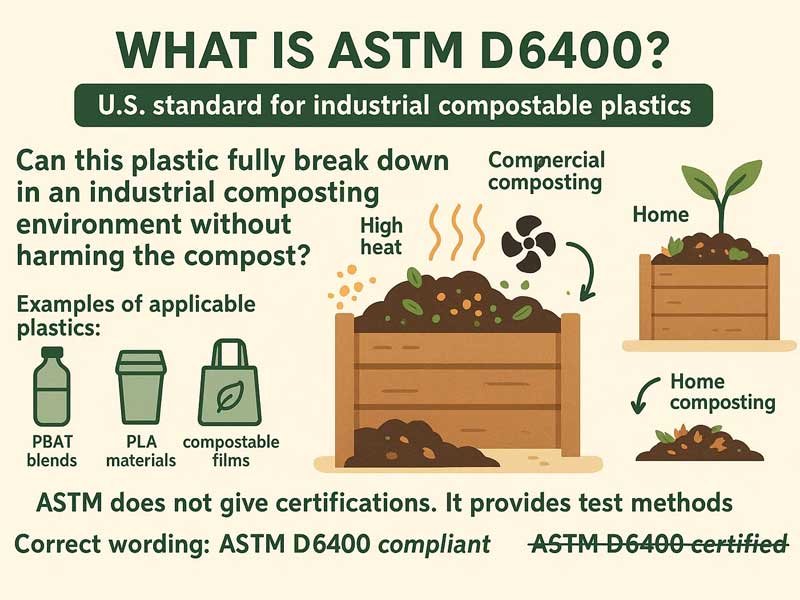
BPI and ASTM D6400
BPI provides third-party certification for compostable products and packaging in North America.
BPI-certified products must meet applicable ASTM compostability standards, such as ASTM D6400 or ASTM D6868, as well as BPI program requirements.
BPI currently offers:
- Commercial Only Certification
- Commercial and Home Certification
These are not interchangeable.
Buyers serving the United States or Canada can review our BPI certification information.
EN 13432
EN 13432 is widely used in Europe for packaging intended for recovery through industrial composting and biodegradation.
A certification should apply to the relevant finished product construction, not just a general raw material.
European buyers can review our EN 13432 certification information.
OK Compost INDUSTRIAL and HOME
OK Compost INDUSTRIAL applies to products designed for controlled industrial composting conditions.
OK Compost HOME applies to products tested for lower-temperature home composting conditions.
A product approved for industrial composting should not automatically be described as home compostable.
AS 4736 and AS 5810
Australia uses separate standards for industrial and home compostability.
- AS 4736 relates to industrial composting.
- AS 5810 relates to home composting.
The applicable mark should match the product, certificate scope, and intended disposal system.
Home Composting vs Industrial Composting
Industrial composting facilities control factors such as temperature, oxygen, moisture, and processing time.
A home compost pile is less controlled. Its temperature may be lower and less stable.
This is why a commercially compostable bag may not break down properly in a backyard compost bin.
BPI also separates commercial-only certification from products certified for both commercial and properly managed home composting.
You can learn more in our guide to home composting vs industrial composting.
Always follow the instructions printed on the bag.
Do Plant-Based Bags Break Down in a Landfill?
You should not expect a compostable bag to behave in a landfill as it would in a composting facility.
Composting is a managed biological process that requires suitable oxygen, moisture, microorganisms, and temperature.
Landfills are designed for waste storage, not efficient composting.
A plant-based or compostable bag placed in general waste may break down very slowly. Its behavior will depend on the material and landfill conditions.
That is why disposal infrastructure matters as much as material choice.
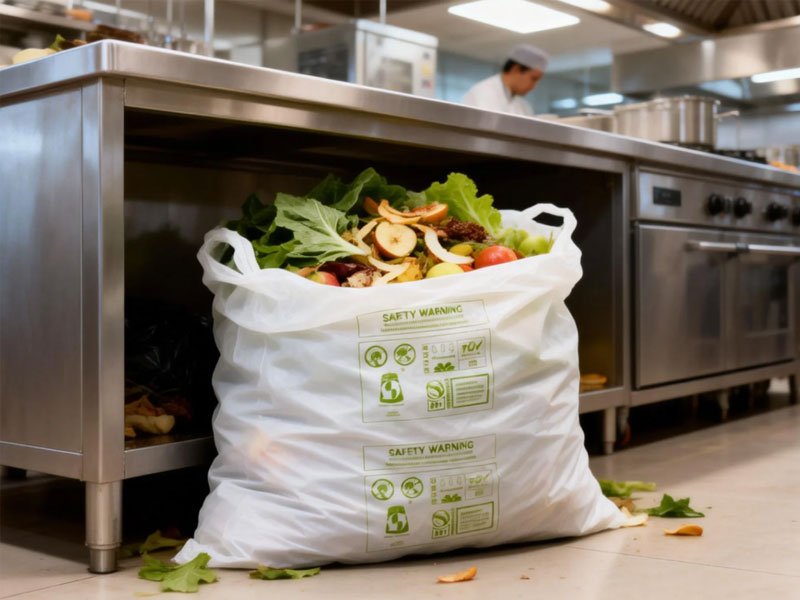
A certified compostable bag provides the clearest benefit when it is used to collect accepted organic waste and is sent to a facility that can process it.
Can Compostable Trash Bags Be Recycled?
Compostable plastic bags should not normally be placed in a conventional plastic recycling bin.
They have different chemical and processing properties from polyethylene film.
The US EPA warns that compostable plastics can contaminate and disrupt a recycling stream when they are mixed with conventional plastics.
Before disposal, check whether your local system accepts the product through:
- Food waste collection
- Green bin collection
- Commercial organics collection
- A compostable packaging drop-off program
- General waste only
Facility acceptance can vary, even when a product is certified.
Some composting facilities do not accept compostable plastics because their process, equipment, or contamination controls are not designed for them.
Read our guide on how to dispose of compostable plastics before making disposal instructions for a product or brand.
Are Plant-Based Trash Bags Better for the Environment?
There is no honest one-word answer.
A plant-based bag may reduce the use of fossil feedstocks. A certified compostable bag may also help collect food scraps and organic waste.
But the final environmental result depends on more than the material name.
You should consider:
- Raw material source
- Agricultural inputs
- Energy used in manufacturing
- Bag thickness
- Transport distance
- Product strength
- Number of bags used
- Local recycling or composting systems
- Actual disposal behavior
The European Commission advises looking at the full life cycle of bio-based plastics rather than assuming that renewable raw material alone guarantees an environmental benefit.
A weak bag that needs to be doubled may use more material than a properly designed bag.
A compostable bag sent to the wrong waste stream may offer little practical benefit.
The best material is the one that matches the waste, performs with the least reasonable material, and has a real end-of-life route.
What Are Green Garbage Bags Used For?
Green garbage bags are often used to identify a specific waste stream.
Depending on the local program, they may be used for:
- Food scraps
- Garden waste
- Organic waste
- Compost collection
- Municipal green bin programs
- General waste identification
However, green color does not guarantee that a bag is plant-based or compostable.
A green bag may still be ordinary polyethylene.
Check the printed certification mark and the local waste program instructions.
For organic collection projects, our guide to compostable bags for green bins explains how bag selection should match the local processing system.
How to Choose the Right Trash Bag Material
Start with the waste, not the marketing claim.
For Light, Dry Waste
HDPE may work well for:
- Paper
- Tissues
- Office waste
- Hotel room waste
- Light bathroom waste
For Heavy or Sharp Waste
A thicker LDPE or LLDPE bag may be more suitable for:
- Commercial cleaning
- Construction waste
- Yard waste
- Irregular items
- Heavy mixed waste
For Food Scraps and Organic Waste
A certified compostable liner may be suitable when:
- The local collection program accepts it
- The certification matches the market
- The bag has enough wet-load strength
- The size fits the caddy or bin
- The disposal instructions are clear
For Long-Term Storage
Conventional polyethylene may be more suitable when the bag needs long-term moisture resistance, shelf stability, or extended storage.
Compostable bags are normally designed for controlled use and storage conditions.
What Should Business Buyers Ask a Supplier?
If you are sourcing plant-based garbage bags for a brand, distributor, retailer, or waste program, ask for more than a general price.
You should confirm:
- Finished bag dimensions
- Gusset format
- Film thickness
- Bag weight
- Resin or material system
- Certification standard
- Certificate holder
- Certification scope
- Bag color and Pantone reference
- Printing colors
- Seal type
- Bags per roll or pack
- Retail box requirements
- Outer carton details
- Shelf-life guidance
- Target market
- Intended disposal route
- Order quantity
I also recommend asking whether the quotation is based on a certified finished product or only a certified raw material.
That small question can prevent a large compliance problem later.
OEM and Private-Label Plant-Based Trash Bags
A business may need more than a standard stock bag.
For an OEM project, bag performance must be matched to the real use.
A manufacturer may adjust:
- Size
- Thickness
- Film color
- Transparency
- Seal structure
- Perforation
- Roll count
- Printing
- Retail packaging
- Outer cartons
However, changes to the material, film thickness, printing, or product construction may affect the certification scope.
Certification should be reviewed before mass production, not after the packaging has already been printed.
Brands and distributors planning a private-label range can review our OEM compostable bag manufacturing service.
For a made-to-spec project, see our custom and OEM manufacturing process.
FAQ
What are trash bags made of?
Most conventional trash bags are made from HDPE, LDPE, LLDPE, or a blend of polyethylene resins. Compostable trash bags may use PLA, PBAT, thermoplastic starch, and other certified biodegradable materials.
What are garbage bags made of?
Garbage bags and trash bags are usually made from the same materials. The name changes by country and market, but the common conventional material is polyethylene.
What are bin bags made of?
Most bin bags are made from HDPE, LDPE, or LLDPE. In the UK, “bin bag” is a common name for a trash bag or garbage bag.
What are trash bags made out of if they are plant-based?
Plant-based bags may contain PLA, starch, bio-based polyethylene, or other materials derived partly from renewable resources. PBAT is often added to certified compostable blends to improve flexibility.
Are plant-based trash bags biodegradable?
Not always. Plant-based describes raw material origin. Biodegradable describes how a material breaks down under certain conditions.
Are plant-based trash bags compostable?
Some are, but the claim should be supported by a recognized certification. Check whether the certification is for industrial composting, home composting, or both.
What are compostable bags made of?
Compostable bags are often made from blends of PLA, PBAT, thermoplastic starch, and other certified biodegradable materials. The exact formula depends on the application and certification.
Are cornstarch garbage bags fully compostable?
Not necessarily. A bag may contain cornstarch but also contain conventional plastic. Look for finished-product certification rather than relying on the cornstarch claim alone.
Are plant-based trash bags vegan?
Plant-based raw materials do not automatically prove that every ink, adhesive, additive, or processing aid is vegan. A buyer making a vegan claim should request a specific supplier declaration.
What are black garbage bags made of?
Most black garbage bags are made from polyethylene plus a black color masterbatch. They may contain virgin or recycled resin. Black color alone does not show whether the bag is recycled or compostable.
Can compostable bags go in the recycling bin?
They should not normally be mixed with conventional plastic recycling. Check local instructions and use an accepted organic waste or composting route where available.
Do compostable bags break down in landfill?
A landfill does not provide the same controlled conditions as a composting facility. Breakdown may be slow or incomplete, so compostable bags should be sent to the correct collection system where possible.
Conclusion
Most trash bags are made from HDPE, LDPE, or LLDPE polyethylene.
Plant-based trash bags are more complex.
Some are made from bio-based polyethylene. Others use certified compostable blends of PLA, PBAT, and starch. The words plant-based, biodegradable, and compostable describe different things.
Do not choose a bag by color or a green-sounding claim.
Check the material. Check the certification. Then check whether the local waste system can process it.
That is the practical way to choose a better trash bag.