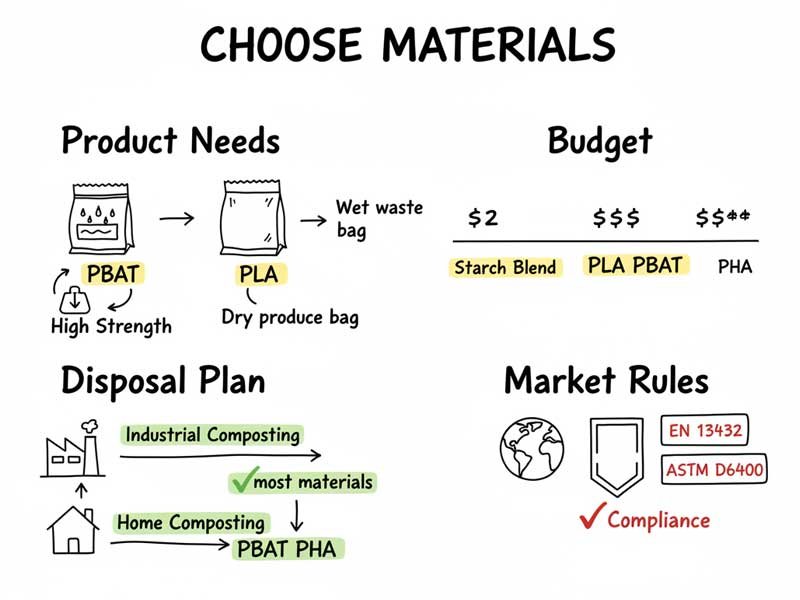
Businesses, municipalities, distributors and brands looking to reduce reliance on conventional plastic garbage bags have several alternatives available.
However, there is no single replacement that works best in every waste stream.
The right option depends on the type of waste, moisture level, load requirements, collection system, local processing infrastructure and environmental objective.
Common alternatives include:
| Alternative | Main Advantage | Main Limitation | Typical Use |
|---|---|---|---|
| Certified compostable bags | Designed for defined composting systems | Requires appropriate collection and processing | Food waste, organics, FOGO |
| Paper waste bags | Plastic-free and fibre-based | Poor wet strength unless specially designed | Dry waste, yard waste |
| Recycled-content plastic bags | Reduce virgin plastic use | Still plastic and not compostable | General mixed waste |
| Reusable liners / containers | Reduces single-use liner consumption | Requires washing and operational controls | Closed-loop facilities |
| Liner-free collection | Avoids disposable bags entirely | Not practical for every waste stream | Selected institutional systems |
The European Commission notes that compostable and biodegradable plastics can provide benefits in specific applications, but also have trade-offs and should be used where they fit the actual waste-management system.

What Is the Best Alternative to Plastic Garbage Bags?
There is no universal “best” alternative.
A better question is:
What waste stream will the bag serve, and where will the waste go after collection?
For separately collected food waste or organics, certified compostable liners may be appropriate where the receiving program accepts them.
For general mixed waste that will not enter composting, recycled-content plastic bags may be more practical.
For dry waste, paper-based bags may work.
For controlled facilities, reusable or liner-free systems may reduce single-use bag demand altogether.
So the decision should follow:
Waste stream → disposal route → local acceptance → performance requirement → material choice
1. Certified Compostable Garbage Bags
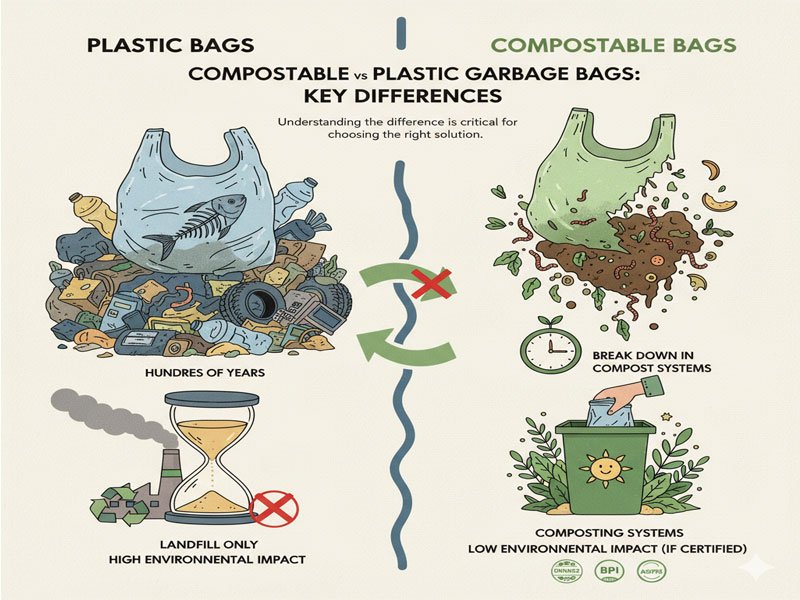
Certified compostable bags are designed to biodegrade and disintegrate under defined composting conditions.
They are commonly used for:
- food scraps;
- kitchen organics;
- municipal bio-waste;
- hospitality food waste;
- FOGO collection;
- selected institutional composting programs.
Applicable standards and certification schemes vary by market, such as EN 13432 in Europe, ASTM D6400-related certification in the US and AS 4736 in Australia.
When They Make Sense
Certified compostable bags are most appropriate when the bag and its contents will enter a compatible composting system.
Certification does not guarantee that every composting facility accepts the product.
Important Limitation
Compostable bags are still a type of plastic material in regulatory and technical contexts.
The European Commission explicitly treats biodegradable and compostable plastics as plastics, even though they are designed for different end-of-life conditions.
So “compostable” should not automatically be marketed as “plastic-free.”
2. Paper Garbage Bags
Paper-based garbage bags can reduce or eliminate conventional plastic use in selected applications.
They may be suitable for:
- dry waste;
- yard waste;
- light paper waste;
- some organic-waste collection systems where wet strength is sufficient.
Their main limitation is moisture resistance.
Wet food waste, grease and heavy loads can weaken standard paper structures.
For this reason, paper bags should be evaluated for:
- wet strength;
- seam integrity;
- basis weight;
- coating or treatment;
- compatibility with the destination waste system.
A paper bag is not automatically the right solution simply because it is plastic-free.
3. Recycled-Content Plastic Garbage Bags
Recycled-content trash bags are still plastic, but they can reduce demand for virgin resin.
They may be appropriate for general mixed waste where composting is not part of the disposal route.
Common procurement considerations include:
| Factor | Buyer Check |
|---|---|
| Recycled content | Post-consumer vs post-industrial percentage |
| Strength | Tear and puncture performance |
| Thickness | Balance between material use and durability |
| Colour consistency | Important for private label |
| Odour / appearance | May vary with recycled feedstock |
| Regulatory requirements | Depends on destination market |
This option should be described accurately as recycled-content plastic, not non-plastic.
4. Biodegradable Garbage Bags
The word biodegradable alone is not enough to determine whether a waste bag is suitable for composting.
Biodegradation depends on:
- the environment;
- temperature;
- moisture;
- oxygen;
- microorganisms;
- timeframe.
The FTC warns against broad, unqualified degradable or biodegradable claims for products that normally enter landfill, incineration or recycling systems unless the claim is properly substantiated and qualified.
For procurement, ask:
Biodegradable under what conditions, within what timeframe, and according to which test or certification?
5. Reusable Liners and Reusable Containers
In some controlled environments, the best alternative to a disposable plastic bag may be to avoid a single-use bag entirely.
Reusable liners, washable containers or collection bins may be feasible in:
- industrial kitchens;
- closed-loop institutional systems;
- selected commercial facilities;
- internal waste transfer operations.
This option can reduce single-use material consumption, but requires:
- cleaning;
- hygiene management;
- labour;
- storage;
- operational discipline.
It is not suitable for every waste stream or facility.
6. Liner-Free Waste Collection
Some programs may operate without disposable liners.
This can reduce material use but may increase:
- bin cleaning;
- odour control requirements;
- handling effort;
- leakage risk.
Liner-free systems are therefore highly application-dependent.
They should be evaluated as an operational alternative rather than simply a packaging alternative.
Compostable vs Paper vs Recycled Plastic
| Feature | Compostable Bag | Paper Bag | Recycled Plastic Bag |
|---|---|---|---|
| Plastic-free | No, not necessarily | Usually yes | No |
| Compostable | If appropriately certified | Depends on construction | No |
| Wet-waste performance | Generally good when correctly specified | Variable | Good |
| Heavy-load performance | Depends on thickness and formulation | Limited to moderate | Often strong |
| Uses recycled material | Usually not defining feature | May | Yes |
| Suitable for organics systems | Potentially | Sometimes | Usually no |
| Suitable for mixed waste | Possible, but compostability benefit may be lost | Limited | Often suitable |
| Certification important | Yes | Depends on claim | Depends on recycled-content claim |
No row should be read as an environmental ranking.
The correct choice depends on the application and disposal system.
Are Compostable Garbage Bags Plastic-Free?
Not necessarily.
Many compostable flexible bags use compostable polymers such as PBAT and PLA.
These materials are engineered for biodegradation and composting under defined conditions, but they are still classified as plastics in many regulatory contexts.
The European Commission states that bio-based, biodegradable and compostable materials are distinct types of plastics and that feedstock origin does not determine compostability.
So buyers should avoid treating:
compostable = plastic-free
as a universal statement.
Are Paper Bags Always More Sustainable?
Not necessarily.
Paper can reduce reliance on conventional plastic, but its suitability depends on:
- fibre source;
- bag weight;
- wet-strength treatment;
- transport efficiency;
- number of bags needed;
- disposal route.
A weak paper bag that requires double-bagging or frequent replacement may not deliver the intended environmental benefit.
The relevant question is whether the bag performs adequately for the intended use with an appropriate material and end-of-life route.
Do Compostable Bags Work in Landfill?
Compostable bags are designed for composting conditions, not landfill degradation.
Landfills often limit oxygen, moisture and biological activity.
The FTC specifically warns that biodegradable or degradable claims can be misleading when products are normally disposed of in landfill or incineration environments that do not support rapid breakdown.
Therefore, a compostable certificate should not be presented as evidence that a bag will quickly disappear in landfill.
What Should B2B Buyers Evaluate?
For B2B sourcing, do not select an alternative based only on the material name.
Evaluate:
| Procurement Question | Why It Matters |
|---|---|
| What waste is being collected? | Wet organic waste differs from dry or mixed waste |
| Where will it go? | Composting, landfill and incineration require different thinking |
| Is the bag accepted locally? | Certification does not guarantee facility acceptance |
| What strength is required? | Heavy and wet waste need different construction |
| Is the environmental claim specific? | Avoid vague “green” or “plastic-free” claims |
| What documentation is available? | Certification and recycled-content claims need evidence |
| What is the total material use? | Thickness and bag size affect resource use |
| Is private-label printing required? | Ink, colour and claims may affect specifications |
FTC guidance also cautions against broad claims such as “eco-friendly” when the specific environmental benefit is not clear and substantiated.
Common Mistakes When Replacing Plastic Garbage Bags
The most common mistakes are treating “non-plastic,” “biodegradable,” “bio-based” and “compostable” as interchangeable terms; choosing compostable bags when no composting route exists; assuming paper can handle wet waste without testing; treating recycled-content plastic as plastic-free; and selecting a bag before confirming the actual waste stream and destination facility.
A technically better sourcing sequence is:
Application first → waste route second → performance third → environmental attribute fourth → certification fifth.
FAQ – Alternatives to Plastic Garbage Bags
What is the best alternative to plastic garbage bags?
There is no single best option. Certified compostable bags can be suitable for accepted organic-waste systems, paper bags may suit dry waste, recycled-content plastic bags may suit mixed waste, and reusable or liner-free systems may work in controlled facilities.
Are compostable garbage bags plastic-free?
Not necessarily. Many compostable bags are made from compostable plastic polymers such as PBAT and PLA.
Are non-plastic trash bags really plastic-free?
Some are, such as certain paper-based bags. Others marketed as “non-plastic” may still contain compostable polymers, so buyers should verify the actual material composition.
Are biodegradable trash bags a good replacement for plastic garbage bags?
Only if the biodegradability claim is clearly defined and appropriate for the intended end-of-life environment. A generic biodegradable claim does not establish compostability.
Can recycled plastic bags be considered an alternative to conventional plastic bags?
They are an alternative to virgin-plastic bags, not a non-plastic option. Their main environmental attribute is reduced virgin resin use.
Are compostable bags suitable for general landfill waste?
They can physically be used, but the compostability benefit is not realised if the bag does not enter a suitable composting system.
Can paper trash bags replace plastic for food waste?
Sometimes, but wet strength, leakage resistance and facility acceptance must be evaluated. Standard paper bags may not perform well with wet food waste.
Related Buyer Guides
- Eco Friendly Trash Bags: B2B Buyer Guide
- Eco-Friendly vs Compostable Trash Bags
- Compostable Trash Bags
- Compostable Garbage Bags Wholesale
Source Compostable Garbage Bags for Organic-Waste Programs
ORIZON manufactures compostable garbage bags and bin liners for B2B buyers where certified compostability is appropriate to the intended waste stream.
For a quotation, provide the bag dimensions, thickness, waste type, bags per roll, required certification, printing requirements, estimated quantity and delivery destination.