When sourcing custom dog waste bags, one of the first decisions a buyer must make is whether to use compostable material or conventional polyethylene, commonly known as PE.
At first glance, the choice may appear simple: compostable bags are positioned as an environmentally responsible option, while PE bags are usually associated with lower cost and traditional plastic performance.
In practice, however, the right material depends on the intended market, product positioning, budget, disposal system, printing requirements and local regulations.
A recent promotional-product enquiry illustrates this clearly. The buyer requested 10,000 custom dog waste bag rolls or promotional sets for the European market. The bags needed to be blue, printed in white and packed with a branded plastic dispenser and printed retail box.
Most importantly, the buyer specifically requested non-compostable PE bags and asked suppliers not to offer PBAT, PLA or starch-based materials.
This was not necessarily because the buyer was unconcerned about sustainability. Instead, recycled PE, promotional pricing, printing performance and the intended giveaway application were more important for this particular project.
So, how should brands choose between compostable and PE dog waste bags?
What Are Compostable Dog Waste Bags?
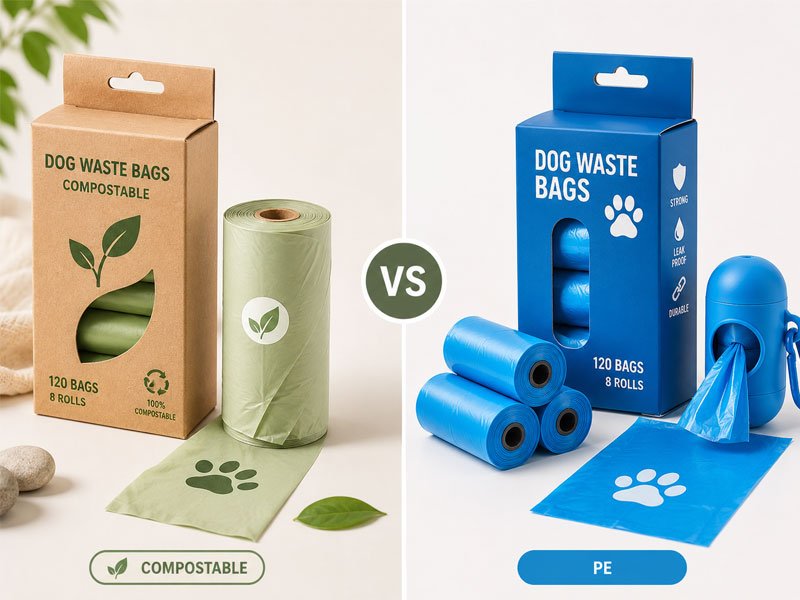
Compostable dog waste bags are usually manufactured from a blend of biodegradable polymers and plant-based components.
Common materials may include:
- PBAT
- PLA
- Corn starch or other plant-based fillers
- Compostable additives and color masterbatch
Properly certified compostable bags are designed to break down under specified composting conditions without leaving conventional plastic fragments.
Depending on the formulation and certification, the bags may be suitable for industrial composting, home composting or both.
Common compostability standards include:
- EN 13432
- ASTM D6400
- TÜV Austria OK compost INDUSTRIAL
- TÜV Austria OK compost HOME
- AS 4736
- AS 5810
- BPI certification requirements
Buyers can review our global compostable certification guide to understand which standards apply to Europe, North America and Australia.
Certification should always be verified for the relevant finished product, material formulation and target market.
What Are PE Dog Waste Bags?
PE dog waste bags are made from polyethylene, generally using LDPE, HDPE or a combination of polyethylene grades.
The main options include:
Virgin PE
Virgin PE is made from newly produced plastic resin. It normally provides stable film quality, consistent color, good sealing and reliable printing performance.
Recycled PE
Recycled PE may contain post-industrial recycled material, post-consumer recycled material or a combination of both.
The recycled content can vary significantly, depending on the required strength, color, odor, appearance and regulatory requirements.
For branded projects, buyers should ask the supplier to specify:
- Type of recycled material
- Percentage of recycled content
- Whether the material is post-industrial or post-consumer
- Available traceability documents
- Applicable EU material compliance documentation
Recycled PE can reduce the use of virgin plastic, but it remains a conventional plastic material. It should not be marketed as compostable or biodegradable unless there is valid evidence supporting such a claim.
Conventional waste bags are generally made from HDPE, LDPE or LLDPE. Our guide to plastic, recycled PE and plant-based bag materials explains how these materials differ.
Compostable vs. PE Dog Waste Bags: Key Differences
| Factor | Compostable Dog Waste Bags | PE Dog Waste Bags |
|---|---|---|
| Main material | PBAT, PLA, starch or similar compostable compounds | LDPE, HDPE, virgin PE or recycled PE |
| Environmental positioning | Plastic-free or compostable product positioning | Conventional plastic or recycled-content positioning |
| Certification | Compostability certification may be required | Material declarations and recycled-content documentation may be required |
| Cost | Usually higher | Usually more economical |
| Film consistency | Can vary depending on formula and storage | Generally stable and predictable |
| Printing | Suitable for flexographic printing, but ink selection matters | Usually suitable for stable, high-speed flexographic printing |
| Shelf life | Requires careful storage and stock management | Generally longer and less sensitive |
| Moisture sensitivity | More sensitive to heat, humidity and storage conditions | Usually less sensitive |
| Promotional giveaways | Possible, but may increase project cost | Commonly used for mass promotional campaigns |
| Premium eco brands | Strong fit | Recycled PE may be acceptable depending on positioning |
| Disposal | Depends on local composting rules and pet-waste acceptance | General waste unless a suitable recycling route exists |
When Should You Choose Compostable Dog Waste Bags?
Compostable dog waste bags are often the better choice when environmental positioning is central to the product.
They may be suitable for:
- Sustainable pet brands
- Plastic-free retail ranges
- Eco-conscious subscription boxes
- Organic and natural pet shops
- Brands targeting Australia, Europe, the UK or North America with recognized compostability claims
- Private-label products sold at a premium price
- Buyers who require third-party compostability certification
Explore our complete range of compostable pet waste bags for B2B and private-label programs.
A compostable bag can support a stronger environmental story, but the buyer must consider more than the raw material.
The full product may also include:
- Printing ink
- Paper core
- Roll label
- Retail box
- Adhesive
- Dispenser
- Packaging film
If a brand claims that an entire product or package is compostable, every relevant component should be reviewed carefully.
When Should You Choose PE Dog Waste Bags?
PE dog waste bags may be the more practical choice when price, durability and promotional volume are the main priorities.
They are often suitable for:
- Promotional giveaways
- Trade shows
- Pet-care campaigns
- Veterinary clinics
- Municipal pet-waste programmes
- Hotel or property-management giveaways
- Large retail promotions
- Budget-sensitive private-label projects
- Projects requiring plastic dispensers and low-cost retail boxes
For example, a buyer purchasing 10,000 promotional sets may prefer:
- One printed dispenser
- One inserted roll
- Blue PE bags
- One-color white printing
- A printed carton box
In this type of campaign, the product may be distributed free of charge. The buyer may therefore prioritise unit cost, logo visibility and reliable delivery over premium compostable positioning.
Is Recycled PE a Good Middle Option?
Recycled PE can provide a compromise between conventional plastic performance and reduced use of virgin resin.
However, buyers should understand its limitations.
A higher recycled content may affect:
- Film color
- Surface smoothness
- Odor
- Tensile strength
- Puncture resistance
- Sealing consistency
- White ink opacity
- Batch-to-batch consistency
Dark colors such as black, navy blue and dark green are often easier to produce with recycled PE than light or transparent colors.
For a blue dog waste bag with white printing, the supplier should test whether the white logo has sufficient opacity. In some cases, a stronger ink deposit or double printing pass may be required.
The buyer should also avoid vague claims such as “eco-friendly plastic” unless the claim can be clearly explained and documented.
A more accurate statement may be:
Manufactured with XX% recycled polyethylene.
This is more transparent than describing the product as biodegradable or compostable.
Which Material Is Better for Printing?
Both PE and compostable films can be custom printed, usually by flexographic printing. Brands developing printed rolls, retail packs or promotional sets can review our custom dog poop bag manufacturing options, including bag sizes, thicknesses, printing and packaging formats.
However, printing quality depends on several factors:
- Film surface treatment
- Ink compatibility
- Logo size
- Ink coverage
- Bag color
- Film thickness
- Printing speed
- Number of print colors
- Required opacity
White printing on a blue bag is a common promotional design, but white ink can be less opaque than darker ink colors.
Before mass production, buyers should request:
- Printing area dimensions
- Artwork guidelines
- Pantone references
- Digital artwork approval
- Printed film sample where necessary
- Confirmation of whether one or two printing passes are required
For simple logos, one-color printing is usually the most economical solution.
Cost Comparison
PE dog waste bags are generally less expensive than certified compostable dog waste bags.
The final cost depends on:
- Bag dimensions
- Film thickness
- Bags per roll
- Number of rolls
- Printing coverage
- Material type
- Recycled content
- Paper core or coreless format
- Dispenser type
- Retail box structure
- Carton printing
- Packing labour
- Quality-control requirements
For promotional products, the cheapest solution is often:
- Standard-size PE bag
- Standard blue color
- No printing on the bag
- One-color printed dispenser
- One inserted roll
- Simple one-color printed box
A slightly more premium solution may include white printing on the bags and four-color printing on the retail box.
For compostable retail products, the packaging and certification presentation often become more important, which can increase the overall project cost.
Performance and Thickness
Material thickness should not be selected by micron value alone.
A thicker bag is not automatically stronger if the material formula, film orientation and sealing quality are poor.
Common factors affecting performance include:
- Tensile strength
- Tear resistance
- Puncture resistance
- Bottom-seal strength
- Perforation quality
- Roll winding
- Material uniformity
A standard dog waste bag size is often approximately:
- 23 × 33 cm
- 15 bags per roll
- Flat top
- Star-sealed or flat-sealed bottom
The appropriate thickness depends on the material.
A PE bag and a compostable bag with the same thickness may not provide exactly the same hand feel or mechanical performance.
The correct approach is to approve physical samples rather than compare specifications only on paper.
The most common format is approximately 9 × 13 inches, but buyers should review the complete dog waste bag size and thickness guide before confirming dispenser compatibility and roll diameter.
Shelf Life and Storage
PE bags generally have a longer and more stable shelf life.
Compostable bags require more careful storage because heat, humidity and direct sunlight may accelerate material ageing.
Recommended storage conditions normally include:
- Cool and dry warehouse
- No direct sunlight
- Protection from excessive humidity
- Original sealed packaging
- Reasonable inventory turnover
Brands purchasing compostable bags should avoid ordering excessive quantities that may remain in storage for several years.
For long promotional campaigns or central warehouse distribution, PE may offer simpler stock management.
Are Compostable Dog Waste Bags Always the Greener Choice?
Not automatically.
The environmental impact depends on the full product lifecycle, including:
- Raw-material production
- Manufacturing efficiency
- Transportation
- Packaging
- Product usage
- Disposal method . Material certification does not automatically determine the correct disposal route. Buyers and users should also understand how to dispose of dog poop bags in local waste systems.
- Local waste-management infrastructure
A certified compostable bag may offer meaningful benefits when it is used and disposed of in an appropriate system.
However, some composting facilities do not accept pet waste, even if the bag itself is certified compostable.
Similarly, a recycled PE bag can reduce virgin-plastic consumption, but it will not biodegrade in normal environmental conditions.
Brands should therefore avoid absolute claims and communicate clearly.
Instead of saying:
This bag is completely harmless to the environment.
A more responsible claim would be:
Made from certified compostable material according to the applicable standard.
Or:
Made with XX% recycled polyethylene to reduce the use of virgin plastic.
EU Market Considerations
For products sold or distributed in the European Union, buyers should request documentation that is relevant to the material, ink and intended use.
Depending on the project, this may include:
- Material specification
- Technical data sheet
- Safety data information
- REACH-related declarations
- SVHC declarations
- Heavy-metal testing
- Packaging compliance information
- Recycled-content declaration
- Compostability certificate, where applicable
- Printing-ink compliance statement
Buyers should also ensure that environmental wording on the product and packaging is accurate, specific and supported by evidence.
Terms such as “biodegradable,” “compostable,” “recyclable” and “made from recycled material” do not mean the same thing.
How to Choose the Right Material
Before requesting a quotation, answer the following questions:
- Is the product intended for retail sale or free promotional distribution?
- Is environmental certification essential to the brand?
- What is the target unit price?
- Is recycled content required?
- What bag color and printing design are needed?
- Will the product include a dispenser?
- Does the dispenser also need recycled material?
- Is the retail box printed in one color or four colors?
- Which country will the product be sold in?
- What documentation is required by the importer?
- What is the expected shelf life?
- How will the bags be disposed of after use?
For a complete specification review before requesting prices, use our OEM dog waste bag sourcing checklist.
These questions allow the supplier to recommend a realistic product rather than simply offering the most expensive or lowest-cost material.
Recommended Solutions by Application
Premium Sustainable Retail Brand
Recommended configuration:
- Certified compostable bag
- 15 bags per roll
- Custom color
- One- or two-color printing
- Recyclable or responsibly sourced paper box
- Compostability certification information clearly displayed
Recycled-Content Retail Product
Recommended configuration:
- Recycled PE bag
- Clearly declared recycled percentage
- Dark or medium bag color
- Limited printing coverage
- Recycled plastic dispenser where available
- Paper retail packaging
Large Promotional Giveaway
Recommended configuration:
- Standard PE or recycled PE
- Standard bag size
- Blue or another stock color
- Unprinted bag or one-color logo
- Standard dispenser mold
- One-color dispenser printing
- Simple printed carton box
Lowest-Cost Promotional Set
Recommended configuration:
- Unprinted PE bags
- One standard roll
- Standard dispenser
- One-color logo on the dispenser
- Economical one-color carton box
Final Conclusion
There is no single material that is best for every dog waste bag project.
Compostable dog waste bags are a strong option for brands that prioritise certified environmental performance, plastic-free positioning and premium retail presentation.
PE dog waste bags remain suitable for projects where durability, stable production, longer shelf life and competitive pricing are more important.
Recycled PE can be a useful middle option, especially for high-volume promotional projects, provided that the recycled content and environmental claims are clearly documented.
The most responsible sourcing decision is not simply to choose the material with the greenest name. It is to select a material that fits the product’s actual application, target market, disposal system and brand promise.
Conclusion
There is no single material that is best for every dog waste bag project.
Compostable dog waste bags are a strong option for brands that prioritise certified environmental performance, plastic-free positioning and premium retail presentation.
PE dog waste bags remain suitable for projects where durability, stable production, longer shelf life and competitive pricing are more important.
Recycled PE can be a useful middle option, especially for high-volume promotional projects, provided that the recycled content and environmental claims are clearly documented.
The most responsible sourcing decision is not simply to choose the material with the greenest name. It is to select a material that fits the product’s actual application, target market, disposal system and brand promise.
Planning a Private-Label Dog Waste Bag Project?
We specialize in certified compostable dog waste bags for OEM, wholesale and private-label programs. For buyers comparing compostable and conventional PE options, our team can help evaluate the material, specifications, certification requirements and packaging structure before project development.
Send us your required bag size, thickness, bags per roll, printing design, packaging format, order quantity and destination market. Our team will recommend a suitable certified compostable solution and prepare a customized quotation.
Download our compostable bag catalog and certification pack, to review our available products, material options and OEM capabilities.