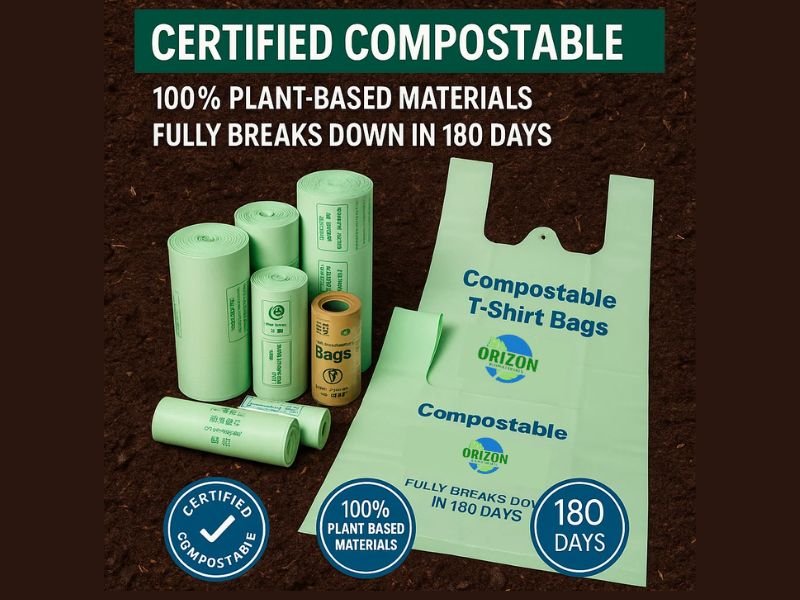
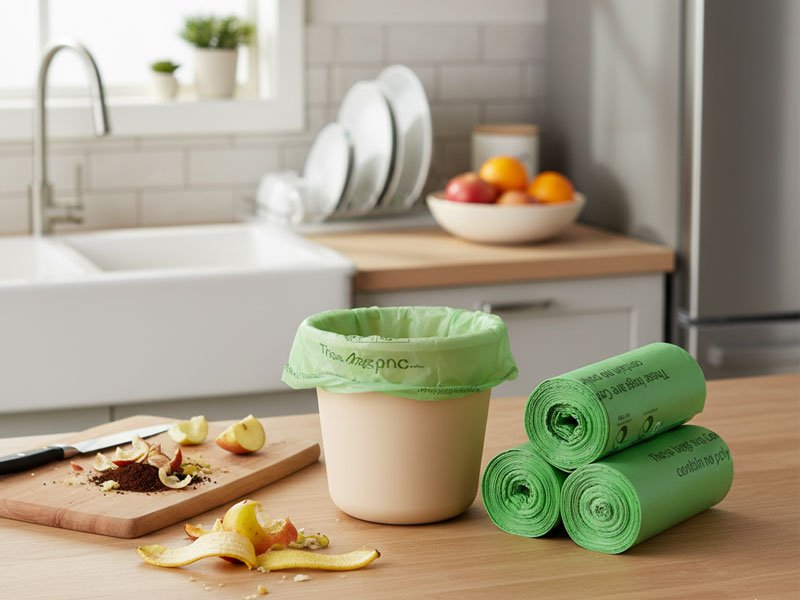
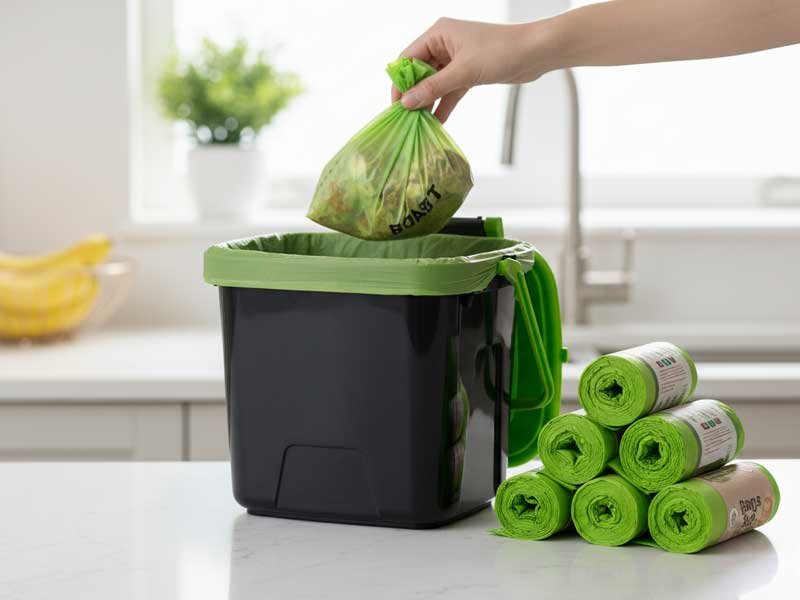
Dog waste station bags are not selected in the same way as small retail rolls sold to pet owners.
For parks, apartment communities, HOAs, property-management companies and municipal programmes, bag material is only one part of the procurement decision. Buyers must also consider dispenser compatibility, bags per refill, perforation strength, outdoor storage, refill frequency, certification requirements and total operating cost.
Certified compostable bags can help public and commercial programmes reduce their dependence on conventional plastic. However, PE bags may still be selected when lower cost, longer storage periods or compatibility with an existing dispenser system are the main priorities.
This guide compares compostable and PE dog waste station bags specifically for public dispensers and commercial refill programmes.
Buyers sourcing small retail rolls, custom-printed dispensers or promotional sets can read our guide to compostable vs. PE dog waste bags for custom and promotional projects.
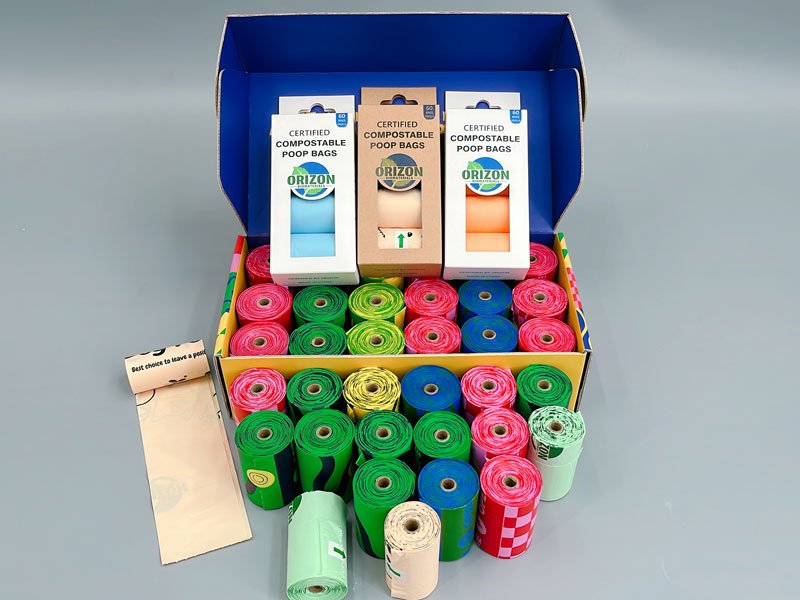
What are Compostable Dog Waste Bags?
Dog waste station bags are refill bags designed for public or shared pet-waste dispensers.
They are commonly installed in:
- Public parks
- Dog parks
- Apartment communities
- Residential developments
- HOA-managed properties
- Hotels and resorts
- Commercial properties
- Walking trails
- Campgrounds
- Municipal pet-waste programmes
Unlike conventional retail dog waste bags, which are often packed in small rolls of approximately 15 bags, station bags are designed for higher-volume use and controlled dispensing.
Common station bag formats include:
Roll-Style Station Bags
The bags are wound on a roll and dispensed individually through a compatible station opening.
Roll-style bags may be supplied with a paper core or in a coreless format, depending on the dispenser design.
Header-Style Station Bags
The bags are connected to a header section and dispensed one at a time from a compatible station.
Header-style bags can help control dispensing and reduce the risk of users removing a complete roll.
You can learn more about our header-style dog waste station refill bags.
Tissue-Style or Interleaved Bags
The bags are folded and packed so that pulling one bag presents the next bag through the dispenser opening.
This format is often used in compact public dispensers where roll diameter is limited.
The correct format depends on the installed station. Material alone does not determine whether a refill bag will fit or dispense correctly.
What Are Compostable Dog Waste Station Bags?
Compostable dog waste station bags are manufactured from materials designed to biodegrade under the conditions defined by an applicable compostability standard.
Common material components may include:
- PBAT
- PLA
- Corn starch or other plant-based components
- Compostable processing additives
- Compostable colour masterbatch
Depending on the formulation and certification, a finished bag may be certified for industrial composting, home composting or a specific regional standard.
Common standards and certification programmes include:
- EN 13432
- ASTM D6400
- BPI certification
- TÜV Austria OK compost INDUSTRIAL
- TÜV Austria OK compost HOME
- AS 4736
- AS 5810
These standards are not interchangeable.
For example, an industrially compostable product should not automatically be described as home compostable. Buyers should confirm which certification is required in the destination market and whether the certificate applies to the relevant product, material formula and thickness range.
Review our compostability certification guide for more information about international standards.
It is also important to distinguish material certification from local waste acceptance.
A certified compostable bag is designed to perform under specified composting conditions. This does not automatically mean that every composting facility or municipal collection programme will accept pet waste.
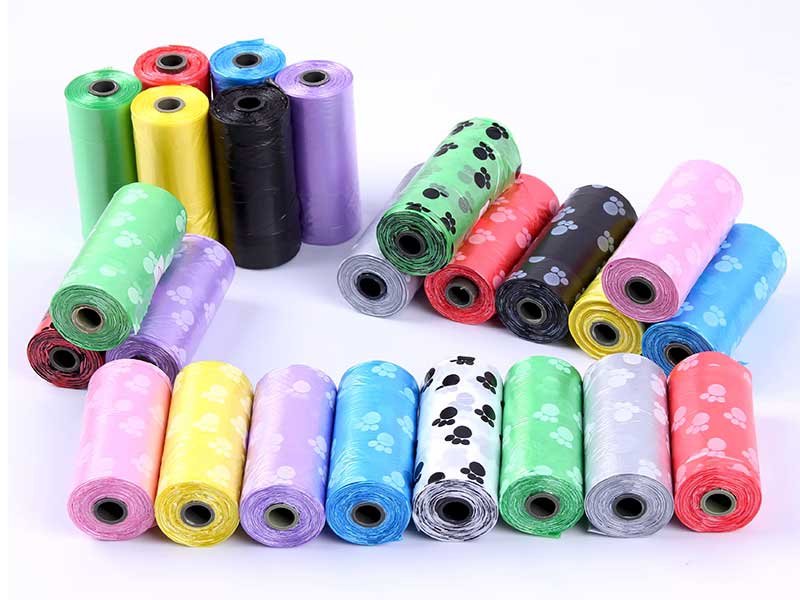
What are Plastic Dog Waste Bags?
What Are PE Dog Waste Station Bags?
PE dog waste station bags are manufactured from polyethylene.
Common material options include:
Virgin LDPE
Low-density polyethylene generally provides a soft film, stable sealing performance and consistent production quality.
Virgin HDPE
High-density polyethylene can produce a thinner, firmer film and may be used where high bag counts and compact roll dimensions are required.
Recycled PE
Recycled PE may contain post-industrial or post-consumer recycled material.
The recycled content can vary according to:
- Required bag strength
- Film thickness
- Colour
- Odour requirements
- Printing requirements
- Sealing performance
- Batch consistency
- Available documentation
Recycled PE can reduce the use of virgin plastic, but it remains conventional plastic.
It should not be described as compostable or biodegradable unless the finished product has separate, valid evidence supporting that claim.
For public procurement, buyers requesting recycled PE should ask the supplier to state:
Relevant chemical or regulatory compliance documents
The percentage of recycled content
Whether it is post-industrial or post-consumer material
Available traceability documentation
Material declarations
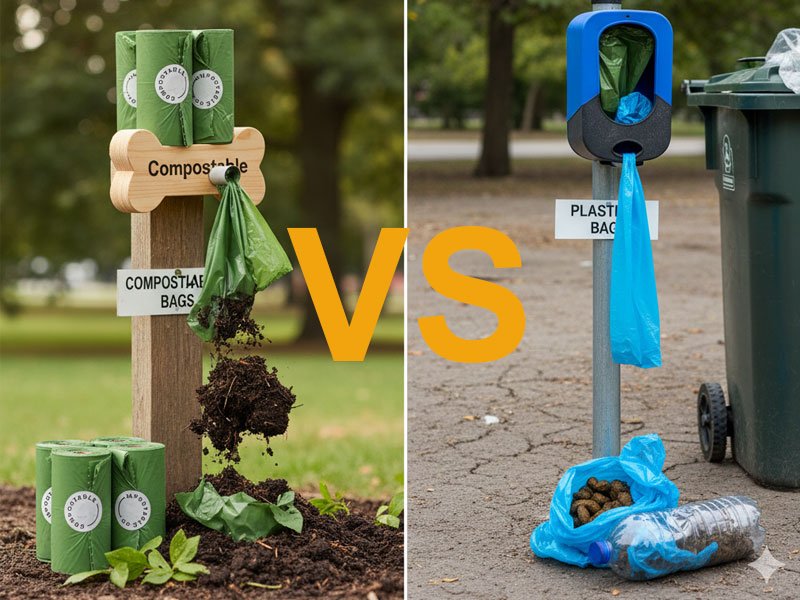
Compostable vs. PE Dog Waste Station Bags
The following comparison summarises the main differences for public and commercial refill programmes.
| Factor | Compostable Station Bags | PE Station Bags |
|---|---|---|
| Main material | Certified compostable compounds | Virgin or recycled polyethylene |
| Main procurement objective | Reducing conventional plastic and meeting sustainability requirements | Cost control, storage stability and existing dispenser compatibility |
| Certification | Compostability certification may be required | Material and recycled-content documentation may be required |
| Cost | Usually higher | Usually lower |
| Shelf life | Requires controlled storage and inventory rotation | Generally more stable for long-term storage |
| Heat and humidity sensitivity | More sensitive to unsuitable storage conditions | Generally less sensitive |
| Dispenser compatibility | Must be confirmed by format and dimensions | Often used in established conventional station systems |
| Bags per refill | Depends on thickness, format and dispenser capacity | Can support compact, high-count refill formats |
| Tear and perforation performance | Depends on formula and production consistency | Generally stable, but recycled content may affect performance |
| Environmental positioning | Suitable for certified compostable procurement programmes | Suitable for conventional or recycled-content procurement programmes |
| End-of-life | Depends on certification and local waste-system acceptance | Usually disposed of as general waste after pet-waste use |
| Best suited to | Sustainability-led programmes with defined certification requirements | Budget-led programmes or established PE dispenser systems |
There is no single material that is automatically suitable for every station programme.
The correct decision depends on the complete operating environment.
Material Is Not the Only Procurement Factor
A common sourcing mistake is to compare bags only by material and unit price.
For dog waste stations, operational compatibility is equally important.
1. Dispenser Compatibility
Before requesting a quotation, the buyer should identify the existing dispenser type.
Important measurements include:
- Maximum roll width
- Maximum roll diameter
- Paper-core diameter
- Header width
- Header-hole spacing
- Tissue-pack dimensions
- Dispensing opening size
- Direction of dispensing
Two bags made from the same material may not work in the same station if their roll dimensions, perforation direction or folding method are different.
For projects using an existing station, providing photos and internal measurements of the dispenser can reduce the risk of ordering an incompatible refill.
Read our dog waste station bag size and specification guide before confirming a new refill programme.
2. Bags per Roll or Refill
Public station bags may contain significantly more bags than small retail rolls.
Depending on the station format, a refill may contain:
- 200 bags
- 250 bags
- 300 bags
- 500 bags
- Another custom quantity
The highest possible bag count is not always the best choice.
Increasing the number of bags per roll may affect:
- Roll diameter
- Bag thickness
- Dispensing resistance
- Perforation quality
- Station capacity
- Refill weight
- Carton weight
The objective should be to balance refill frequency with reliable dispensing.
3. Refill Frequency
Refill frequency affects the total operating cost of a dog waste station programme.
A lower bag count can lead to:
- More frequent maintenance visits
- Higher labour requirements
- Increased vehicle or route costs
- A greater risk of empty dispensers
- More frequent carton handling
A higher bag count may reduce maintenance frequency, but only if the larger refill remains compatible with the station and dispenses consistently.
For municipal and property-management projects, the cost of maintenance labour may be more significant than a small difference in bag price.
4. Film Thickness and Performance
Micron thickness is important, but it should not be evaluated alone.
Bag performance also depends on:
- Material formulation
- Film uniformity
- Bottom-seal strength
- Tear resistance
- Puncture resistance
- Perforation consistency
- Winding tension
- Storage history
A thicker bag is not automatically stronger if the seal, perforation or material distribution is inconsistent.
The correct approach is to approve physical samples and test them in the actual dispenser before placing a large order.
5. Perforation and Controlled Dispensing
Station bags must separate cleanly without causing multiple bags to be pulled from the dispenser.
Poor perforation can lead to:
- Bags tearing before use
- Several bags being removed together
- Roll movement inside the dispenser
- Increased bag consumption
- User complaints
- Higher refill frequency
For public stations, perforation quality is a functional requirement rather than only a production detail.
6. Outdoor and Warehouse Storage
Compostable bags require appropriate storage conditions.
They should normally be kept:
- In a cool, dry warehouse
- Away from direct sunlight
- Away from excessive heat
- Protected from high humidity
- In their original sealed packaging
- Under a reasonable inventory-rotation system
PE bags are generally more tolerant of extended storage, but they should still be protected from sunlight, contamination and extreme temperatures.
For projects covering multiple locations, buyers should consider storage conditions at both the central warehouse and the individual maintenance facilities.
7. Carton Packing and Logistics
Public refill programmes often involve high annual consumption.
The following factors can influence transport and storage efficiency:
- Bags per roll
- Rolls per carton
- Carton dimensions
- Carton gross weight
- Pallet configuration
- Warehouse stacking
- Delivery frequency
- Annual call-off quantities
A lower bag price does not always produce a lower delivered cost if the packaging is inefficient or if the cartons cannot be handled easily by maintenance staff.
When Do Compostable Dog Waste Station Bags Make Sense?
Compostable station bags may be suitable when:
- A municipality requires certified compostable materials
- A park or community has a formal plastic-reduction policy
- The tender specifies EN 13432, ASTM D6400, BPI, TÜV or another applicable certification
- Environmental performance is part of the project evaluation
- The buyer can maintain suitable storage conditions
- Inventory can be rotated within a reasonable period
- The required station format can be produced in compostable material
- The local waste-management route has been reviewed
- The project team wants to reduce the use of conventional virgin plastic
For these programmes, certification documents should be checked before environmental claims are added to tenders, product labels or public signage.
Buyers should verify:
- Certificate number
- Certificate holder
- Product category
- Applicable material formula
- Thickness or product limitations
- Certification validity
- Approved logo-use requirements
When May PE Station Bags Still Be Selected?
PE station bags may remain practical when:
- The existing dispenser is designed for a specific conventional PE refill
- The main purchasing requirement is the lowest unit cost
- The project requires long-term warehouse storage
- The refill programme covers a high number of stations
- There is no local system accepting compostable bags containing pet waste
- The tender does not require compostability certification
- A recycled-content PE option is acceptable
- The buyer needs a very thin, compact, high-count refill
- Stable batch-to-batch dispensing performance is the main priority
This does not mean PE is environmentally equivalent to a certified compostable material.
It means the procurement decision must reflect the actual station system, budget, storage conditions and waste route.
Is Recycled PE a Middle Option?
Recycled PE may help reduce the amount of virgin plastic used in a station programme.
However, a higher recycled content can affect:
- Film colour
- Surface appearance
- Odour
- Tensile strength
- Puncture resistance
- Sealing consistency
- Perforation performance
- Batch-to-batch uniformity
Dark colours such as black, dark green or navy are often more practical for recycled PE than light or transparent colours.
Buyers should avoid broad claims such as:
Eco-friendly plastic bags
A more specific claim would be:
Manufactured with XX% recycled polyethylene.
The percentage and type of recycled content should be supported by appropriate supplier documentation.
Recycled PE is not compostable and should not be presented as a substitute for certified compostability.
Disposal and Local Waste-System Compatibility
The disposal route is one of the most misunderstood parts of dog waste bag procurement.
A compostability certificate describes how a material performs under defined test conditions. It does not automatically determine how a used dog waste bag should be collected in every city or country.
Some composting facilities do not accept pet waste because of:
- Pathogen-management requirements
- Facility permits
- Feedstock restrictions
- Local collection policies
- Operational contamination concerns
Similarly, used PE dog waste bags are generally not suitable for normal plastic-film recycling once they contain pet waste.
For both material types, buyers should consult:
- The relevant municipality
- The contracted waste-management company
- The receiving composting facility
- Local environmental regulations
- Tender-specific disposal requirements
Users can also review our guide on how to dispose of dog poop bags.
A responsible environmental claim should describe what the material is certified to do without promising that every local waste system will process it in the same way.
Procurement Checklist for Parks, HOAs and Municipal Programmes
Before requesting prices, prepare the following information.
Existing Station
- Station brand or model
- Roll, header or tissue format
- Internal dispenser dimensions
- Maximum roll diameter
- Maximum roll width
- Paper-core requirements
- Photos of the dispenser
- Current refill sample, if available
Bag Specification
- Bag width and length
- Film thickness
- Bottom-seal style
- Bags per roll or pack
- Perforation direction
- Bag colour
- Printed or unprinted
- Required dispensing method
Material Requirements
- Certified compostable or PE
- Industrial or home compostability requirement
- Required certification standard
- Virgin or recycled PE
- Required recycled-content percentage
- Applicable material documentation
Project Information
- Number of installed stations
- Estimated monthly consumption
- Annual quantity
- Delivery schedule
- Central or regional warehouse locations
- Required Incoterm
- Destination country
- Tender deadline
- Sample-approval requirements
Packing and Logistics
- Rolls per carton
- Maximum carton weight
- Pallet requirements
- Label requirements
- Batch identification
- Delivery frequency
- Call-off order structure
Providing this information allows the manufacturer to evaluate the whole refill system rather than quoting only a bag size.
How ORIZON Supports Dog Waste Station Projects
ORIZON specialises in certified compostable dog waste bags for B2B, municipal, community and commercial refill programmes.
Our OEM evaluation can include:
- Roll-style station bags
- Header-style dispensing bags
- Tissue-style or folded refill formats
- Custom bag dimensions
- Custom bags per roll
- Core and coreless options
- Custom colours
- One- or multi-colour printing
- Carton packing
- Private-label packaging
- Certification-document review
- Dispenser-compatibility evaluation
For an existing public station, send us:
- Dispenser photos
- Internal dimensions
- Current refill specifications
- Required quantity
- Destination market
- Certification requirements
Our team can review whether a certified compostable format can be developed for the programme.
Explore our compostable dog waste station bags for parks, communities, property-management companies and municipal projects.
Conclusion
There is no single material that is suitable for every dog waste station programme.
Compostable station bags are a strong option for parks, residential communities and municipal projects that require certified materials and have a clearly defined procurement and waste-management strategy.
PE station bags may remain practical for programmes prioritising lower cost, long storage periods or compatibility with an established conventional dispenser system.
Recycled PE can reduce the use of virgin plastic, but it remains conventional plastic and should not be presented as compostable.
The final decision should be based on:
- Dispenser compatibility
- Bags per refill
- Maintenance frequency
- Material performance
- Storage conditions
- Certification requirements
- Local disposal rules
- Annual consumption
- Total operating cost
The most responsible purchasing decision is not simply to choose the material with the greenest name. It is to select a refill solution that works reliably in the installed station, meets the applicable documentation requirements and supports the programme’s actual environmental objectives.
Planning a Dog Waste Station Refill Programme?
ORIZON specialises in certified compostable dog waste station bags for wholesale, OEM and public-facility projects.
Send us your station type, refill format, bag dimensions, bags per roll, annual quantity, destination country and certification requirements.
We will evaluate the specifications and prepare a customised compostable dog waste station bag solution for your project.
Contact our team to discuss your requirements.
FAQ
Are compostable dog waste station bags suitable for every public park?
Not necessarily.
Suitability depends on the installed dispenser, required refill format, storage conditions, certification requirements and local waste-management system.
A compostable bag should be tested in the actual station before a large order is confirmed.
Can compostable station bags fit an existing PE dispenser?
Possibly, but material is not the only compatibility factor.
The supplier must confirm:
- Roll width
- Roll diameter
- Core size
- Header dimensions
- Folding format
- Perforation
- Dispensing direction
A physical sample test is recommended.
Are used PE dog waste bags recyclable?
Used dog waste bags are generally unsuitable for normal plastic-film recycling because they are contaminated with pet waste.
The correct disposal method depends on local waste-management rules.
Do compostable dog waste bags require industrial composting?
It depends on the certification.
Products certified to industrial composting standards are designed for controlled commercial or municipal composting conditions.
Home-compostable claims require a relevant home-compost certification.
Even when the bag is certified, buyers must still confirm whether the local facility accepts pet waste.
Are recycled PE dog waste station bags compostable?
No.
Recycled content and compostability are different material characteristics.
A recycled PE bag remains conventional plastic unless it has separate evidence proving compliance with a recognised compostability standard.
How many bags should a public station refill contain?
The appropriate quantity depends on:
- Station capacity
- Roll diameter
- Bag thickness
- Site traffic
- Maintenance schedule
- Refill frequency
Common commercial configurations may contain several hundred bags per refill, but the final quantity must be matched to the installed dispenser.
What information is required for a municipal quotation?
The supplier normally needs:
- Station type and dimensions
- Bag size
- Bags per roll or pack
- Film thickness
- Material requirement
- Certification standard
- Annual quantity
- Packing requirement
- Delivery schedule
- Destination
- Tender documentation requirements
How should compostable station bags be stored?
They should generally be stored in a cool, dry place, protected from direct sunlight, excessive heat and high humidity.
Original packaging should remain sealed until use, and the buyer should maintain reasonable inventory rotation.