Last reviewed: October 9, 2026
Compostable toilet bags can be useful for festivals, outdoor events, crew camps, glamping areas and temporary sanitation systems that use removable waste liners.
However, choosing a suitable toilet bag involves more than selecting a material or looking for a compostability logo.
Event organizers and B2B buyers should consider:
- toilet compatibility;
- bag dimensions;
- film thickness;
- bottom-seal structure;
- closure method;
- expected waste load;
- heat exposure;
- servicing frequency;
- temporary storage;
- waste collection; and
- final disposal.
A toilet bag is only one part of a complete sanitation system.
For a broader overview of event and mobile sanitation planning, see: Portable Sanitation Systems
Quick Answer
Compostable toilet bags may be suitable for festivals and outdoor events when:
- the toilet is designed to use a removable liner;
- the bag fits correctly without excessive stretching;
- the film and seal are suitable for the expected load;
- used bags can be safely closed and removed;
- a servicing and temporary-storage plan is in place; and
- the final disposal route has been confirmed.
A compostability claim does not replace an event sanitation or waste-management plan.
Important ORIZON Certification Scope Notice
This article does not state or imply that ORIZON festival toilet bags, camping toilet bags, portable toilet liners or outdoor sanitation bags are covered by ORIZON’s current TÜV AUSTRIA, DIN CERTCO, BPI, AS 4736 or AS 5810 certificates.
ORIZON’s existing compostability certificates apply only within the product and specification scopes stated in the relevant certification documents.
Where certification is required for a festival or portable-sanitation project, the proposed finished product must be reviewed separately before certification claims or conformity marks are used.
For current ORIZON certificate numbers, scopes and validity information, see: ORIZON Evidence & Verification Center
Where Compostable Toilet Bags Fit in Festival Sanitation
Not every portable toilet requires a liner.
Many rented portable toilets use internal holding tanks and are serviced by specialist sanitation contractors. Those systems normally do not require event organizers to install separate waste bags.
Compostable toilet bags are more relevant where the sanitation system is specifically designed around a removable liner.
Typical applications may include:
- crew and staff camping areas;
- glamping facilities;
- folding camping toilets;
- bucket toilets;
- bag-based dry toilets;
- temporary emergency toilets;
- remote activity zones;
- filming or production locations; and
- backup sanitation systems.
The toilet design should always be confirmed before choosing a liner.
Crew & Staff Camping Areas
Festival workers, performers, contractors, security teams and volunteers may stay in temporary areas away from the main sanitation facilities.
Compact bag-based toilets may be useful as:
- overnight backup toilets;
- sanitation units in remote staff areas;
- temporary toilets during setup or breakdown; and
- emergency systems when regular units are unavailable.
Glamping & Premium Camping Areas
Some glamping tents, cabins and temporary accommodation areas use compact portable toilet systems.
Where a removable liner is part of the toilet design, the bag should provide:
- correct fit around the rim;
- sufficient usable height;
- suitable closure space; and
- adequate strength for removal.
Remote Activity Areas
Outdoor sports, trail events, filming locations, temporary exhibitions and remote checkpoints may operate far from permanent sanitation infrastructure.
Compact bag-based systems can sometimes provide a practical temporary option where properly managed.
What Are Compostable Festival Toilet Bags?
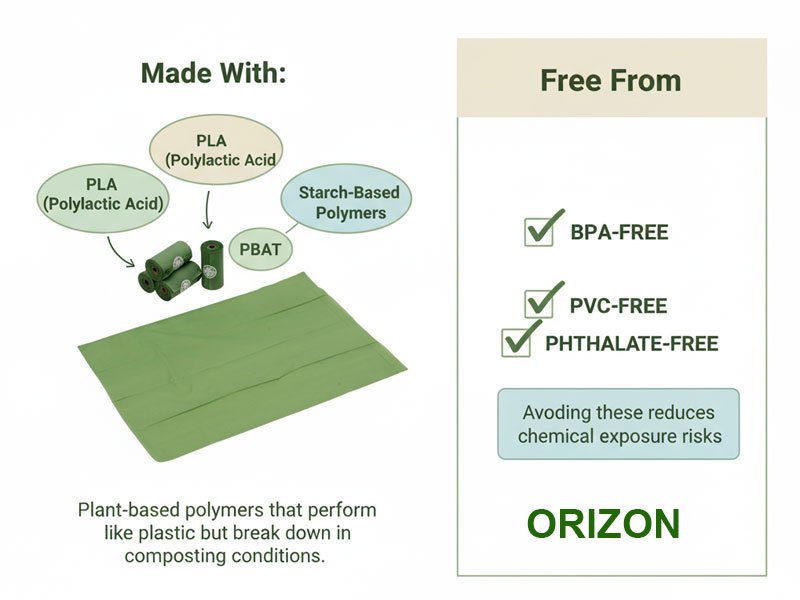
Compostable festival toilet bags are removable liners manufactured from compostable polymer formulations for compatible temporary sanitation systems.
Common formulations may include combinations of:
- PBAT;
- PLA;
- starch-based materials; and
- other compostable polymer components.
The exact formulation depends on the required bag structure, thickness and performance.
“Compostable” and “biodegradable” should not automatically be treated as the same claim.
A general biodegradable claim may not identify:
- the degradation conditions;
- the applicable test method;
- the disposal environment; or
- whether the finished product has relevant supporting evidence.
For more detail: Compostable vs Biodegradable Toilet Bags
What Makes a Toilet Bag Suitable for Festivals?
Festival toilet bags may experience more demanding conditions than bags used during a short camping trip.
They can be exposed to:
- repeated use;
- liquid and solid waste;
- high outdoor temperatures;
- pressure around the bottom seal;
- movement during removal;
- temporary storage; and
- transportation before disposal.
The following factors should therefore be reviewed before ordering.
1. Toilet Compatibility
Start with the toilet itself.
Do not select a bag only according to litre or gallon capacity.
Measure:
- toilet opening;
- internal container width;
- internal depth;
- rim shape;
- required liner overhang; and
- method used to secure the liner.
A bag that is too small may stretch across the rim and increase stress on the film and seal.
A bag that is too large may fold poorly, slide into the toilet or become difficult to remove.
For OEM projects, useful information includes:
- toilet drawings;
- internal dimensions;
- photographs;
- product model;
- product link; or
- physical samples where practical.
2. Film Thickness
Film thickness is normally measured in microns (μm).
The appropriate thickness depends on:
- bag dimensions;
- expected waste volume;
- liquid load;
- storage time;
- seal structure;
- closure method;
- temperature;
- material formulation; and
- whether absorbent material is used.
A thicker bag is not automatically the best solution.
Increasing thickness may also increase:
- material consumption;
- roll diameter;
- packaging volume;
- carton weight;
- freight cost; and
- unit cost.
For further guidance: Compostable Toilet Bag Thickness Guide
3. Bottom-Seal Structure
The bottom seal is one of the most important parts of a toilet liner.
Common structures include:
Star Seal
Star-sealed bottoms are often used for:
- roll-packed bags;
- bucket liners;
- folding camping toilets; and
- compact sanitation bags.
Flat Seal
Flat-sealed bags may be suitable for:
- larger liners;
- flat-packed products;
- rectangular containers; and
- certain custom toilet systems.
There is no universal best seal.
Performance depends on the combination of:
- bag dimensions;
- film formulation;
- film thickness;
- seal conditions;
- waste load; and
- finished-product construction.
For more information: Leak-Resistant Compostable Toilet Bags
4. Closure Method
The liner should leave enough usable material above the toilet rim for closure and removal.
Possible closure methods include:
- knotting an extended bag top;
- tie handles;
- drawstrings;
- separate ties; or
- secondary containment.
A bag may technically fit inside a toilet but still be too short for safe handling after use.
This should be checked during sample evaluation.
5. Liquid & Absorbent Material
A compostable toilet bag does not automatically solidify liquid waste.
Some sanitation systems may use:
- absorbent pads;
- wood fibre;
- sawdust;
- approved absorbent materials; or
- gelling products.
These materials may help reduce free liquid, but compatibility must be considered separately.
A compostable bag does not make everything placed inside it compostable.
Buyers should consider:
- bag compatibility;
- absorbent composition;
- disposal requirements;
- environmental claims; and
- local waste rules.
6. Heat Exposure
Festival toilet systems may be exposed to high temperatures inside:
- toilet tents;
- enclosed structures;
- vehicles;
- temporary storage areas; or
- locations in direct sunlight.
Higher temperatures can affect:
- odour;
- moisture;
- film flexibility;
- closure performance; and
- pressure around seals.
Compostability certification should not be treated as proof of heat resistance.
Where heat performance is important, the finished bag should be evaluated under realistic use conditions.
7. Replacement Frequency
Do not wait until the bag is completely full.
Overfilling increases stress on:
- film;
- bottom seal;
- closure;
- toilet rim; and
- staff handling procedures.
Event operators should establish:
- inspection frequency;
- maximum fill level;
- replacement schedule;
- high-traffic servicing frequency; and
- staff responsibility.
8. Temporary Storage & Waste Handling
Used toilet bags should not be left beside toilets or in public areas.
A controlled temporary-storage location should be considered.
The location should ideally be:
- inaccessible to the general public;
- separated from food and drinking water;
- protected from puncture or vehicle damage;
- accessible to trained staff;
- suitable for the expected waste quantity; and
- accessible to the waste contractor.
The complete handling process may include:
- bag removal;
- closure;
- secondary containment where required;
- staff transportation;
- temporary storage;
- contractor collection;
- transportation; and
- final disposal.
For additional guidance: Portable Toilet Waste Handling Systems
Odour Control at Outdoor Events
Compostable does not mean odour-proof.
Odour control depends on the complete sanitation system.
Important factors include:
- replacement frequency;
- closure method;
- free liquid;
- absorbent material;
- ventilation;
- temperature;
- toilet cleaning;
- storage duration; and
- secondary containment.
Fragrance should not be treated as a substitute for proper sanitation management.
The most effective approach is normally a combination of suitable bag performance and a reliable servicing schedule.
Certification & Environmental Claims
Certification is one of the areas where buyers should be particularly careful.
A material name such as PBAT, PLA or starch does not prove that the finished toilet bag is certified.
Likewise, a certificate covering another product category should not automatically be applied to a festival toilet liner.
Buyers should review:
- certification body;
- certificate holder;
- certificate number;
- certified product description;
- certified scope;
- relevant thickness conditions;
- colour and printing conditions;
- validity; and
- certification-mark rules.
Buyers may encounter certification programs and standards including:
| Standard / Certification | General Context |
|---|---|
| EN 13432 | Industrial compostability requirements commonly referenced in Europe |
| ASTM D6400 | Commercial / industrial compostability requirements for plastics |
| BPI Certification | Commercial compostability certification used in North America |
| OK compost INDUSTRIAL | Industrial composting certification scheme |
| OK compost HOME | Home-composting certification scheme |
| AS 4736 | Commercial compostability framework used in Australia |
| AS 5810 | Home-compostability framework used in Australia |
Important
This table explains common compostability standards and certification programs. It does not mean that ORIZON festival toilet bags are certified under all or any of these programs.
Certification applicability must be established from the relevant certification documentation for the actual finished product.
For current ORIZON certification information: ORIZON Evidence & Verification Center
Can Used Festival Toilet Bags Be Composted?
Not automatically.
Three separate questions need to be answered:
- Does the finished bag have appropriate evidence for the intended composting claim?
- Does the receiving facility accept that type of compostable bag?
- Does the facility accept the waste and every other material inside it?
Used toilet bags may contain:
- human waste;
- toilet paper;
- absorbent material;
- gelling products;
- wipes;
- hygiene products;
- cleaning products; and
- other waste.
Even where the bag itself has appropriate compostability evidence, the contents may make the complete waste stream unsuitable for composting.
Event organizers should confirm the disposal route with the relevant waste contractor or receiving facility.
Do Not Assume Used Bags Can Be Buried
Compostable does not mean:
- bury anywhere;
- leave in natural soil;
- discard outdoors; or
- place in any organic-waste bin.
Human waste and sanitation waste remain subject to applicable health, waste and disposal requirements.
How Manufacturing Affects Festival Toilet Bag Performance
Compostability is only one part of product performance.
Manufacturing consistency can affect:
- film thickness;
- film flexibility;
- bottom seals;
- perforation;
- roll winding;
- bag opening;
- puncture resistance; and
- storage stability.
For example:
- unstable perforation may cause bags to tear during separation;
- uneven film may create weak areas; and
- inconsistent seals may fail even when the main film remains intact.
For further manufacturing information: How Compostable Toilet Bags Are Manufactured
Compostable vs Conventional Toilet Liners for Events
| Factor | Compostable Toilet Bags | Conventional PE Toilet Liners |
|---|---|---|
| Material | Compostable polymer formulation | Conventional polyethylene |
| Compostability claim | Requires appropriate supporting evidence | Should not be marketed as compostable |
| Toilet compatibility | Must match the actual toilet | Must match the actual toilet |
| Leak resistance | Depends on film, seal, fit and use | Depends on film, seal, fit and use |
| Heat performance | Depends on formulation and specification | Depends on resin and specification |
| Disposal | Requires a confirmed waste route | Follows applicable sanitation/waste route |
| Main consideration | Avoid unsupported compostability and disposal claims | Conventional plastic end-of-life |
There is no universal best choice for every event.
Selection should consider:
- sanitation system;
- environmental goals;
- local disposal infrastructure;
- event duration;
- waste handling; and
- product performance.
Compostable Toilet Bags vs Dry Flush Systems
A compostable toilet liner and a dry-flush toilet system are not the same product.
A toilet bag is generally a removable liner used inside a compatible portable toilet.
A dry-flush system may mechanically wrap or isolate waste after each use and can depend on proprietary equipment or cartridges.
The appropriate choice depends on:
- toilet system;
- servicing method;
- event size;
- waste handling;
- budget; and
- disposal plan.
For a detailed comparison: Dry Flush Toilet Bags vs Compostable Toilet Bags
Festival Toilet Bag Planning Checklist
Before approving a toilet-bag system, confirm the following.
Event
- Expected attendance
- Event duration
- Overnight camping
- Staff and crew numbers
- Expected weather
- High-traffic periods
Toilet System
- Toilet type
- Bag-based design
- Opening dimensions
- Internal dimensions
- Required liner overhang
- Closure method
Bag Specification
- Width
- Length
- Gusset
- Film thickness
- Bottom seal
- Roll or flat-pack format
- Colour
- Bags per roll
Performance
- Expected load
- Maximum fill level
- Liquid exposure
- Seal performance
- Leak resistance
- Heat exposure
- Removal
- Temporary storage
Operations
- Inspection frequency
- Replacement schedule
- Staff training
- Secondary containment
- Storage location
- Waste contractor
- Emergency backup plan
Compliance & Disposal
- Required environmental claim
- Applicable documentation
- Local event requirements
- Waste contractor acceptance
- Receiving-facility acceptance
- Final disposal route
What B2B Buyers Should Send to a Manufacturer
A clear project brief makes product development easier.
Provide:
- intended event or application;
- toilet type or model;
- toilet dimensions;
- required bag size;
- expected film thickness;
- seal preference;
- closure method;
- expected waste load;
- expected storage time;
- climate or temperature conditions;
- absorbent material if used;
- printing requirements;
- packaging format;
- estimated quantity;
- destination country; and
- required environmental or certification claim.
For new products, sample testing with the actual toilet system is recommended before mass production.
Businesses developing a broader outdoor sanitation product line can also review:
For OEM camping and portable-toilet projects:
Common Buyer Mistakes
Assuming Every Portable Toilet Uses a Liner
Many commercial event toilets use holding tanks instead.
Confirm the toilet system first.
Selecting Bags Only by Capacity
A 20-litre or 30-litre label does not tell you the opening shape or required liner dimensions.
Measure the actual toilet.
Asking Only for More Thickness
Additional thickness cannot correct poor fit, insufficient height or a weak seal.
Calling a Bag “Leak-Proof”
“Leak-proof” is an absolute performance claim.
“Leak-resistant” is generally more appropriate unless a defined test method supports the stronger claim.
Assuming Certified Means Accepted
Even where a bag has applicable certification, the receiving facility may reject human waste or other contents.
Ignoring Secondary Containment
Closed toilet bags may still require a second bag, bin or other containment during storage and transportation.
Skipping Product Trials
Large events should not rely only on a basic factory sample.
Test the finished product under realistic load, temperature and handling conditions.
How ORIZON Supports Festival & Outdoor Sanitation Projects
ORIZON supports OEM and private-label manufacturing for camping, festival and portable-sanitation bag projects.
Manufacturing options may include:
- custom dimensions;
- custom thickness;
- star or flat seal;
- compact rolls;
- perforated rolls;
- film colour;
- custom printing;
- retail boxes;
- multilingual packaging; and
- export cartons.
Certification Is Reviewed Separately
Manufacturing capability should not be interpreted as existing product certification.
ORIZON does not represent festival toilet bags or outdoor sanitation liners described on this page as automatically covered by its existing TÜV AUSTRIA or other compostability certificates.
Where certification is required, the proposed finished-product specification should be reviewed separately before certification claims, certification marks or environmental artwork are approved.
For supplier and certification verification: ORIZON Evidence & Verification Center
FAQ
Are compostable toilet bags suitable for festivals?
They may be suitable when the event uses a compatible bag-based toilet system and has clear procedures for bag sizing, servicing, storage, collection and disposal.
They are not required for every portable toilet.
What toilet systems can use festival toilet bags?
They may be developed for compatible bucket toilets, folding toilets, bag-based portable toilets, crew camping toilets, glamping systems and temporary emergency sanitation units.
The actual toilet dimensions should be confirmed before ordering.
Are compostable festival toilet bags leak-resistant?
They can be designed for temporary sanitation use, but performance depends on the film formulation, thickness, bottom seal, bag fit, closure method, waste load and storage conditions.
Sample evaluation under realistic conditions is recommended.
Can used festival toilet bags go into composting?
Not automatically.
The bag, the waste inside it and the receiving facility all need to be considered. A composting facility may accept certain compostable bags while rejecting human waste or other sanitation contents.
Are ORIZON festival toilet bags TÜV AUSTRIA certified?
This page does not claim that ORIZON festival toilet bags, portable toilet liners or outdoor sanitation bags are TÜV AUSTRIA certified.
ORIZON’s current TÜV AUSTRIA certificates apply only within their stated certified product scopes.
A festival toilet-bag project requiring certification must be reviewed separately against the applicable current certification documentation.
What certification should festival toilet bags have?
There is no single certification that automatically applies to every festival toilet bag.
The appropriate documentation depends on the finished product, target market, intended composting environment and environmental claim.
Existing ORIZON certificates should not automatically be extended to a festival toilet-bag product.
Can festival toilet bags be customized for an outdoor brand?
Yes.
OEM options may include custom sizes, thicknesses, roll formats, film colours, printing, retail packaging and private-label branding.
Certification claims and conformity marks should be reviewed separately before artwork approval.
Conclusion
Compostable toilet bags can support festivals and outdoor events where the sanitation system is specifically designed for removable liners.
Successful projects start with the toilet system and operating plan—not with a certification logo.
Confirm:
- toilet fit;
- film thickness;
- bottom seal;
- closure;
- waste load;
- replacement frequency;
- temporary storage;
- contractor collection; and
- final disposal.
For certification-sensitive projects, verify whether the proposed finished product is actually covered before making a claim.
Planning a Festival or Outdoor Sanitation Product?
Send us your toilet dimensions, bag size, quantity, target market and packaging requirements.