Many camping toilet bags are described as biodegradable, compostable, plant-based, or eco-friendly.
These words often appear together.
But they do not mean the same thing.
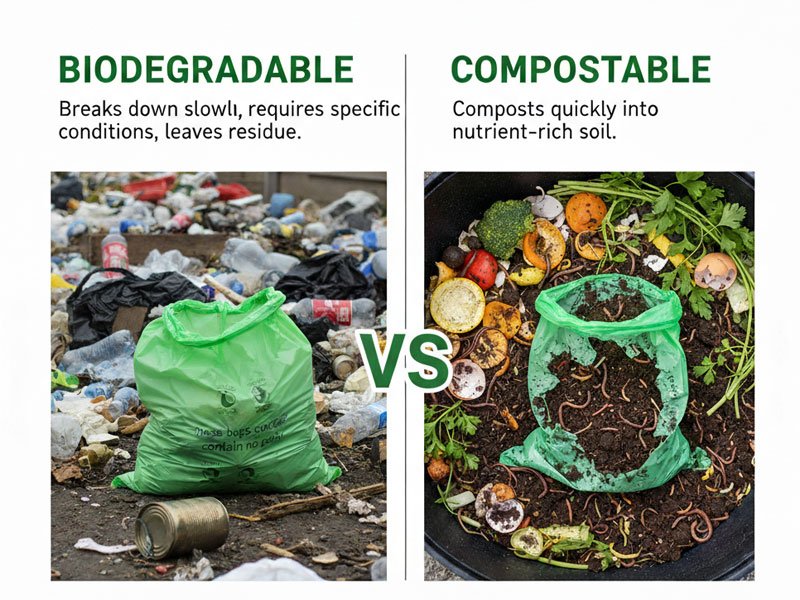
A biodegradable camping toilet bag may break down through biological activity under certain conditions. However, the word “biodegradable” alone does not explain where the bag will break down, how long it will take, or whether it has passed a recognized compostability test.
A compostable camping toilet bag is a more specific type of biodegradable bag. It is designed to break down under defined composting conditions and should be supported by an applicable standard or certification.
The environmental label is only one part of the decision.
For portable toilets, RVs, bucket toilets, and off-grid sanitation systems, buyers must also consider:
- bag size;
- film thickness;
- bottom seal;
- wet-load strength;
- storage temperature;
- odor control;
- storage time;
- and the final disposal route.
This guide explains the difference between compostable and biodegradable camping toilet bags without relying on vague environmental claims.
Quick Answer
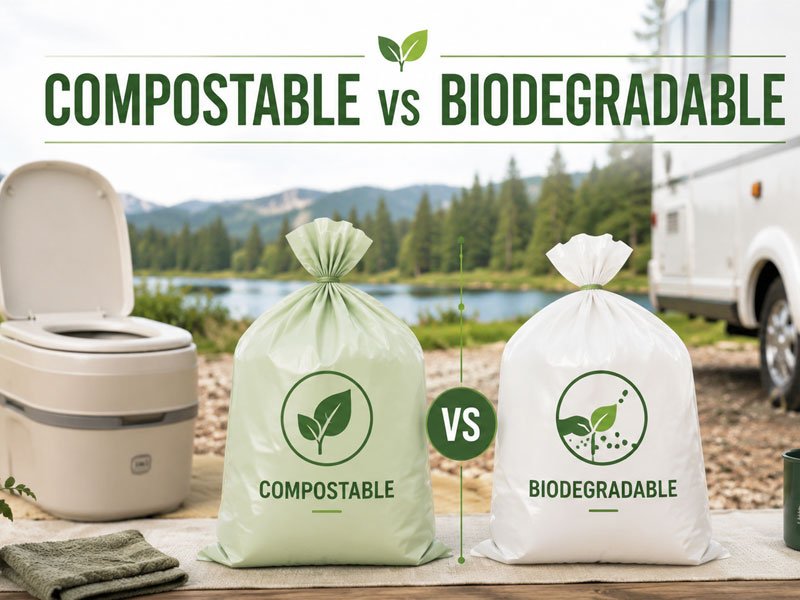
All compostable plastic bags are designed to be biodegradable under defined conditions.
Not all biodegradable bags are compostable.
The European Commission describes compostable plastics as a subset of biodegradable plastics. It also explains that biodegradation depends on the receiving environment, suitable conditions, and enough time.
For camping and portable toilet use, neither term automatically means that a bag is:
- safe to bury;
- accepted in a composting facility;
- suitable for home composting;
- leak-resistant;
- strong enough for human waste;
- or able to control odor.
A responsible buyer should check both the environmental claim and the physical performance of the finished bag.
Buyers should also understand the complete portable toilet waste handling process, because bag certification does not determine how human waste can legally be stored or disposed of.
What Are Biodegradable Camping Toilet Bags?
Biodegradable camping toilet bags are designed to break down through the activity of microorganisms. Buyers who need a broader overview of materials, specifications, and sourcing questions can also read our biodegradable camping toilet bags buyer guide.
However, “biodegradable” is a broad term.
A biodegradable claim should explain:
- the environment in which breakdown happens;
- the test method used;
- the expected time period;
- the level of biodegradation;
- and what remains after the process.
Without this information, the word does not tell a buyer very much.
A bag may be described as biodegradable but still require a controlled environment that is not available at a campsite, in a landfill, or in natural soil.
Some products also use “biodegradable” as a general marketing term without showing a recognized test report for the finished bag.
That is why professional buyers should ask a simple question:
Biodegradable under which standard and in which environment?
What Are Compostable Camping Toilet Bags?
Compostable camping toilet bags are designed to biodegrade and disintegrate under specified composting conditions. Their materials, film extrusion, sealing, and quality-control requirements are explained in more detail in our guide to how compostable toilet bags are manufactured.
Depending on the product and target market, the bag may be tested against standards or certification programs such as:
- ASTM D6400;
- EN 13432;
- BPI Commercial Compostability;
- OK compost INDUSTRIAL;
- or OK compost HOME.
ASTM D6400 covers plastics designed for aerobic municipal or industrial composting facilities. BPI uses ASTM D6400 as its base standard when assessing eligible products for commercial compostability certification.
A certified compostable toilet bag may use a compound film made with materials such as PBAT, PLA, starch-based ingredients, or other compostable polymers.
The material name alone is not enough.
The finished bag, including its film, ink, additives, and other components, should match the applicable certification scope.
Compostable vs Biodegradable Camping Toilet Bags
| Feature | Compostable Camping Toilet Bags | Biodegradable Camping Toilet Bags |
|---|---|---|
| Basic meaning | Designed to break down under defined composting conditions | Designed to break down through biological activity under certain conditions |
| Defined conditions | Normally stated by the relevant standard | May or may not be clearly stated |
| Standardized testing | Often available | Not always available |
| Breakdown time | Defined by the applicable test or certification | May be unclear |
| Industrial composting | Possible when correctly certified and accepted | Not automatically suitable |
| Home composting | Only with a suitable home-compostability certification | Cannot be assumed |
| Landfill breakdown | Cannot be assumed | Cannot be assumed |
| Safe to bury outdoors | No | No |
| Leak resistance | Depends on design and testing | Depends on design and testing |
| Odor control | Depends on the complete toilet system | Depends on the complete toilet system |
| Buyer risk | Lower when certification and product scope are verified | Higher when the claim is vague or unsupported |
The most important difference is not the wording printed on the box.
It is whether the environmental claim is supported by clear conditions, testing, and certification.
Does Compostable Mean Plant-Based?
Not always.
“Biobased,” “biodegradable,” and “compostable” describe different product characteristics.
Biobased describes where part of the material comes from.
Biodegradable describes a breakdown process.
Compostable describes biodegradation under specific composting conditions together with other performance requirements.
A plastic can be partly or fully biobased without being compostable.
A compostable polymer may also contain fossil-derived ingredients while still being designed to biodegrade under the required composting conditions.
The European Commission warns that these terms are often confused and should not be treated as interchangeable.
For buyers, the practical approach is to request documentation for the finished product instead of relying only on a material list.
Does Either Label Prove That the Bag Is Strong?
No.
Compostability and physical performance are different questions.
A compostability certificate does not automatically prove that a portable toilet bag can withstand:
- liquid waste;
- a heavy wet load;
- sharp pressure points;
- vehicle vibration;
- high temperatures;
- or several days of storage.
In my experience working with compostable bag production, leak resistance depends more on the complete bag design than on one environmental label.
Important factors include:
Film Thickness
A thicker film may provide more puncture resistance and wet-load strength. However, the right compostable toilet bag thickness must be selected together with the bag size, film formulation, seal type, and expected waste load.
Bottom Seal
The bottom seal carries much of the waste pressure.
Star seals may help spread the load toward the center of the bag. Flat seals can also work well when their width and sealing conditions match the application.
Neither seal is automatically better for every portable toilet.
Bag Size and Fit
A bag that is too small may stretch across the toilet frame.
A bag that is too large may fold badly, slip, or create weak pressure points.
The toilet opening, bucket depth, rim width, closure method, and required overhang should all be measured.
Film Formulation
Different compostable formulations can have different levels of flexibility, puncture resistance, sealing performance, and heat sensitivity.
Buyers should test the actual finished bag rather than assuming that all PLA, PBAT, or starch-based films behave the same way.
This is especially important when evaluating leak-resistant compostable toilet bags for liquid waste and extended storage.
Heat and Storage Inside RVs
Camping toilet bags often face conditions that ordinary kitchen bags do not.
Our guide to portable toilet bags for RV and van life explains how vehicle heat, limited storage space, movement, and delayed disposal can affect bag performance.
An RV, campervan, or parked vehicle can become hot.
The bag may also hold waste for several hours before a suitable disposal point is available.
These conditions can increase:
- odor;
- moisture;
- pressure on the seal;
- film stress;
- and the risk of leakage during transport.
It would be misleading to say that every biodegradable bag is more heat-resistant than every compostable bag.
Actual stability depends on:
- the polymer formulation;
- film thickness;
- sealing quality;
- waste volume;
- storage time;
- temperature;
- humidity;
- and how the bag is closed.
For longer RV trips, buyers should test filled bags under the expected storage conditions.
Room-temperature testing alone may not show how the bag will perform inside a hot vehicle.
Do Compostable or Biodegradable Toilet Bags Control Odor?
The material claim does not prove odor control.
Odor management depends on the full portable toilet system. The bag, absorbent material, closure method, storage container, and disposal schedule must work together as part of a complete portable sanitation system.
This may include:
- a tight closure;
- a drawstring or tie system;
- absorbent powder;
- a second containment bag;
- a sealed storage container;
- ventilation;
- and frequent disposal.
A thin bag with a weak closure may allow odor to escape even if the film is certified compostable.
A stronger bag may still develop odor problems when waste is stored too long in a hot enclosed area.
For product development, buyers should treat odor control as a separate performance requirement.
Can Compostable Toilet Bags Go Into Industrial Composting?
Only when several conditions are met.
First, the bag must have the correct certification for industrial composting.
Second, the local composting facility must accept certified compostable bags.
Third, the facility must accept the contents inside the bag.
This last point is often missed.
A certification for the bag does not automatically mean that a composting facility accepts human waste, portable toilet waste, absorbent chemicals, sanitation additives, or contaminated liners.
Buyers can learn more about these disposal limitations in our biodegradable toilet bags disposal guide.
BPI also makes clear that certification and composter acceptance are connected but are not the same decision. Composting operators determine which products and feedstocks they accept.
Always check the rules of the receiving facility before giving disposal instructions to customers.
Can Used Toilet Bags Go Into Home Compost?
Do not assume they can.
A bag may carry an OK compost HOME or another home-compostability certification, but the certification relates to the product under defined conditions.
It does not automatically make untreated human waste suitable for a normal backyard compost pile. The distinction is explained further in our guide to composting toilet systems and compostable liners.
Human waste can contain pathogens.
Local health, sanitation, land-use, and waste-management rules may apply.
Unless a local authority or a properly designed sanitation system provides clear instructions, used camping toilet bags should not be placed into an ordinary home compost pile.
Can Biodegradable Toilet Bags Be Buried Outdoors?
No environmental label should be treated as permission to leave or bury a used toilet bag in nature.
Natural soil does not provide the same controlled conditions as an industrial composting facility.
Temperature, oxygen, moisture, microorganisms, and time can vary widely.
The human waste inside the bag can also contaminate soil or water.
Campground rules, park rules, local waste regulations, and Leave No Trace principles should guide outdoor waste handling.
When proper on-site treatment is not available, packing the waste out through an approved disposal route is normally the safer approach.
The correct disposal route should be planned as part of the wider portable toilet waste handling system.
Do Biodegradable Bags Break Down in Landfills?
Breakdown in a landfill should not be assumed.
Landfills often have limited oxygen and moisture movement.
Conditions can vary from one site to another.
A bag designed for industrial composting may not receive the temperature, airflow, microbial activity, or composting cycle required by its standard.
The same problem applies to a vague biodegradable claim.
A buyer should not market a camping toilet bag as a solution for landfill breakdown unless that exact claim is supported by suitable evidence and permitted in the target market.
Which Option Is Better for Camping and Portable Toilets?
Certified compostable camping toilet bags are normally the clearer option when:
- the brand wants a verified compostability claim;
- the target market recognizes the selected certification;
- the finished bag is covered by the certification;
- the disposal route has been checked;
- and the bag passes the required physical tests.
A general biodegradable toilet bag should only be selected after the supplier explains:
- the applicable biodegradation standard;
- the testing environment;
- the expected breakdown period;
- the test result;
- and the permitted claim wording.
For actual sanitation performance, neither option should be approved based only on an environmental label.
The bag must still be tested for the intended toilet system.
Buyers comparing different liner technologies should also understand the practical differences between dry flush toilet bags and compostable toilet bags.
What B2B Buyers Should Check Before Ordering
Camping brands, RV suppliers, portable toilet manufacturers, and emergency sanitation companies should prepare a clear specification. Our compostable toilet bags for camping brands page explains the main OEM, certification, printing, packaging, and private-label options.
Intended Use
Confirm whether the bag will be used for:
- folding camping toilets;
- 5-gallon bucket toilets;
- portable potty systems;
- RV backup toilets;
- composting toilets;
- emergency sanitation kits;
- or dry toilet systems.
Bag Dimensions
Provide:
- bag width;
- bag length;
- gusset dimensions;
- toilet opening size;
- container depth;
- and required rim overhang.
Do not rely only on gallon or liter capacity.
Film and Seal
Confirm:
- target thickness;
- flat seal or star seal;
- roll or flat-pack format;
- perforation;
- closure type;
- and whether a second containment bag is required.
Performance Testing
Request testing that reflects the intended use, such as:
- wet-load testing;
- seal-strength testing;
- leak testing;
- puncture testing;
- filled-bag storage testing;
- temperature-aging testing;
- and transport or vibration testing.
Environmental Claims
Request:
- the certificate holder’s name;
- certificate number;
- certified product scope;
- applicable standard;
- certification validity;
- approved logo artwork;
- and permitted claim wording.
A resin certificate should not automatically be presented as certification of every finished bag.
Packaging and Storage
Compostable bags should be stored away from excessive heat, moisture, and direct sunlight.
Retail packaging should include clear storage and disposal instructions.
Shelf-life claims should be based on the actual film formulation, packaging, and storage test data.
Common Buyer Mistakes
Choosing Only by the Word “Biodegradable”
The claim may not define a useful disposal pathway.
Ask for the standard and test conditions.
Assuming Compostable Means Safe to Bury
Industrial or home compostability does not mean unrestricted breakdown in natural soil.
Checking the Resin but Not the Finished Bag
Printing ink, color masterbatch, additives, labels, and packaging components can affect the finished product claim.
Buyers should therefore verify the certification scope of the finished compostable toilet bag, rather than relying only on a raw-material certificate.
Ignoring the Contents
A composting facility may accept the bag but reject human waste or sanitation additives.
Asking Only for More Thickness
A thicker bag can still leak when the seal is weak or the size is wrong.
Making Absolute “Leak-Proof” Claims
“Leak-resistant” is normally a more responsible term unless the exact claim is supported by a defined test method and result.
FAQ
Are compostable toilet bags also biodegradable?
Yes. Compostable plastics are a specific group of biodegradable plastics designed to break down under defined composting conditions.
Are all biodegradable camping toilet bags compostable?
No. A biodegradable claim does not automatically mean that the bag meets an industrial or home compostability standard.
Are compostable camping toilet bags safe to bury?
No. Compostable should not be interpreted as safe to bury or leave outdoors. Follow local waste and campground rules.
Can compostable toilet bags go into a home compost bin?
Only the bag’s applicable certification can describe its home-compostability conditions. Used bags containing human waste should not be placed in an ordinary home compost pile unless local rules and a properly designed sanitation process clearly permit it.
Which type is more leak-resistant?
Neither label proves better leak resistance. Strength depends on film formulation, thickness, seal design, size, waste load, heat, storage time, and closure.
What certifications should buyers request?
Common references include ASTM D6400, EN 13432, BPI, OK compost INDUSTRIAL, and OK compost HOME. The relevant certification depends on the market and intended claim.
Can compostable toilet bags be used in RVs?
They can be used in some RV and portable sanitation systems. Buyers should test the bags under expected heat, storage time, waste pressure, and vehicle movement.
Are compostable toilet bags the same as dry flush toilet bags?
No. Dry flush systems often use special cartridge films that seal waste after each use. Standard compostable toilet bags are removable liners and may use a tie, drawstring, or other closure.
Conclusion
Compostable and biodegradable camping toilet bags are not the same.
“Biodegradable” is a broad description.
“Compostable” is a more specific claim linked to defined composting conditions and, in many cases, recognized standards or certification programs.
But an environmental claim does not tell the whole story.
A reliable portable toilet bag must also fit the toilet, carry the expected wet load, maintain its seal, tolerate storage conditions, and follow a lawful disposal route.
For camping, RV, off-grid, and emergency sanitation projects, I recommend starting with the real use conditions.
Define the toilet.
Define the waste load.
Define the storage time.
Define the disposal route.
Then select the material, thickness, seal, certification, and packaging around those requirements.
Businesses developing a custom product can review our compostable toilet bags manufacturing options for available sizes, thicknesses, certifications, printing, packaging, and bulk-order requirements.
That is more reliable than choosing a bag based only on the greenest word printed on the box.